





Zestaw obrazów 2019
zdjecie1.jpg
zdjecie2.jpg
zdjecie3.jpg
zdjecie4.jpg
zdjecie5.jpg
zdjecie6.jpg
2019_1.JPG
2019_2.JPG
2019_4.JPG

Gallery
 Nuclear fusion could become the main source of energy in the second half of this century, and Europe is well-positioned to lead the way as long as it manages its resources correctly, according to the people overseeing the research.
‘The world is really looking at us,’ said Professor Sibylle Günter, scientific director of the Germany-based Institute for Plasma Physics, which is coordinating EUROfusion, a new initiative pooling fusion research in Europe due to be officially launched on 9 October. ‘Europe has the opportunity to strengthen its world-leading position here because we have such a broad and well-organised fusion programme.’
Scientists believe nuclear fusion has the potential to meet a large proportion of the world’s energy demand in a cost-effective way. Unlike nuclear fission, which powers the nuclear reactors used today, nuclear fusion does not produce long-lived radioactive waste and is not subject to the same safety concerns.
Instead, nuclear fusion uses the same energy that powers the sun – heating hydrogen atoms to millions of degrees Celsius so that they fuse together into helium, generating energy in the process. However, the big challenge is maintaining the conditions and extremely high temperatures needed for the fusion reaction, and extracting useful heat for electricity generation.
To solve this, regions representing over half the world’s population have joined forces to build ITER – the International Thermonuclear Experimental Reactor – in the hills of Provence, southern France, in a concerted effort to show that the technology can produce at least ten times more energy than it consumes.
The doughnut-shaped reactor, known as a tokamak, which will burn at ten times the temperature of the core of the sun, is expected to start producing a significant net gain in energy. It should produce a power output equivalent to that of a medium-sized power plant.
The success of ITER is crucial. Once the viability of nuclear fusion as a realistic source of energy has been demonstrated, the idea is to use the lessons from ITER to build a demonstration reactor, known for the moment as DEMO, which is expected to start contributing energy to the power grid around 2050.
DEMO will form the template for fusion reactors that can be built across the world, in theory enabling fusion to meet the world’s energy needs in conjunction with renewable energy such as wind and solar power.
‘You just have to imagine what the impacts are for mankind as a whole,’ said Simon Webster, the head of the fusion research unit at the European Commission. ‘It’s absolutely phenomenal what this can deliver when you look at the future needs for energy, the growth of world population, and the growing percentage of energy that will need to be provided by electricity generation. Fusion can tick all these boxes.’
However, energy provision is a political, as well as scientific, decision. Final decisions on DEMO are for the future, once ITER has attained its objectives. Whether this project is an international collaboration like ITER, or whether regions will wish to go it alone remains to be seen. China has already pushed ahead in fusion energy and has developed its own tokamak experiment known as EAST, which is situated in the eastern city of Hefei, and is now planning a more advanced fusion energy test reactor.
‘We could do DEMO in the same way (as the planned new Chinese reactor) and say, “OK we are going to build DEMO, we are open to any collaborations with other parties, but this is how we do it, we need a central team with a budget. If other partners want to join, fine”,’ said Professor Tony Donné, the Programme Manager of EUROfusion.
Challenges
One of the biggest problems facing fusion is the issue of exhaust heat – how to extract useful heat for energy generation. At the moment scientists are developing materials which are tough enough to withstand the the high temperatures and neutron bombardment for long periods of time.
Long-term continuous operation of a tokamak is also an issue, but the EUROfusion programme is also studying an alternative configuration known as a stellarator.
Engineers in Germany recently finished building Wendelstein 7-X, the world’s biggest stellarator, which is now being commissioned prior to the start of operation in 2015.
Whether final commercial reactors take the tokamak or the stellarator design, scientists are confident that fusion can become the world’s leading source of power after 2050, and that people will look back to the roadmap drawn up by Europe’s scientists in 2012. ‘They will be able to see a direct trail from what we are setting up now,’ Webster said.
Source: euro-fusion.org
 On 9 October 2014 the European Commission invites the fusion community into the heart of the European Quarter, the Solvay Library, to officially launch the European Consortium for the Development of Fusion Energy, EUROfusion for short. The new consortium agreement will substitute the fourteen year-old European Fusion Development Agreement (EFDA), as well as 29 bilateral Association agreements between the Commission and research institutions in 27 countries.
The formation of EUROfusion marks a big step forward for Europe’s quest to develop fusion power as a climate-friendly energy source that will contribute to meet a growing global energy demand. The EUROfusion Consortium enables Europe’s national laboratories to pool their resources even more efficiently – a measure which became necessary to meet the challenge of increasingly complex and large-scale projects such as ITER and DEMO.
The preparation for such a joint fusion programme started in 2012. All EU research laboratories jointly drafted a detailed goal-oriented programme to realise fusion energy by 2050. This programme, known as the ‘Roadmap to the Realisation of Fusion Electricity’ outlines the most efficient path to fusion power. By the end of that year it was endorsed by all parties.
The roadmap has two main aims: Preparing for ITER experiments in order to ensure that Europe makes best possible use of ITER and to develop concepts for a fusion power demonstration plant DEMO. The necessary research towards reaching these aims is carried out by universities and research centres within the current European Framework Programme Horizon 2020. More than before does the programme involve industries in the process of designing components and finding technical solutions.
Through EUROfusion, the European fusion research programme will have direct access to various European experiments that are relevant to fulfil roadmap missions. The world’s largest magnetic fusion experiment, the Joint European Torus (JET) in Culham, UK, will continue to be exploited by EUROfusion until 2018. JET, often nicknamed “Little ITER”, has already been paving the way for ITER and continues to align its scientific programme to ITER needs.
The Solvay library is the ideal venue for the launch of EUROfusion: inaugurated in 1902 its architecture accommodated new ways of academic teaching. The new architecture of EUROfusion strengthens Europe’s leading position in fusion research by integrating a strong central programming.
Source: EFDA.org
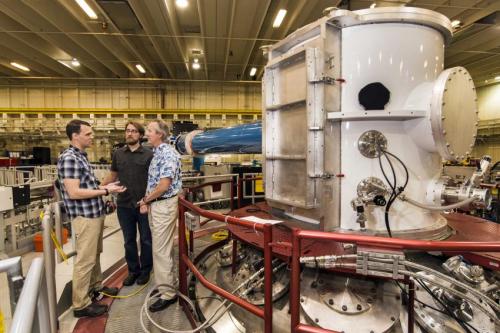 The experimental work is described in a paper to be published in the Sept. 24 Physical Review Letters online. A theoretical PRL paper to be published on the same date helps explain why the experimental method worked. The combined work demonstrates the viability of the novel approach.
"We are committed to shaking this [fusion] tree until either we get some good apples or a branch falls down and hits us on the head," said Sandia senior manager Dan Sinars. He expects the project, dubbed MagLIF for magnetized liner inertial fusion, will be "a key piece of Sandia's submission for a July 2015 National Nuclear Security Administration review of the national Inertial Confinement Fusion Program."
Inertial confinement fusion creates nanosecond bursts of neutrons, ideal for creating data to plug into supercomputer codes that test the safety, security and effectiveness of the U.S. nuclear stockpile. The method could be useful as an energy source down the road if the individual fusion pulses can be sequenced like an automobile's cylinders firing.
MagLIF uses a laser to preheat hydrogen fuel, a large magnetic field to squeeze the fuel and a separate magnetic field to keep charged atomic particles from leaving the scene.
It only took the two magnetic fields and the laser, focused on a small amount of fusible material called deuterium (hydrogen with a neutron added to its nucleus), to produce a trillion fusion neutrons (neutrons created by the fusing of atomic nuclei). Had tritium (which carries two neutrons) been included in the fuel, scientific rule-of-thumb says that 100 times more fusion neutrons would have been released. (That is, the actual release of 10 to the 12th neutrons would be upgraded, by the more reactive nature of the fuel, to 10 to the 14th neutrons.)
Still, even with this larger output, to achieve break-even fusion—as much power out of the fuel as placed into it—100 times more neutrons (10 to the 16th) would have to be produced.
The gap is sizable, but the technique is a toddler, with researchers still figuring out the simplest measures: how thick or thin key structural elements of the design should be and the relation between the three key aspects of the approach—the two magnetic fields and the laser.
The first paper, "Experimental Demonstration of Fusion-Relevant Conditions in Magnetized Liner inertial fusion," (MagLIF) by Sandia lead authors Matt Gomez, Steve Slutz and Adam Sefkow, describes a fusion experiment remarkably simple to visualize. The deuterium target atoms are placed within a long thin tube called a liner. A magnetic field from two pancake-shaped (Helmholtz) coils above and below the liner creates an electromagnetic curtain that prevents charged particles, both electrons and ions, from escaping. The extraordinarily powerful magnetic field of Sandia's Z machine then crushes the liner like an athlete crushing a soda can, forcefully shoving atoms in the container into more direct contact. As the crushing begins, a laser beam preheats the deuterium atoms, infusing them with energy to increase their chances of fusing at the end of the implosion. (A nuclear reaction occurs when an atom's core is combined with that of another atom, releasing large amounts of energy from a small amount of source material. That outcome is important in stockpile stewardship and, eventually, in civilian energy production.) Trapped energized particles including fusion-produced alpha particles (two neutrons, two protons) also help maintain the high temperature of the reaction.
"On a future facility, trapped alpha particles would further self-heat the plasma and increase the fusion rate, a process required for break-even fusion or better," said Sefkow.
The actual MagLIF procedure follows this order: The Helmholtz coils are turned on for a few thousandths of a second. Within that relatively large amount of time, a 19-megaAmpere electrical pulse from Z, with its attendant huge magnetic field, fires for about 100 nanoseconds or less than a millionth of a second with a power curve that rises to a peak and then falls in intensity. Just after the 50-nanosecond mark, near the current pulse's peak intensity, the laser, called Z-Beamlet, fires for several nanoseconds, warming the fuel.
According to the paper's authors, the unusual arrangement of using magnetic forces both to collapse the tube and simultaneously insulate the fuel, keeping it hot, means researchers could slow down the process of creating fusion neutrons. What had been a precipitous process using X-rays or lasers to collapse a small unmagnetized sphere at enormous velocities of 300 kilometers per second, can happen at about one-quarter speed at a much more "modest" 70 km/sec. ("Modest" only comparatively; the speed is about six times greater than that needed to put a satellite in orbit.)
The slower pace allows more time for fusible reactions to take place. The more benign implosion also means fewer unwanted materials from the collapsing liner mix into the fusion fuel, which would cool it and prevent fusion from occurring. By analogy, a child walking slowly in the ocean's shallows stirs less mud than a vigorously running child.
Sandia senior scientist Mike Campbell said, "This experiment showed that fusion will still occur if a plasma is heated by slow, rather than rapid, compression. With rapid compression, if you mix materials emitted from the tube's restraining walls into the fuel, the fusion process won't work; also, increased acceleration increases the growth of instabilities. A thicker can [tube] is less likely to be destroyed when contracted, which would dump unwanted material into the deuterium mix, and you also reduce instabilities, so you win twice."
Besides the primary deuterium fusion neutron yields, the team's measurements also found a smaller secondary deuterium-tritium neutron signal, about a hundredfold larger than what would have been expected without magnetization, providing a smoking gun for the existence of extreme magnetic fields.
The question remained whether it was indeed the secondary magnetic field that caused the 100-fold increase in this additional neutron pulse, or some other, still unknown cause. Fortunately, the pulse has a distinct nuclear signature arising from the interaction of tritium nuclei as they slow down and react with the primary deuterium fuel, and that interaction was detected by Sandia sensors.
The secondary magnetic field is the subject of the second, theoretical paper, "Understanding fuel magnetization and mix using secondary nuclear reactions in magneto-inertial fusion." Using simulations, Sandia researchers Paul Schmit, Patrick Knapp, et al confirmed the existence and effect of extreme magnetic fields. Their calculations showed that the tritium nuclei would be encouraged by these magnetic fields to move along tight helical paths. This confinement increased the probability of subsequently fusing with the main deuterium fuel.
"This dramatically increases the probability of fusion," Schmit said. "That it happened validates a critical component of the MagLIF concept as a viable pathway forward for fusion. Our work has helped show that MagLIF experiments are already beginning to explore conditions that will be essential to achieving high yield and/or ignition in the future."
The foundation of Sandia's MagLIF work is based on work led by Slutz. In a 2010 Physics of Plasmas article, Slutz showed that a tube enclosing preheated deuterium and tritium, crushed by the large magnetic fields of the 27-million-ampere Z machine and a secondary magnetic field, would yield slightly more energy than is inserted into it.
A later simulation, published January 2012 in Physical Review Letters by Slutz and Sandia researcher Roger Vesey, showed that a more powerful accelerator generating 60 million amperes or more could reach "high-gain" fusion conditions, where the fusion energy released exceeds by more than 1,000 times the energy supplied to the fuel.
A paper led by Sefkow et al, published July 24, in Physics of Plasmas, further explicated and designed the experiments based on predictions made in Slutz's earlier paper.
But, said Campbell, "there is still a long way to go."
Source: phys.org
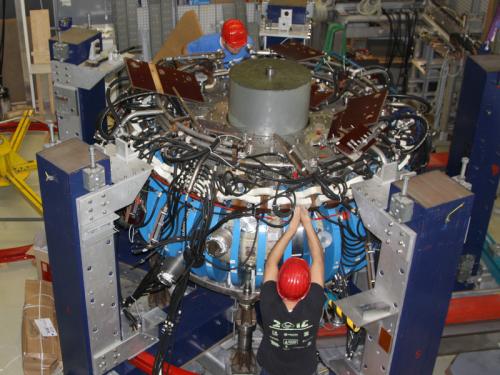 The small WEGA fusion device at Max Planck Institute of Plasma Physics (IPP) in Greifswald is being handed over to the University of Illinois in Urbana-Champaign. The "Wendelstein-Experiment in Greifswald für die Ausbildung" (Wendelstein Experiment in Greifswald for Training) is making room for the Wendelstein 7-X large-scale device. Urbana is succeeding Greifswald, Stuttgart and Grenoble as fourth site for the sturdy device.
WEGA has been in operation at IPP Greifswald since 2001. The small, but versatile fusion device was used for training students and young scientific personnel to bridge the time till completion of the Wendelstein 7-X large-scale device. At the end of 2013 its time was up and WEGA had to be shut down; its place was needed for setting up the technical equipment for Wendelstein 7-X.
"This was a good opportunity for the University of Illinois", states the division head responsible at IPP, Professor Dr. Robert Wolf. "It was just at this time that the Center for Plasma Material Interactions (CPMI) were looking for a small plasma device." The transfer agreement was signed by IPP in mid-September 2014. Illinois are taking the responsibility and meeting the cost of dismantling WEGA, transporting it to the USA and re-assembling it at CPMI. Under its new name, HIDRA (Hybrid Illinois Device for Research and Applications), the device will continue to be used for plasma physics and fusion research. "We were very fortunate", says CPMI Director Professor David Ruzic, who sees numerous application possibilities for the device, including in particular investigation of the interaction between the plasma and wall material of the plasma vessel. The objective of fusion research is to develop a power plant that, like the sun, derives energy from fusion of atomic nuclei.
Transfer of WEGA is one of several constituents of American-German collaboration around Wendelstein 7-X. In 2011 the USA had already set up a three-year cooperation project with IPP whereby scientists from the fusion institutes at Princeton, Oak Ridge and Los Alamos contributed with equipment and studies valued at about ten million dollars for building Wendelstein 7-X. In return, the United States will become partner in the research programme of the German device, a collaboration for which a new 500,000 dollar programme was set up for US universities.
Little WEGA is likewise a member of the Wendelstein family at IPP. It can look back upon an eventful past: Under the name "Wendelstein Experiment in Grenoble for the Application of Radio Frequency Heating" it was commissioned in 1975 as a joint German-French-Belgian project. Scientists from IPP at Garching and Centre d´Etudes Nucléaires at Grenoble had jointly planned, built and operated WEGA. After a seventeen-year stopover at the University of Stuttgart the device started up again at IPP Greifswald in 2001.
WEGA provided much of the new personnel of the branch institute, established in 1994, with their first experience of a plasma experiment. New heating antennas, diagnostics and control equipment for big-brother Wendelstein 7-X were tested on the adaptable WEGA device. It was the subject of two bachelor, two master, 13 diploma and six PhD theses. "At the age of almost 40 years, WEGA is certainly one of the longest-living fusion experiments, if not the longest ever", says Professor Wolf, who together with the WEGA team is happy that the sturdy device still has a future. "In presumably three weeks it will start out on its hitherto longest journey – this time even across the Atlantic."
Source: phys.org
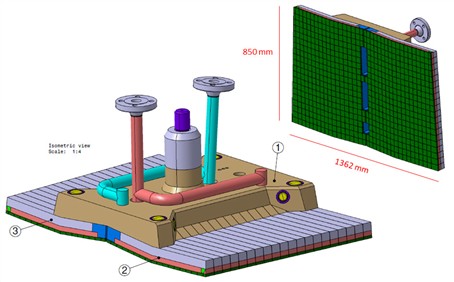 With the semi-prototype of the Blanket First Wall completed earlier this year, F4E is moving full-speed ahead and has just completed the signing of the contracts related to the manufacturing of the first full-scale prototypes. As this is a technically-challenging project which requires hitherto unknown technology and in order to mitigate risks and maintain competition until the series production, F4E has signed contracts with three different entities, namely Atmostat (ALCEN group, France), AREVA (France) and a consortium which consists of AMEC (United Kingdom), Iberdrola (Spain) and MIB (Spain). Each of these companies is to manufacture a prototype of a Blanket First-Wall panel, as well as carry out specific industrialisation studies for the fabrication of the series of the 215 panels and present a cost and schedule assessment.
The First Wall consists of 6-10 mm thick beryllium tile panels of 1 m x 1.5 m which are fixed to a bi-metallic support structure made from a 15-25 mm thick Copper Chromium Zirconium (CuCrZr) alloy bonded using Hot Isostatic Pressing (HIP) to a 40-50 mm thick 316L (N) stainless steel backing plate – together these components form the Blanket modules. The Blanket is the part of the ITER machine that acts as a first barrier and protects the vacuum vessel, which is the heart of the ITER machine, from the neutrons and other energetic particles that are produced by the hot plasma. The First Wall consists of 440 panels, of which F4E will provide about half and depending on the location of the modules in the Blanket, different design parameters are necessary. During operation, the ITER First Wall panels will be cooled by pressurised water.
“We are happy work on the Blanket First Wall continues to move forward”, says Francesco Zacchia, Blanket First Wall coordinator in the F4E In-Vessel Project Team dealing with the management of the contracts. “We now look forward with anticipation to the delivery which is foreseen for early 2017 and will qualify the successful companies to participate in a future F4E Call for tender for the manufacturing of the actual ITER Blanket First Wall”.
Source: F4E


nsp_133.JPG)


nsp_133.JPG)


 |
 |
 |
 |
 |
 |
 |
 |
Media


Research projects carried out at the IPPLM are funded by the Polish Ministry of Education and Science, the National Science Centre and by the European Commission within the framework of EUROfusion Consortium under grant agreement No 101052200. Financial support comes also from the International Atomic Energy Agency, European Space Agency and LaserLab Consortium as well as from the Fusion for Energy Agency.