





Zestaw obrazów 2019
zdjecie1.jpg
zdjecie2.jpg
zdjecie3.jpg
zdjecie4.jpg
zdjecie5.jpg
zdjecie6.jpg
2019_1.JPG
2019_2.JPG
2019_4.JPG
ZFiZPL
Institute of Plasma Physics and Laser Microfusion
Department of Laser Plasma Physics and Applications
23 Hery Street
01-497 Warsaw, Poland
Phone: +48 22 638 14 60 ext. 42
Fax: +48 22 666 83 72
E-mail: This email address is being protected from spambots. You need JavaScript enabled to view it.
Bus nr 112, 122, 171, 220, 523 to Radiowa bus stop
MISSION
It’s been over 40 years since the Institute of Plasma Physics and Laser Microfusion (IPPLM) started conducting research on laser-induced plasma physics and the phenomena related to the optimization of laser thermonuclear fusion which is considered the crucial form of the inertial confinement fusion [Research]. Implemented mostly within the European cooperation, the works in question are financed mainly by the Polish and international research projects [Projects] with the financial support of the Ministry of Science and Higher Education. Currently, it is the Department of Laser Plasma Physics and Applications (DLPPA) that implements this program as a research centre with extensive experience and significant scientific achievements, maintaining effective collaboration with prestigious European laboratories, which is an important area of its scientific activity [Cooperation]. In order to conduct the research at the DLPPA, modern measuring equipment is developed, constructed and purchased [Equipment] and implemented for joint research effort in foreign laboratories.
The DLPPA consists of teams of researchers dealing with experimental research in the High Power Laser Laboratory and in foreign centers as part of international cooperation, as well as a team performing theoretical research and numerical simulations.
The research works in the DLPPA are performed by experienced researchers with extensive scientific achievements, who enjoy international recognition, as well as by young researchers who contribute to achieving valuable results of investigations under the guidance of older colleagues. The continuous development of the research staff’s skills which can be confirmed through obtaining academic degrees and titles, exerts a significant impact on the quality of research results [Staff].
The results of research works carried out by the Department are published in recognized international journals and presented at important conferences and scientific meetings [Publications].

Building of the Department of Laser Plasma Physics and Applications (DLPPA) in the IPPLM
RESEARCH
The area of research works performed in the DLPPA encompasses four overlapping groups of the below-mentioned topics which deal with laser-matter interactions.
I Research on the physics of interaction of high-power laser pulse with matter, including the processes of generation of ultrafast ions and electrons
Non-linear interactions of high-intensity laser pulses (power density) with different targets, in particular the processes of laser acceleration of mater (plasma, ions, electrons and macroparticles) are investigated experimentally and theoretically by the Department within the framework of Polish and European projects.
The DLPPA team has developed and tested the original mechanism of ion acceleration in laser plasma as a result of ponderomotive forces interaction (Skin Layer Ponderomotive Acceleration – SLPA). According to the SLPA method, forces induced by an ultra-short laser pulse of great intensity near the surface of critical concentration in the expanding laser plasma accelerate the streams of fast electrons and ions of high intensity. This mechanism was thoroughly analysed theoretically and with the application of numerical simulations. Experiments with an aim to investigate the SLPA effects were carried out within the framework of national and European Laserlab projects, mainly at the PALS Research Centre in Prague (Czech Republic) as well as in the LULI Laboratories, Ecole Polytechnique (France) and RAL (England).
The researchers of DLPPA have also prepared and implemented in practice the concept of the original system to efficiently accelerate a macroparticle or an ion stream with the use of a laser pulse. In the conventional laser method applied to accelerate matter, the laser-irradiated foil is transformed with the pulse energy into a macroparticle accelerated by the reaction force in the opposite direction of laser plasma expansion. It is the so-called rocket effect. In the new method of the laser acceleration of the macroparticle called Laser-Induced Cavity Pressure Acceleration (LICPA), the pressure of laser plasma retained in a small cavity situated in front of the foil target additionally accelerates the macroparticle in the guiding channel. The computer simulations presented the possibility to accelerate the macroparticle in the LICPA system much more efficiently than in the case of the application of the “rocket effect” alone. This method was investigated experimentally and numerically as part of the Polish and Laserlab-Europe projects. The experiments are performed mainly at the PALS Research Centre in Prague with the application of a high-energy laser (up to 700 kJ).
|
|
|
Scheme of the Laser-Induced Cavity Pressure Accelerator (LICPA) |

The DLPPA staff prepared a 2D computer model for numerical simulations of proton and ion laser acceleration at relativistic (>1018 W/cm2) and ultra-relativistic (?1023 W/cm2) laser radiation intensities. Such radiation intensities will be obtained with the use of large lasers built within the European ELI infrastructure (Extreme Light Infrastructure) project in the Czech Republic, Hungary and Romania. Various schemes of the experimental investigations are analysed. The numerical calculations showed that as a result of laser-target interaction at ultra-high laser intensities it is possible to generate femtosecond pulses of fast protons and ions of energies above 1 GeV. Such particle energies are unattainable in conventional accelerators. The results of these numerical calculations will be used to prepare joint research projects with the application of high power lasers operated within the Eli programme.
An advanced physical and computer model of a heavy ion laser accelerator with a multi-petawat laser (PICDOM code) was developed. Dynamic atomization of the atoms and "synchrotron" radiation generated by electrons were included in the model. The acceleration and properties of heavy ion beams with a mass number A ? 200 generated by the interaction of a multi-PW laser pulse with a sub-micrometer constant target was examined numerically.
The properties of laser-generated carbon ion beams were also numerically tested given realistic laser and target parameters. The possibilities of generating carbon ion beams with parameters enabling fast fuel ignition at the laser energy ~100 kJ were specified. It was demonstrated that giant (multi-PW) gamma-ray pulses can be generated when interacting with a 150kJ / 1ps laser, 4 x 10²² W/cm2 with a carbon target.
In the DLPPA, the properties of intense electromagnetic pulses (IEM) produced during the interaction of high-intensity laser pulses with a fixed target were experimentally tested. Such pulses disrupt the operation of experimental equipment and pose a potential threat to electronic devices. Antennas, inductive sensors and diagnostics for electron measurements are used to record IEM signals. IEM research in the framwork of the HARMONIA and Laserlab-Europe projects was carried out by a team of the DLPPA employees in the HPLL and in PALS laboratories in the Czech Republic as well as CELIA in France as part of scientific cooperation.
II Research on physical processes pertaining to the optimization of selected variants of laser fusion
The IPPLM has participated in the European HiPER project (European High Power Laser Energy Research Facility) which deals with the development of a physical concept and technical design of laser infrastructure to demonstrate the effective production of energy through the inertial confinement fusion (Inertial Fusion Energy - IFE). As part of this project between 2008 and 2011, the Department’s efforts focused on the optimization of the selected variants of laser fusion and participation in the preparation of the research program for the future applications of the HiPER infrastructure in the various non-fusion research.. Joint experiments encompassing the above-mentioned issues were carried out mainly at the PALS Research Centre in Prague (Czech Republic) and other big European laboratories [Cooperation].
The above-mentioned method of laser ponderomotive ion acceleration (SPLA) is also investigated in terms of its suitability for laser fusion in the so-called ion fast ignition of thermonuclear DT fuel preliminary spherically compressed with a high power laser.
 |
| Scheme of the fast ignition of pre-compressed DT fuel |
Moreover, the possibility to apply the developed in DLPPA the LICPA system to perform laser fusion with impact fast ignition of the laser-compressed DT fuel is analysed.
Teams of DLPPA researchers are carrying out projects focused on the new different concept of laser fusion where a powerful concentric shock wave is applied for the ignition of laser pre-compressed DT fuel (shock ignition). Such a wave generating the central thermonuclear ignition is brought about by an additional very short pulse of the high power laser. In this scenario, the entire process is performed using a single properly shaped laser pulse. These works in the scope of the DLPPA are carried out within the research projects sponsored mainly by the Laserlab-Europe consortium in European laboratories, primarily at the PALS Research Centre in Prague. Various diagnostics developed by the DLPPA teams are applied there, including interferometry as well as ion and X-ray diagnostics.
 |
|
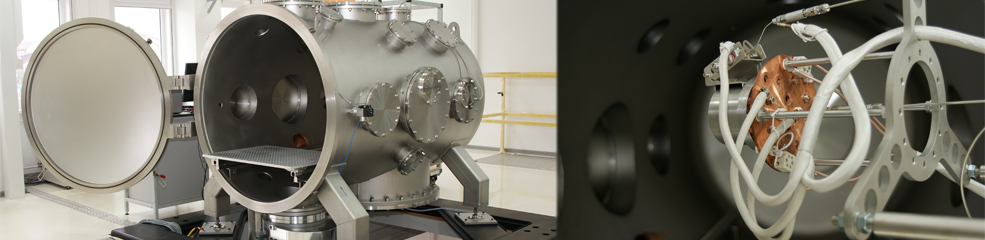
Inside the experimental chamber (PALS laser in Prague) |
The DLPPA team in cooperation with their Czech colleagues carried out pilot research on the TERESA system installed in the ELI-Beamlines high power laser. This system is applied to test a repetitive laser ion source. The Polish team measured the emission of ions emitted from the laser plasma with the application of the Thomson parabola spectrometer, ion collectors and semiconductor detectors. Aluminum ions of energy greater than 6 MeV were registered.
III Research on hydrodynamic processes in laser-produced expanding plasma
The DLPPA investigates the properties of laser-generated collimated plasma streams (plasma jets) and possibilities of their applications. In experiments, performed mainly at the PALS Research Centre in Prague, interactions of such jets with rarefied gas are researched. These works are carried out under the Laserlab-Europe projects [Projects], and their results refer to laser fusion and can be used for simulations of astrophysical phenomena in a laboratory.
The DLPPA team at the PALS Research Centre in Prague performs pioneering measurements of spontaneous magnetic fields (SMF) and electron concentration in the expanding laser plasma within the scope of the Laserlab-Europe project. The information on the SPM structure and current density distributions in plasma combined with two-dimensional simulations make it possible to conclude that the SPM are generated by intense fast electron streams due to the resonant absorption. Recently, the research has been performed also with the application of targets with special construction which make it possible to generate high-power magnetic fields. The results gained will be important for optimization of laser fusion and simulation of astrophysical phenomena.
The main diagnostic systems developed in the DLPPA and used in experiments in Prague for expanding laser plasma research are designed at the Institute, i.e. precise three-frame laser interferometry as well as polaro-interferometry. The above-mentioned methods are supplemented with the application of ion and X-ray diagnostics.
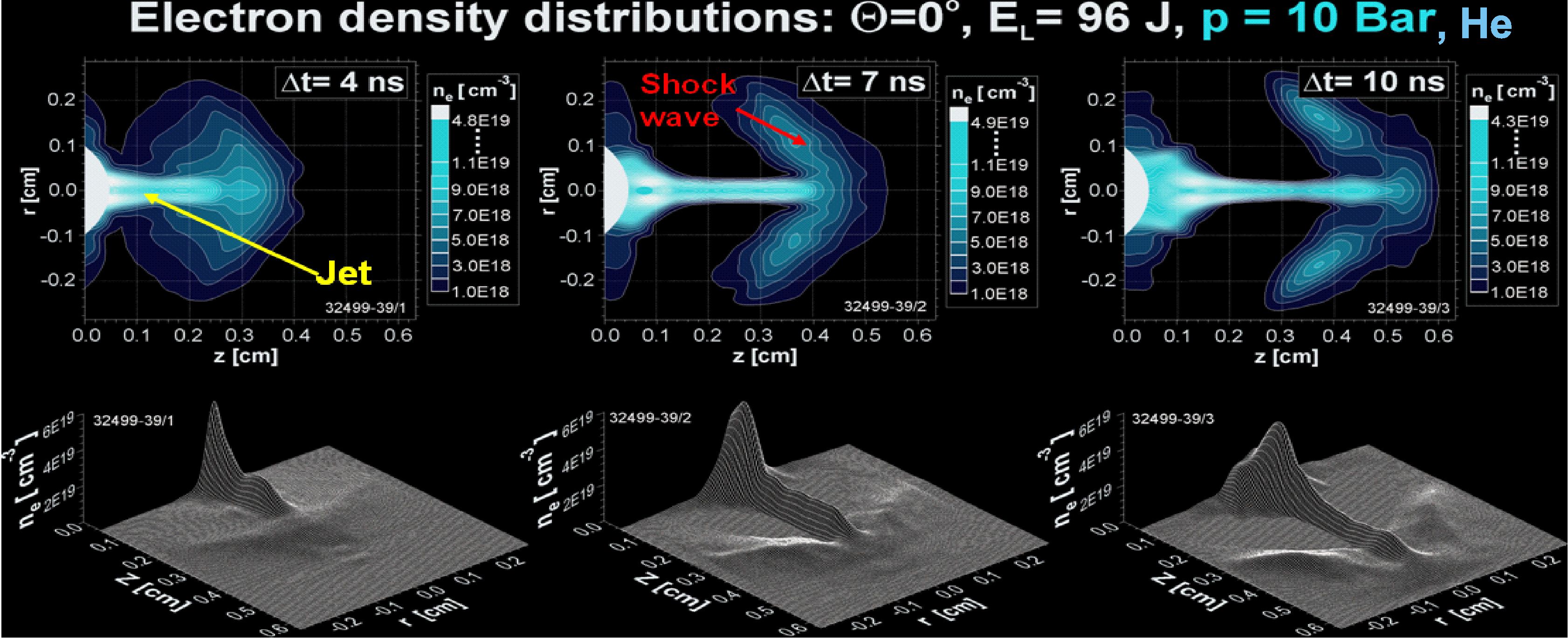 |
| Plasma concentration distributions recorded with the use of the 3-frame interferometer showing the interaction of laser-generated plasma stream with gas inside the experimental chamber |
With the application of the 3-frame complex interferometry and 14-channel magnetic electron spectrometer on the PALS system, SPM distributions and electron current density in the laser plasma were measured. A methodology was developed to perform the quantitative analysis of data from the above-mentioned diagnostics. The measurement results confirmed the non-thermal generation of hot electrons. These results are important from the point of view of research on laser fusion and laboratory astrophysics.
The research team from the High Power Laser Laboratory in the LULI laboratory in France, using a polaro-interferometer, performed measurements of spontaneous laser-generated magnetic fields with high spatial resolution. These studies, supplemented by measurements of ion acceleration, were carried out as part of cooperation in the framework of the European project.
In the Department of Laser Plasma Physics and Applications, new methods of acceleration of plasma objects, alternative to the classical mechanism of propulsion, have been developed. An important element of these new methods is the special construction of targets that contain a cavity that is an energy trap for the incident laser pulse, which leads to a much higher absorption of radiation. High absorption causes that the plasma produced has a much higher temperature and pressure compared to those obtained in the classical ablation experiment. The main factor driving the thin foil, which is part of the target, is the pressure generated in the cavity. This pressure acceleration character means that you can choose (depending on your needs) any direction of acceleration of the foil (plasma object). In addition, in one of the variants of the method (Reversed Acceleration Scheme), the two-stage acceleration mechanism is much more effective than it is in the case of classical ablation propulsion.
 |
| Basic types of targets used in the laser pressure method: "backward" (a), "forward" (b) |
The effectiveness of the developed pressure method has been confirmed experimentally at the PALS laser system in Prague (iodine laser energy ~ 600 J), as well as by means of numerical modeling. The experimental results obtained (speed of accelerated macroparticles, emission of fusion neutrons) are at the level of results achieved in leading plasma laboratories (USA, Japan).
An important feature and additional advantage of the acceleration method used is its insensitivity to the type of laser used (specifically the wavelength of the laser radiation). This creates additional research opportunities also in plasma laboratories that do not have lasers generating short-wave radiation - the most useful in acceleration studies using the classical ablation method.
IV Development of new methods and equipment for investigation of laser-induced plasma
In 2010, the DLPPA welcomed the arrival of a high power laser (10 TW) which was financed with the funds from the European HiPER project, own resources of the IPPLM and the financial support of the Ministry of Science and Higher Education [Projects].
On 1 February 2013, the High Power Laser Laboratory was established at the IPPLM (HPLL). Its aim is to carry our research on laser plasma and its applications (mainly in the framework of the European cooperation). Currently, the equipment built and purchased in the period 2011-2013 within the Regional Operational Program for Mazovian Voivodeship (ROPMV) called “Expansion and modernization of the high power laser laboratory”, co-financed by the EU, is primarily used for this research [Projects]. The several systems for laser plasma diagnostics were built, namely: a multi-frame polaro-interferometer, two Thomson ion spectrometers, an X-ray spectrometer, a high-speed X-ray camera and a vacuum plasma chamber with the necessary equipment [Equipment].
The HPLL still applies diagnostics previously developed and built at the DLPPA, including systems for testing ions and X radiation emitted from laser plasma [Equipment].
Recently, the equipment for testing electromagnetic pulses (IEM) generated in laser plasma have been developed and appied. Special broadband probes (antennas) have been prepared to record IEM pulses. A set of diagnostics was also prepared for measuring electrons emitted from laser plasma [Equipment].
In order to perform the research projects, these previously prepared in the DLPPA and those meant for the future, works on developing new equipment for laser plasma diagnostics are underway. These devices will be applied in the planned experiments in the HPLL and in the research within the international cooperation in large European laser laboratories [Cooperation] such as the PALS Research Centre and ELI-Beamlines in Prague (Czech Republic), CELIA in Bordeaux (France), ELI-NP in Bucharest-Măgurele (Romania).
 |
| Stand for investigation of ion stream emitted from laser-produced plasma |
STAFF
The staff of the DLPPA (IPPLM) carry out experimental, theoretical and numerical investigations of plasma generated with the high power laser as well as possible applications of such plasma. They are well prepared and experienced to carry out research in the area in question. Experimental works are performed in the Institute (mainly in the High Power Laser Laboratory, HPLL) and centres collaborating with the DLPPA within the framework of joint research projects. Formulating a research methodology, preparation and tests of measuring equipment are an important area of the Department’s activities applied while performing joint projects in other laboratories. It also refers to the research program with the application of high power lasers as part of the European ELI project in the Czech Republic, Hungary and Romania.
The DLPPA researchers employed in the High Power Laser Laboratory and Division of Plasma Hydrodynamics closely cooperate within the framework of Polish and foreign research projects. While conducting experimental research in the HPLL and other laboratories, the same equipment is used. Many publications reflecting the results of a joint scientific effort are worked on by the members of above-mentioned teams and constitute their achievements.
One must underscore that in addition to the activities of the DLPPA staff, many research works within the scope of the Department are performed together with the employees from other departments of the IPPLM, in particular from the Department of Nuclear Fusion and Plasma Spectroscopy. From time to time, researchers from other scientific centres join the DLPPA team. During the summer school break, traineeships are organised for students of the Department of Physics of the Warsaw University of Technology and the Military University of Technology.
Research works within the scope of the DLPPA interest are performed by the following scientific and technical staff:
Department of Laser Plasma and Applications:
dr inż. Marcin Rosiński – assistant professor, Head of Department and the HPLL
High Power Laser Laboratory:
- mgr Oleh Byrka – engineering and technical specialist
- dr Hanna Marchenko – assistant professor
- Janina Pokorska – engineering and technical specialist
- dr Piotr Rączka – assistant professor
- mgr inż. Maciej Szymański – senior research and technical specialist
- mgr inż. Przemysław Tchórz – assistant
- dr Agnieszka Zaraś-Szydłowska – assistant professor
Laboratory of Plasma Hydrodynamics:
- prof. dr hab. Jan Badziak – professor
- dr Katarzyna Batani – assistant professor
- dr hab. Stefan Borodziuk – IPPLM professor
- dr inż. Jarosław Domański – assistant professor
- mgr Michał Kustosz – research and technical specialist
- prof. dr hab. inż. Tadeusz Pisarczyk – professor, Head of the Laboratory
- dr Zofia Rusiniak – assistant professor
COOPERATION
The research experience and results achieved by the DLPPA staff as well as modern research equipment applied make the IPPLM an attractive partner for cooperation in Poland and abroad.
The cooperation of the DLPPA with other research centres related to the laser-matter interaction and laser fusion in the High Power Laser Laboratory is almost entirely performed within the scope of the Polish and international projects [Projects]. The agreements of the IPPLM with domestic and foreign research centres deal with joint projects coordinated by the outside organizations. They are performed with the participation of the DLPPA staff, partly in foreign laboratories and partly in the HPLL.
The scope of experimental, theoretical and numerical research in the DLPPA in majority falls within issues covered by the research program of the Department in the multi-annual perspective, in particular:
- research on the physics of laser pulse interactions with matter at laser power densities >1018 W/cm2 in various experimental conditions,
- laser acceleration of ions, electrons and plasma,
- research on phenomena related to the optimization of selected laser-induced fusion options,
- research on expanding laser plasma with the application of, among others, precise methods for displaying expanding laser plasma, including polarointerferometry,
- preparation and testing of measuring methodology and diagnostic systems meant to be used in the research of the HPLL and big laser laboratories in Europe such as PALS in Prague, PETAL and LMJ in Bordeaux, ELI-Beamlines in Prague, ELI-NP in Bucharest,
- development of the applications for high-power short-pulse lasers for research in the fields of atomic and nuclear physics, astrophysics, medicine and the like.
Agreements regarding the cooperation of the IPPLM (including the DLPPA) and foreign research centres:
- Framework Agreement on Joint Scientific Research between the IPPLM and the Institute of Plasma Physics of the Czech Academy of Sciences. Implementation period: 2016–2019.
- Memorandum of Understanding to continue and develop the cooperation of the IPPLM and the Institute of Physics of the Czech Academy of Sciences (IoP CzAS) in the scope of research performed as part of the ELI-Beamlines Laboratory in the IoP CzAS. Implementation period: since 2018.
- Consortium Association Laserlab-Europe (AISBL). The purpose of this association is to organize and promote the cooperation of European laboratories in the field of research and applications of laser-matter interactions. Implementation period: since 2018.
- Research Project Framework Cooperation Agreement regarding research cooperation between the IPPLM and the CELIA laboratory at the University of Bordeaux, France. Implementation period: since 2014.
- Protocol of Scientific Collaboration between the IPPLM and the Department of Physics at the University of Messina, Italy. Implementation period: 2011–2013 (automatically renewable every 3 years).
- Memorandum of Scientific Collaboration of the implementation of the Extreme Light Infrastructure – Nuclear Physics (ELI-NP) between “Horia Hulubei” National Institute of Physics and Nuclear Engineering (NIPNE), Bucharest-Măgurele, Romania and IPPLM, Warsaw, Poland, to implement the Extreme Light Infrastructure – Nuclear Physics (ELI-NP) project in Bucharest-Măgurele, Romania. Implementation period: 2013–2018 (renewable).
- Cooperation agreement involving IPPLM – ENEA – Energy Research Centre, Frascati, Italy, in the field of laser fusion research within the EUROfusion program. Implementation period: since 2012.
Agreements regarding the cooperation of the IPPLM (including the DLPPA) and Polish research centres:
- ELI-POLSKA National Consortium of universities and research centres dinterested in participating in the construction and utilization of the European Extreme Light Infrastructure. It was signed on July 8, 2019 by representatives of 11 Polish universities and research units, including the IPPLM.
The agreement will guarantee effective participation in a unique investment venture and the use of three large lasers for research: ELI-Beamlines in the Czech Republic, ELI-ALPS in Hungary and ELI-NP in Romania. High-power ultra-short pulses (over 10 MW) generated by these lasers can be used, among others, for the acceleration of electrons and ions of intense gamma ray beams, for research in the areas of atomic and nuclear physics, in medical imaging and diagnostics, in radiotherapy, for the production of new materials and new optical solutions. - Centre for New Energy Technologies Consortium [CeNTE]. The scope of its activities encompasses research and development of technologies for thermonuclear energy conversion as well as related and supporting technologies. The CeNTE Consortium gathers 16 institutions aside from the IPPLM (the coordinator). Implementation period: since 2014.
- The XFEL-POLSKA National Consortium for utilising the European X-ray Free Electron Laser (XFEL) at the DESY centre in Hamburg. In 2017, Appendix No. 1 to the Multilateral Agreement of 30 January 2008 on the establishment of the XFEL-POLSKA National Consortium was adopted. Its members were scientific units and universities interested in joining the Consortium and conduct research with the implementation of the XFEL system. Over 20 scientific organizations are members of the Consortium. Implementation period: since 2007 (Appendix in 2017).
- Cooperation Agreement between the IPPLM and the Military University of Technology regarding the organization of internships for the MUT students. Implementation period: since 2013 without restrictions.
- Cooperation Agreement between the IPPLM and the Department of Physics, Warsaw University, regarding the organization of internships for the WU students. Implementation period: 2012–2014 (renewable).
PROJECTS
Research projects performed entirely or partially by the DLPPA team are related to the multi-annual research program [Mission]. Most of works associated with laser-matter interactions and laser fusion are performed and financed within the Polish and international (mainly European) projects supported with funds from the Ministry of Science and Higher Education. These projects are coordinated in majority by the IPPLM. Some projects, coordinated by foreign institutions but with the DLPPA participation, focus on research conducted in European laboratories as well as partially in the High Power Laser Laboratory (HPLL) with employees from other research centres.
The most important research projects which have been performed in recent years by the DLPPA team in cooperation with other scientific centres are listed below:
- EUROfusion Project RoHGIFE (Routes to High Gain for Inertial Fusion Energy, 1.01.2019–31.12.2020). The RoHGIFE project is the continuation of the EUROfusion ToIFE (Towards Demonstration of Inertial Fusion for Energy, 2014–2018).
The project, run within the European cooperation, deals with theoretical, numerical and experimental research of various variants of thermonuclear fusion (inertial confinement fusion). In the period 2019-2020, the DLPPA performs numerical research related to the so-called fast ion ignition (FII), including intense ion beam acceleration with lasers for FII and their interactions with fusion targets, as well as investigation of electromagnetic pulse emission from plasma generated by terawatt and petawatt and lasers in correlation with the particle emission from plasma. - Experiment 19-PS-F2 carried out at LULI pico2000 in September 2019, J. Santos: „High-resolution measurements of laser-driven magnetic fields with application to isochoric heating and ion acceleration”, Collaboration: CELIA - Univ. Bordeaux, LULI, CEA-DAM-DIF, Univ. Alberta, Czech Inst. Plasma Physics, IPPLM-Warsaw, Univ. York, HZDR, Tech. Univ. Darmstadt, ILE – Osaka Univ., UCSD).
In the 19-PS-F2 experiment performed in the LULI laboratory in France as part of the scientific cooperation of several laboratories, the team from the DLPPA carried out high resolution measurements of spontaneous magnetic field distributions and electron concentration distributions in laser generated plasma.
- Laserlab-Europe Project: PALS-002628: Comprehensive investigations of the optical generators of the strong magnetic field and magnetized plasma foe ICF and astrophysical applications (2019–2020).
The project extending the research scope of the PALS-2368 project deals with investigating spontaneous magnetic fields (SMF) and magnetized plasma generated with the PALS laser in the PALS Research Centre in Prague (the Czech Republic). The research is performer with the use of the polarointerferometer as well as ion and X-ray diagnostics, with the application of targets of special construction. The results gained will be important for optimization of laser Fusion and simulation of astrophysical phenomena.
- Laserlab-Europe Project: PALS-002514: Alternative method of acceleration of dense plasma objects (macroparticles/plasma streams), (1.01.2019–31.12.2020).
The aim of the research is to optimize the conditions of lightning and construction of targets irradiated with the PALS laser to effectively accelerate macroparticles and dense plasma streams. Special kinds of targets are applied, namely the Cavity Acceleration Pressure. The experiments deal with laser fusion research.
- Laserlab-Europe Project: PALS-002368: Space-time measurements of spontaneous magnetic field in correlation with the electron and ion emission from the ablative plasma on the PALS laser in the context of ICF application (1.01.2018–30.11.2019).
The project dealt with spatial and temporal measurements of spontaneous magnetic fields (SPM) in correlation with electron and ion emission from ablation plasma at PALS in Prague. The results are crucial for various applications, in particular for laser fusion and astrophysical research. - EUROfusion Project WP-ER: ENR-IFE19.CEA-01: Study of Direct Drive and Shock Ignition for IFE: Theory, Simulations, Experiments, Diagnostics development (2014–2018).
As part of the project, the research regarding the concept of laser fusion with impact ignition was carried out at PALS in Prague. The researchers tried to identify mechanisms of laser energy transmission to the shock wave in fast electron plasma. Time correlations between fast electron fractions generated were checked as a result of various mechanisms depending on the laser radiation wavelength. Spectroscopic measurements of electron and ion emission coupled with measurements of the polaointerferometric plasma parameters were performed.
- NCN HARMONIA Grant No. 2014/14/ST7/00024: Electromagnetic pulses initiated with the laser-target interaction in high power lasers laboratories (2015–2018).
The project assumed carrying out research into generating electromagnetic pulses (EMP) as a result of high power laser – matter interactions. In addition to the HPLL research, the EMP measurements were also conducted in the CELIA laboratories at Bordeaux University (France), the CLF laboratory in the Rutherford Appleton Laboratory (Great Britain) as well as at PALS, Prague. In order to perform the EMP measurements, special probes designed in the DLPPA were applied. The mechanisms for generating the EMP and the characteristics of their emission in different conditions of laser-target interactions were examined. The results obtained should turn useful while designing experiments in large laser laboratories such as the Extreme Light Infrastructure currently built in Prague, Szeged and Bucharest and the multi-kJ PETAL laser in Bordeaux.
- Laserlab-Europe Project: PALS-2200: Comprehensive investigation of ablative plasma with the use of femtosecond polaro-interferometry for applications in inertial confinement fusion and astrophysics (2016–2017).
The project focused on the measurements of spontaneous magnetic fields (SMF) in laser plasma with the implementation of a two-channel polaro-interferometer illuminated by a laser pulse of 40fs. The SPM distributions obtained can be implemented in laser fusion research with DT fuel fast ignition.
- COST Action MP 1208 Project: Memorandum of Understanding for the implementation of a European Concerted Research Action designated as COST Action MP1208: Developing the Physics and the Scientific Community for Inertial Confinement Fusion at the Time of NIF ignition (2013–2017).
The main purpose of the project performed with the DLPPA participation was to support the European cooperation in the development of inertial confinement fusion research regarding the results obtained in the National Ignition Facility (NIF) in the United States where works are underway to maximize the efficiency of laser fusion and DT fuel ignition.
- SILMI – RNP-ESF (European Science Foundation) Project: Studies of macroscopic effects of high-intensity laser-matter interaction and applications of results of these investigations (2014–2016).
The aim of the project performed with the participation of the DLPPA was to support the European fundamental research and applications regarding processes of high power lasers interactions with matter in the scope of theory, experiment and practical appliations.
- NCN – HARMONIA Grant No. 2012/04/M/ST2/00452: Studies of nonlinear laser-plasma interactions and generation of shock waves in plasma for the purposes of inertial confinement thermonuclear shock ignition (2013–2015).
The research dealt with fusion with the so-called shock ignition of nuclear fuel in which the ignition of the compressed DT fuel is initiated by a strong shock wave generated by the laser. The experiments were mainly performed at the PALS RC in Prague with the application of the PALS kJ laser whose parameters, such as intensity and duration of laser pluse, are close to the expected parameters of the pluse generating a shock wave which enables fuel ignition. As a result of measurements supported by computer simulations, the main mechanisms responsible for non-linear character of plasma-laser radiation interaction in conditions corresponding to the shock ignition were identified and characterised. Moreover, the influence of these mechanisms on the efficiency of energy transfer from the laser to the shock wave was determined. The conditions in which it is possible to generate a shockwave with pressure meeting the requirements of the shock ignition (300 Mbar) were specified, and a new method of shockwave generation enabling to achieve the required pressure at much lower energy and intensity of laser pulses than in case of methods used so far was suggested and demonstrated.
- ROP_MV Project No. MJWPU.420-738/10: Development and modernization of the High Power Laser Laboratory (HPLL) in the IPPLM. The project was co-financed by the European Union in the framework of the Regional Operational Program for Mazowieckie Voivodeship (ROP-MV, 2011–2013).
In order to perform more extensive research with the application of the 10TW Pulsar laser in the HPLL, the ROP-MV project was carried out to build and purchase the diagnostic equipment for laser plasma research, including a fast camera and an X-ray spectrometer, multi-frame interferometer, two ion mass spectrometers and the systems for measuring the acquisition of results. Moreover, the program dealt with the construction of two plasma chambers with vacuum systems and the modernization of the laboratory rooms [Equipment].
- HiPER Project: Grant Agreement No.: 211737. Project funded by the EU Commission: HiPER – European High Power Laser Experimental Research Facility, Preparatory Phase Study (2008–2011).
The European HiPER laser infrastructure currently under development is to demonstrate the efficiency of laser fusion as a future energy source and to conduct research into various applications of high power density laser. The IPPLM within the HiPER project studied the application of laser-generated ion pulse to initiate the fast ignition of thermonuclear fuel and analyzed the possibility of using the HiPER infrastructure to simulate astrophysical phenomena and study mechanisms of laser acceleration of ions.
With the HiPER project funds as well as with domestic financing, the 10TW PULSAR high-power laser generating pulses of 40fs duration and power density >1018 W/cm2 was bought for the IPPLM and installed in the DLPPA [Equipment].
- Laserlab-Europe Projects: The following projects financed by the Laserlab-Europe Consortium were performed in 2007-2014 by the DLPPA staff within international cooperation.
These projects dealt with investigating various aspects of high-power lasers interactions with solid targets, including ion streams measurements, X-ray radiation and plasma jets emitted from laser plasma (at PALS) as well as laser ion acceleration (in the LULI laboratory) and dense plasma (at PALS). The phenomena crucial for the optimization of laser fusion were also studied.
- LULI-001317: Laser-induced generation of high-density high-current proton beams using skin-layer ponderomotive acceleration,
- PALS-1887: The effect of preformed plasma on a laser-driven shock produced in a planar target at the conditions relevant to shock ignition,
- PALS-1766: Mutual interactions of laser-produced plasmas with different atomic numbers in an axially symmetrical geometry,
- PALS-1552: Plasma jet creation and its interaction with plasmas and other jets,
- PALS-1514: Highly efficient acceleration and collimation of high-density plasma for fusion-related applications.
EQUIPMENT
The equipment of the High Power Laser Laboratory (HPLL) in the IPPLM is made up of the following research units: 10TW Pulsar high power laser, two measurement stands consisting of plasma vacuum chambers equipped with diagnostic systems for investigating laser-matter interactions.
The 10TW Pulsar laser was purchased for the HPLL in 2010 from the funds of the HiPER (European High Power Laser Energy Research Facility) project [Projects], own funds of the IPPLM as well as the financial support of the Ministry of Science and Higher Education. In order to research the processes of interaction of the 10TW Pulsar laser with the target, the HPLL staff applies diagnostic tools developed over the years in the IPPLM and modern equipment built in 2011-2013 as part of the project “Expansion and modernization of the high power laser laboratory” of the Regional Operational Program for Mazowian Voivodeship (ROP-MV), co-financed from the EU funds. As part of the ROP-MVW project, two modern plasma vacuum chambers were built to investigate these interactions. [Projects].
The Pulsar high power laser
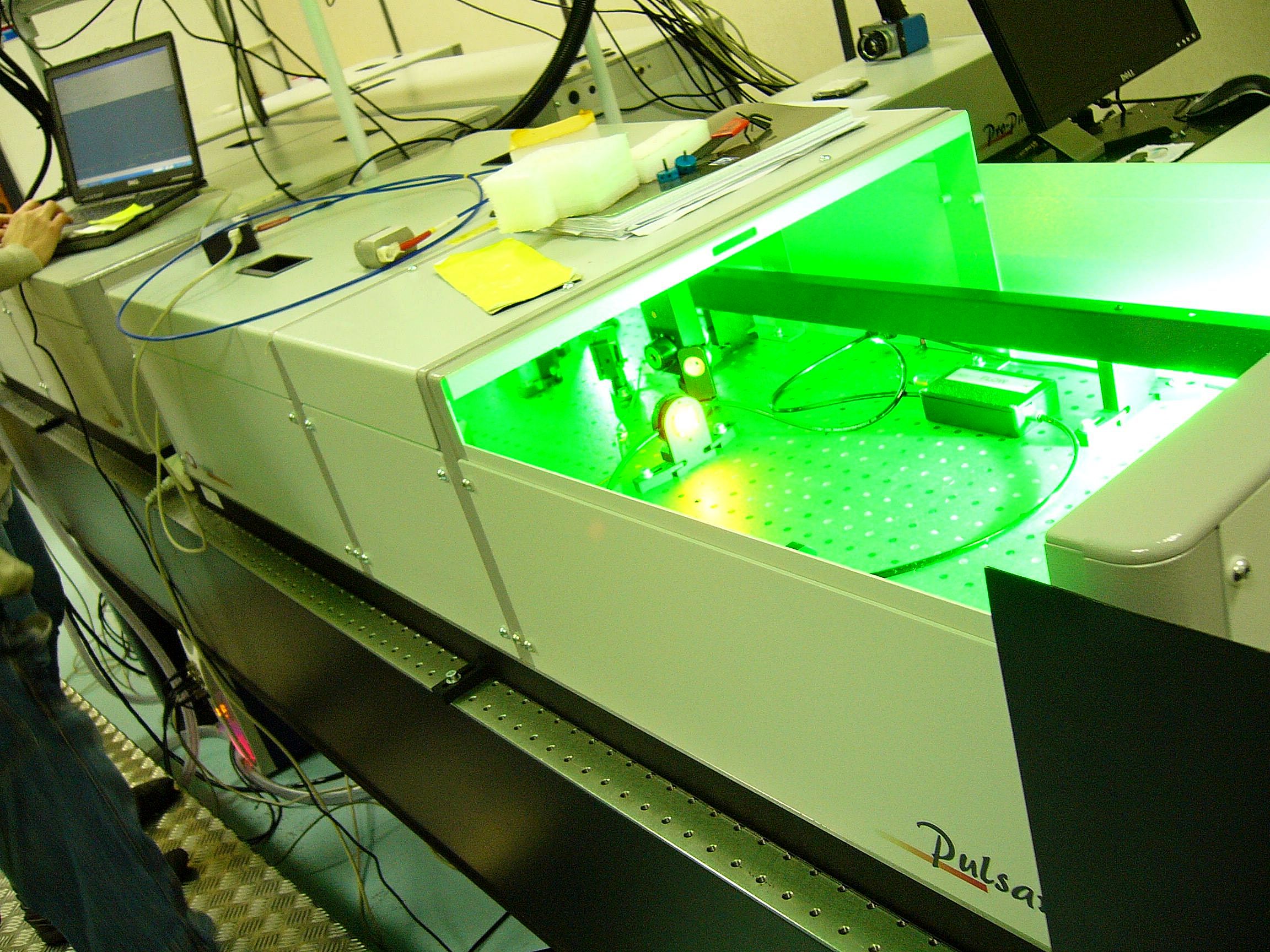
The Pulsar laser of over 10TW power generates ultrashort pulses of energy up to 500 mJ and ~40 fs duration. The laser comprises 7 modules: a generator, booster, stretcher, regenerative amplifier, two multi-pass amplifiers, and an optical compressor.
 |
|
Simplified scheme of the Pulsar femtosecond laser system |
The sequence of femtosecond pulses is generated with the frequency of 80 MHz, then it goes through consecutive modules where it is subject to modification to reach the required parameters. First, the beam is directed to the booster where one pulse of 10 Hz frequency is cut out of the sequence of pulses coming from the generator. The laser can also operate in a single shot mode. Then, the beam passes through the stretcher where the pulse is temporarily extended on the diffraction grating up to 300 ps duration. The pulse extended in such way is amplified 106 times in regenerative and multi-pass amplifiers, reaching the energy level up to 500 mJ.
The last element of the laser is an optical compressor in which the pulse duration on the diffraction gratings gets shortened to around 40 fs. The pulse compression takes place in a vacuum chamber to avoid optical non-linear phenomena which occur in the air of normal pressure during high power laser pulse propagation. The test revealed that laser operation is stable and pulse parameters are repeatable. During the experiments, the pulse energy is measured at each shot. It is possible to introduce an auxiliary laser beam into the trajectory of the main laser beam with a wavelength and divergence consistent with the main beam. The auxiliary laser is utilized for the precise setting of the target without the application of the main laser and for other activities related to adjusting the system.
 |
 |
| Amplifiers of laser beam in the Pulsar laser | Optical compressor in the Pulsar laser system |
Stand to examine laser-matter interactions
The stands for performing laser-plasma experiments guarantees obtaining the planned parameters of the laser beam focused on the target as well as the conditions which ensure the correct measurement of electrons, ions and X-ray radiation emitted from laser plasma. Two independent plasma chambers were installed in the HPLL and independently connected to the optical laser pulse compressor. Propagation of the beam directed to each of the experimental chambers takes place in a vacuum hose. It is necessary to avoid the breakdown in the air caused by the high power laser pulse. Mounting plates supported on the floor independently of the chamber housing were inserted in the chamber. It makes it possible to avoid vibrations and shifts related to the operation of the pumping system.
The air pressure in the vacuum plasma chambers amounts to 10-6 Tr which provides adequate conditions for obtaining reliable results of laser-matter interactions when using laser-irradiated targets made of metals, plastic and gas targets. The pumping systems provide the adequate level of vacuum and their main elements constitute modern turbomolecular pumps.
The system focusing a laser beam on the target consists of a flat guidance mirror and an off-axis parabolic mirror. The beam coming into the plasma chamber is reflected from the flat mirror and falls on the parabolic mirror whose optical axis is inclined from the mechanical axis at an angle of 30°23’. As a result, the beam is focused in the centre of the chamber where the target is located.
 |
|
Inside the experimental chamber: 1 – guiding mirror, 2 – parabolic mirror, 3 – target, 4 – positioning system, |
The target positioning system makes it possible to set the target surface in the focal plane with an accuracy of up to 0,5 µm. A set of four small tables enable researchers to move the target in three directions as well as rotate it. The tables are driven by remotely controlled motors, which allows to move the target with a resolution of 0,156 µm and its rotation with a resolution of 0,015°. The motors are connected to the computer control station. The repeatability of the movement of linear tables is 1 µm.
Thanks to the special observation system the researchers can see craters formed after each shot and precisely select the point on the target which should be shot at. Prior to the laser shot it is possible to determine the exact position of the target surface against the focus. It is possible to move the target quickly and precisely without opening the chamber. A computer code, written especially for this purpose, is applied and ensures the control of tables and shutters as well as gives the possibility to see the image from the cameras.
 |
 |
| The Pulsar laser experimental stand | Equipment for precise positioning of target irradiated with the Pulsar laser beam |
 |
| Checking of the target position inside the Pulsar plasma chamber |
 |
| View of the measuring systems inside the Pulsar experimental chamber |
Diagnostic systems to investigate laser-matter interactions built as part of the ROP-MV
Two Thomson spectrometers
The Thomson spectrometer is an important device used to measure the parameters of ions emitted from laser plasma. In the spectrometer the distributions of ion energy are determined on the basis of the shape of parabolas which show the traces of ions after passing through the system of magnetic and electric fields in the detector.
In the spectrometers built in the IPPLM, permanent magnets and non-parallel electrodes generating electrostatic field were applied. The maximum value of the electric field intensity is greater than 4 MV/m, and the maximum magnetic induction parameters are not lower than 500 mT.
In order to record the parabolas illustrating the energy distribution of the analysed ions, radiochromatic films or electro-optical image recorders with automatic recording of results in the computer can be applied.
Three-frame interferometer and polaro-interferometer to investigate the distribution of electron concentration and magnetic fields in laser-induced plasma
The three-frame interferometer makes it possible to record three interferograms in the form of separate frames at the exposure time equal to the duration of the pulse of the plasma probing laser. The analysis of interferograms with the application of a special computer program allows to determine the plasma concentration distributions at subsequent time moments determined by the delay time of the order of single nanoseconds between three plasma probing beams. The primary beam of the diagnostic laser is separated by means of an optical system into three probing beams, mutually delayed by means of optical delay lines.
 |
| Tree-frame interferometer designed to measure laser plasma concentration distributions |
Polaro-interferometer was designed and built in the IPPLM to investigate expanding laser plasma in the HPLL and laboratories collaborating with the DLPPA. The set of equipment consists of the following components: two two-channel polaro-interferometric modules (2KPI) situated inside the plasma chamber, the system for introduction of diagnostic beams as well as the system for separating and registering frames. The 2KPI module contains the following elements: two polarizers, lenses, optical wedges, filters and CCD cameras for image recording. Moreover, this module is equipped with small protective windows.
 |
| Scheme of polaro-interferometer system |
The task of the polarizers is to spatially divide the diagnostic beam into two channels where the planes of linearly polarized beams are mutually perpendicular. Both channels are equivalent and can act as a polarimeter or shadow photo system depending on the twisting angle of one polarizer as opposed to the other. In case the polarizers are crossed completely, only the polarogram will be recorded, while during large twists of the polarizer planes a shadowing occurs. Placing an optical wedge in one of the channels makes it play the role of an interferometer.
The image registration system is installed outside the experimental chamber. It has its own power supply and is isolated from electromagnetic interference. It consists of four CCD cameras which make it possible to record images with high spatial resolution and dynamics. Each of the cameras is equipped with a cassette with filters (interference and grey ones). The cameras are connected to the computer and operated by a special application.
X-ray spectrometer
A focusing X-ray spectrometer with a curved crystal is applied for spectral research of X-ray radiation emitted from laser plasma. The registration of spectral lines combined with simulations makes it possible to determine the temperature and concentration of plasma. The quartz crystal allows for the registration of spectra in the range from 6 to 8 A. A passive recording method with the application of RFC films read in a special reader system or a back-illuminated CCD camera are used as a detectors.
The completed spectrometer, after adjusting the appropriate distances of each of its elements i.e. plasma source – crystal and crystal – detector, was placed in the experimental chamber, covering the crystal and the detector properly.
Fast four-frame camera to register plasma images in vacuum ultraviolet and soft X-ray radiation
The four-frame camera for recording plasma images in vacuum ultraviolet (VUV) and soft X-ray radiation (SXR) applied in the HPLL allows fast simultaneous registration of the structure and dynamics of expanding laser plasma in the above-mentioned spectral ranges with nanosecond time resolution. An image intensifier with an electro-optic lens applied for the research of fast-changing objects with high luminance is a recording element which allows to obtain images (frames) of the phenomenon studied. This system consists of four CCD cameras which make it possible to record images with high spatial resolution and dynamics. The cameras are connected to the computer and operated by a special code. It allows to control the operation of cameras, view images, acquire images, export registered images to specific graphic formats and process these images.
 |
|
Scheme of the electrostatic ion energy analyser and the recorded Ta ion spectrum |
 |
| The electrostatic ion energy analyser installed in the stand for measuring the ion emission from laser-generated plasma |
Diagnostic systems for laser-matter research built in the DLPPA without using the funds from the ROP-MV project
Electrostatic ion energy analyser
The system is applied to determine with very high accuracy the composition and degree of ionization of ion fluxes emitted from plasma. Moreover, the analyser specifies the distribution of ion energy as well as other characteristics of the ion flux. The analyser consists of the following basic elements: cylindrical electrostatic system for ion deflection by an angle of 90 degrees and a detector with an open electron multiplier with amplification of 107. The analyser was designed and built in the IPPLM and is considered a unique device worldwide.
Ion collectors
An ion collector of the Faraday cup type is applied to determine the basic characteristics of the ion flux based on the measurement of the ion time of flight from the laser-irradiated target to the collector. Ion collectors make it possible to specify: average velocity and average ion energy, total ion charge and density of the ion current as well as angular distribution of ions emitted from plasma. Researchers in the DLPPA apply several kinds of ion collectors to measure ion stream parameters within a range of several orders of magnitude (ion energy from sub-keV to MeV in particular).
Trace detectors to specify the light ion energy spectrum and the number of ions of a particular type
The HPLL researchers apply mainly CR-39 trace detectors (PM-355). They are particularly useful in specifying energy spectra of light ions (e.g. protons, carbon ions) in the energy range >1 MeV where the measurement with the application of ion collectors is not very precise.
Different kinds of X-ray detectors
X-ray detectors are used to measure soft and hard X-ray radiation emitted from laser plasma. These are primarily BPYP and FLM low-capacity silicon detectors. They are equipped with various filters (mainly Al and Be), and the thickness of their active layer may differ. The detectors allow to measure X-ray radiation from plasma in the range of 5–20 keV with sub-nanosecond resolution. Very fast (<100 ps) InP and diamond detectors are applied to record soft X-ray and XUV pulses.
X-ray detectors without time resolution
In order to measure X-ray radiation emitted from laser plasma, the DLPPA researchers take advantage of thermoluminescent detectors (TLD), bolometers, photodiodes combined with charge amplifiers and scintillation detectors with Cs(TI) or plastic scintillators. TLD detectors and bolometers can be used to calibrate other detectors. A two-dimensional image of the X-ray emitting area is obtained by means of a pinhole camera equipped with an X-ray film or an optical CDD camera without a glass window. The above-mentioned detectors can be used with the chosen thickness of the dead layer and active layer as well as the appropriate absorption filter.
Equipment designed for measuring electromagnetic fields (EMF) generated as a result of laser-target interaction
Several types of probes (antennas) were prepared to record EMF parameters in experiments carried out in various European centers as part of the HARMONIA project, the Laserlab-Europe project [Projects] and in the IPPLM in the High Power Laser Laboratory, PALS laboratories in Prague as well as CELIA in Bordeaux. The probes are installed in different places inside and outside the chamber in which the laser-target interaction takes place. Important data is provided by a flat broadband antenna which records the parameters of the multi-GHz LMP radiation component.
In an aim to measure the parameters of electrons escaping from the target, imaging plates, specialized electron spectrometers, magnetic analyzers using permanent magnets as well as Faraday cages connected to fast current sensors were prepared. Systems for measuring ion parameters generated in the laser plasma are also applied in IEM studies [Equipment].
Local News
- 1
- 2
- 3
- 4
- 5
The Polish CeNTE Consortium has been granted observer status in the DONES programme
28-04-2026
The DONES programme is one of the key European initiatives supporting the development of fusion energy and research in plasma physics. It is now entering a further stage of institutional...
Read moreIPPLM joins the Enterprise Europe Network
31-03-2026
On 23 March 2026, the Institute of Plasma Physics and Laser Microfusion (IPPLM) joined, with its technological offer, the group of entities affiliated with the Enterprise Europe Network (EEN), interested...
Read moreIPPLM as a co-creator of the exhibition "E = mc² – the formula that changed the world" at the National…
18-02-2026

On 16 February 2026, the official opening of two new permanent exhibitions took place at the National Museum of Technology in Warsaw. The Institute of Plasma Physics and Laser Microfusion...
Read moreIPPLM supports children and young people at the TPD "Helenów" Centre
22-12-2025

The Sylwester Kaliski Institute of Plasma Physics and Laser Microfusion (IPPLM) has for many years been actively engaged in initiatives supporting children and young people supported by the TPD "Helenów"...
Read moreIPPLM researchers took part in an experimental campaign on the GEKKO XII laser
20-11-2025

On 10–14 November 2025, a research team from the Sylwester Kaliski Institute of Plasma Physics and Laser Microfusion (IPPLM) – Prof. Katarzyna Batani, Dr Hanna Marchenko and Dr Agnieszka Zaraś-Szydłowska...
Read moreRegister for the 18th Kudowa Summer School on Plasma Physics!
07-11-2025

We invite you to take part in the 18th Kudowa Summer School "Towards Fusion Energy", which will be held on 8–12 June 2026 in Kudowa-Zdrój, Poland. The event is organised...
Read moreIPPLM participated in the second technical meeting within the DONES Con-P1 project
17-10-2025
The Institute of Plasma Physics and Laser Microfusion (IPPLM) took part in the second technical meeting held as part of the DONES Consolidation Phase 1 (DONES ConP1) project, co-financed by...
Read moreProf. Jan Badziak from IPPLM among the World’s Top 2% Scientists
15-10-2025
Prof. Jan Badziak, from the Department of Laser Plasma and Magnetized Dense Plasma Physics at the Institute of Plasma Physics and Laser Microfusion (IPPLM), has been included in the prestigious...
Read more29th Science Festival with the participation of IPPLM
10-10-2025

During the 29th Science Festival in Warsaw, held on 19–28 September 2025, researchers from the Institute of Plasma Physics and Laser Microfusion (IPPLM) conducted lessons for upper-grade primary school students. The...
Read morePLASMA 2025 and the 20th Anniversary of the Euratom–IPPLM Association – event summary
26-09-2025

From 15 to 19 September 2025, Warsaw hosted the international scientific conference PLASMA 2025 – International Conference on Research and Application of Plasmas, dedicated to plasma research, diagnostics, and applications....
Read moreWe bid farewell with deep sorrow to Professor Jerzy Wołowski
25-09-2025

It is with great sadness that we have received the news of the passing of Professor Jerzy Wołowski (1936–2025) an outstanding physicist, long-time employee of the Institute of Plasma Physics...
Read more20th anniversary of the Euratom–IPPLM Association (CeNTE): Celebrating two decades of fusion research coordination
16-09-2025

On 19 September 2025, during the PLASMA 2025 International Conference on Research, Diagnostics and Applications of Plasma in Warsaw, the IPPLM will mark 20th anniversary of the coordination of research on nuclear fusion...
Read moreIPPLM at the 49th Congress of Polish Physicists in Katowice
13-09-2025
During the 49th Congress of Polish Physicists, held from September 5–11, 2025, in Katowice, the Institute of Plasma Physics and Laser Microfusion (IPPLM) was represented both among the speakers and...
Read moreProf. Agata Chomiczewska appointed Deputy Director for Scientific Affairs at the IPPLM
03-09-2025

We are pleased to announce that the Minister of Energy, Mr. Miłosz Motyka, has appointed Dr. hab. Agata Chomiczewska to the position of Deputy Director for Scientific Affairs at the...
Read moreA historic milestone – the Scientific Council of the Institute confers the degree of habilitated doctor
10-07-2025
For the first time in the history of the Institute of Plasma Physics and Laser Microfusion (IPPLM), the Scientific Council has adopted a resolution to confer the degree of habilitated...
Read moreNew Board of the Plasma Physics Division of the European Physical Society
04-07-2025

In the first quarter of 2025, elections were held for the Board of the Plasma Physics Division of the European Physical Society (EPS Plasma Physics Division). Six candidates who received...
Read moreIPPLM researchers bring fusion expertise to 10th Central & Eastern Europe Nuclear Industry Congress 2025
12-06-2025
Researchers from the Institute of Plasma Physics and Laser Microfusion (IPPLM), Dr. Natalia Wendler and Dr. Paweł Gąsior, recently participated in a panel discussion at the 10th Central & Eastern...
Read moreIPPLM at the 3rd edition of the "Science for Society" Congress
29-05-2025

On 25-26 May 2025, the 3rd edition of the "Science for Society" Congress took place in the Large Hall of the Warsaw University of Technology. The aim of the event...
Read moreInvitation to the 3rd edition of the "Science for Society" Congress with the participation of IPPLM
22-05-2025

The 3rd edition of the "Science for Society" Congress will take place on 25–26 May 2025 at the Warsaw University of Technology. This unique event demonstrates that science is not...
Read moreJoin the 28th Science Picnic!
07-05-2025

The Institute of Plasma Physics and Laser Microfusion (IPPLM) invites you to its stand on Saturday, 10 May, during the 28th Science Picnic, organized by Polish Radio and the Copernicus...
Read moreCooperation agreement between the IPPLM and the National Museum of Technology
18-04-2025

On 17 April 2025, a cooperation agreement was signed between the National Museum of Technology (NMT) and the Institute of Plasma Physics and Laser Microfusion (IPPLM). The ceremonial meeting, attended by...
Read morePolish and French researchers join forces in research on nuclear fusion
31-03-2025

On 24-25 March 2025, a Polish-French meeting was held at the headquarters of the Institute of Nuclear Physics of the Polish Academy of Sciences (IFJ PAN) and the French Institute...
Read moreJoin us for the International Conference on Research and Application of Plasmas – PLASMA 2025!
13-03-2025

The Institute of Plasma Physics and Laser Microfusion (IPPLM) invites you to attend the PLASMA 2025 – International Conference on Research and Application of Plasmas, which will be held from...
Read moreExperimental research session in the Plasma-Focus PF1000U laboratory as part of the ICDMP collaboration
27-02-2025

On February 10–21, 2025, an experimental session was held in the Plasma-Focus PF-1000U laboratory, in which, in addition to the IPPLM team, a three-person team of researchers from the Prague...
Read moreLaser demonstration on JET detects fusion fuels
11-02-2025

Scientists and engineers from eight nations, including Poland, have carried out a project using lasers on the Joint European Torus (JET) to study fusion fuel retention. Laser Induced Breakdown Spectroscopy (LIBS),...
Read moreWorld News
- 1
- 2
- 3
- 4
- 5
In Memoriam — Professor Francesco Romanelli
24-03-2026

The world of fusion research mourns the loss of Professor Francesco Romanelli, a visionary scientist whose work helped bring humanity closer to clean, limitless energy. Over four decades, he explored...
Read moreIgniting the future: Breakthroughs in inertial confinement Fusion
25-07-2025

In December 2022, the National Ignition Facility (NIF) at Lawrence Livermore National Laboratory (USA) marked a historic milestone in fusion science: an experiment produced 3.15 MJ of fusion energy from 2.05 MJ of laser...
Read moreWendelstein 7-X sets new fusion performance records
04-06-2025

On May 22, 2025, the Wendelstein 7-X (W7-X) stellarator at the Max Planck Institute for Plasma Physics (IPP) in Greifswald concluded its latest experimental campaign with a major success: a...
Read moreEuropean tokamak sets new fusion plasma record
20-02-2025

On February 12, 2025, the WEST tokamak, located at CEA Cadarache in southern France, set a new world record by sustaining fusion plasma for 1,337 seconds, or over 22 minutes....
Read moreDr. Gianfranco Federici appointed as the new EUROfusion Programme Manager
17-12-2024
At the 49th General Assembly held in Barcelona, December 2024, Dr. Gianfranco Federici was elected as the new Programme Manager of EUROfusion. He succeeds Prof. Ambrogio Fasoli, who will return...
Read moreEUROfusion and F4E join forces for Europe’s fusion future
16-12-2024

EUROfusion and Fusion for Energy (F4E) have signed a Memorandum of Understanding (MoU) to advance fusion research and development in Europe. This agreement reinforces cooperation in...
Read moreJohn J. Hopfield and Geoffrey E. Hinton awarded the 2024 Nobel Prize in Physics
08-10-2024

John J. Hopfield and Geoffrey E. Hinton have been awarded the 2024 Nobel Prize in Physics "for foundational discoveries and inventions that enable machine learning with artificial neural networks." The Nobel...
Read moreWendelstein 7-X begins new experimental campaign
10-09-2024

The Wendelstein 7-X, the world’s most advanced stellarator, is launching a new experimental campaign after a year of intensive maintenance and upgrades. This phase, known as OP2.2, begins on 10...
Read moreITER's New Project Baseline: A Robust Path to Fusion Energy Research
04-07-2024

On 3 July, ITER Director-General Pietro Barabaschi presented the new project baseline, under evaluation by the ITER Organization's governing body. This plan aims to ensure a robust start to scientific...
Read moreITER Council Presents Updated Project Baseline
21-06-2024

The ITER Council convened this week for its 34th meeting, where nearly 100 attendees reviewed significant updates to the project baseline. The proposed changes aim to optimize the overall project...
Read moreEurope and Japan celebrate breakthrough in paving the way for fusion energy
01-12-2023

The prospect of harnessing fusion energy is closer. The successful operation of JT-60SA, the most powerful experimental device to date, built by Europe and Japan, is a landmark achievement for...
Read moreFirst plasma was successfully generated at JT-60SA
26-10-2023

A momentous achievement in the field of nuclear fusion has been accomplished by a collaborative team of engineers from Europe and Japan. They have successfully generated tokamak plasma for the...
Read moreThe Nobel Prize in Physics 2023
03-10-2023
Pierre Agostini, Ferenc Krausz and Anne L’Huillier are the winners of this year's Nobel Prize in Physics. It was awarded "for experimental methods that generate attosecond pulses of light for...
Read moreUS Lab Replicates Fusion Ignition Breakthrough
08-08-2023
The US National Ignition Facility (NIF) has achieved fusion ignition once again, building on its landmark 2022 success. This achievement, powered by hydrogen within a diamond capsule, signifies a major...
Read moreNew Programme Manager Elect announced by EUROfusion
20-07-2023
Professor Ambrogio Fasoli became the new EUROfusion Programme Manager Elect. The decision was made by EUROfusion General Assembly at the meeting on 18 July 2023. His tenure will officially commence...
Read moreEUROfusion stands in solidarity with research in Ukraine
24-02-2023

Today, as we commemorate the anniversary of the invasion of Ukraine by Russia, the EUROfusion consortium stands in solidarity with our Ukrainian member and research colleagues. EUROfusion remains committed to supporting...
Read moreEight-minute production of plasma with gigajoule energy turnover at Wendelstein 7-X
23-02-2023

Another target has been achieved only recently by the W7-X researchers, namely they managed to acquire an energy turnover of 1.3 gigajoules in the device, which is 17 times higher...
Read moreThe Nobel Prize in Physics 2022
04-10-2022

Alain Aspect, John F. Clauser and Anton Zeilinger are the winners of this year's Nobel Prize in Physics. It was awarded “for experiments with entangled photons, establishing the violation of...
Read moreNew experiments for fusion energy record breaker JET
27-09-2022

A new wave of fusion energy experiments on UK Atomic Energy Authority’s record-breaking Joint European Torus (JET) started this month. EUROfusion researchers are using the famous JET machine to conduct a...
Read moreITER appoints new Director-General
21-09-2022
Pietro Barabaschi has become the next Director-General of the ITER Organization as a result of the unanimous choice of the Council from among finalist candidates. In the transition period Dr....
Read moreStarting power plant design
07-07-2022

At a livestreamed Horizon EUROfusion event in Brussels on 5 July 2022, EUROfusion celebrated the start of conceptual design activities for Europe's first demonstration fusion power plant DEMO. This first-of-a-kind...
Read moreCelebration of achieving a crucial assembly milestone in the ITER Project
17-05-2022

This month, we have witnessed the successful lifting and lowering into the machine well of the first sub-section of the ITER plasma chamber. The weight of the component is the...
Read moreBurning plasma achieved in inertial fusion at the National Ignition Facility
15-02-2022
Obtaining a burning plasma is a critical step towards self-sustaining fusion energy. A burning plasma is one in which the fusion reactions themselves are the primary source of heating in...
Read moreHistoric milestone reached by JET scientists
20-01-2022

Iconic fusion energy machine JET – which reaches controlled temperatures 10 times hotter than the core of the sun – completed its 100,000th live pulse last night. Weighing 2,800 tonnes, the...
Read moreHorizon Europe Grant Agreement signed
20-12-2021

15 December 2021 saw the EUROfusion consortium signing the Grant Agreement under Horizon Europe, the European Framework Programme from 2021 – 2027, in an aim to launch comprehensive R&D approach...
Read more |
 |
 |
 |
 |
 |
 |
 |


Research projects carried out at the IPPLM are funded by the Polish Ministry of Education and Science, the National Science Centre and by the European Commission within the framework of EUROfusion Consortium under grant agreement No 101052200. Financial support comes also from the International Atomic Energy Agency, European Space Agency and LaserLab Consortium as well as from the Fusion for Energy Agency.