

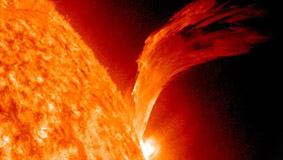
stp506RADIOACTIVE materials decay at a predictable rate—so predictable, in fact, that scientists widely use them to date artefacts and geological objects. That, at least, is the received wisdom, which Jere Jenkins and Ephraim Fischbach, from Purdue University in Indiana, think may need revising. In 2006 Dr Jenkins noticed that the decay rate of the radioactive isotope manganese-54 dipped 39 hours before a solar flare came crashing into Earth's protective magnetic field. Now it seems that the sun might affect other types of decay, too.

As the researchers report in Astroparticle Physics, the decay rate of chlorine-36 increases as Earth approaches the sun. The difference is tiny: the rate fluctuates by less than 1% between the aphelion and perihelion, the points on Earth's orbit when it is farthest and closest to the sun, respectively. But it is discernible and persistent. As-yet-unpublished data for manganese-54 suggest that isotope follows a similar pattern. If confirmed, the insight might, among other things form the basis of a system for forecasting dangerous cosmic storms.

Solar flares, in which charged particles are ejected from the sun, can damage satellites and ground-based electronic infrastructure. In 2005 an unseasonal solar storm knocked out a number of Global Positioning System (GPS) birds, some of them for good. It also forced airliners to be redirected from Arctic routes, where Earth's magnetic field provides least cover from the nefarious effects a hail of such particles can have on the people's, and machines', health. And that was a mere breeze compared with the solar storm of 1859, thought to have been many times more devastating on the basis of the disruption it caused to the nascent telegraph service. These days, another Carrington Event, as the 19th-century episode is known, risks crippling a planet increasingly reliant on all sorts of electronic gubbins.

A number of advance-warning systems, enabling countermeasures such as temporary shutdown of vulnerable electronics, are in the works. But reliable forecasts are scarce. This is because solar storms are not yet well understood. Paradoxically, Dr Jenkins and Dr Fischbach think this might change with the help of neutrinos, the ethereal particles which pervade the universe but rarely interact with anything—and themselves a cause of much head-scratching among physicists.

Neutrinos are a byproduct of the nuclear fusion which powers the sun. Earth's elliptical orbit means that the flux of solar neutrinos which stream through it varies during the year. The changes in chlorine-36 and manganese-54 decay rates observed by the Purdue team, including the dip prior to the flare in 2006, mirror the changes in neutrino flux detected by other experiments. Unlike their tiny radioactive sample, though, those existing neutrino detectors are vast (to shorten the odds that the elusive particles deign to react with at least one atom inside it) and often sit deep underground (to shield the detectors from other particles which leave neutrino-like traces; only neutrinos, thanks to their signature unwillingness to react, are able to penetrate ). As a result, any system based on such detectors would be hard to scale up.

If Dr Fischbach and Dr Jenkins are right about neutrinos affecting radioactive decay, it would herald a new era in neutrino physics, not just space-weather forecasting. That is still a prodigious if. For a start, like many things neutrino-related, the mechanism through which the particles might affect decay rates remains a mystery. On the rare occasions that they do interact, neutrinos do so via the weak nuclear force, which is also responsible for the sorts of radioactivity present in chlorine-36 and manganese-54. Physicists critical of the work point out that in the Purdue team's proposal the strength of the force, which can be calculated from the observed changes in decay rates, is much larger than established particle theory would have it.

Such discrepancies might be explained if a neutrino somehow amplifies the decay rates. In the conventional view, most neutrinos pass through matter without so much as a shudder. Those that do interact tend to do so only once; the likelihood of a single neutrino scattering off one atom and then another in short order is infinitesimal. However, rather controversially, Dr Fischbach thinks that the large number of neutrinos that seem not to be interacting may in fact be doing so, just that the effects of these interactions in stable matter are too small to see. In an unstable radioactive sample, he speculates, they might come to light, because decay rates are known to be extremely sensitive to the energy released in the process. As a result, if solar neutrinos transferred a mere millionth of their energy to a decaying nucleus, that might have a big effect on the rate at which it breaks up.

Whatever the mechanism, the correlation between radioactive decay rates and neutrino flux looks striking, and has been observed in a number of samples in different laboratories. Wary neutrino physicists warn that it could all yet prove to be an artefact of the way the experiments were conducted. That was the case in 2011, when their colleagues in Italy clocked neutrinos travelling faster than light, only to discover that the result, at odds with Einstein's cherished theory of relativity, was down to a loose cable.

Even if this time all cables were taut, many hurdles remain. Dr Fischbach admits that while whatever process generated the flare in 2006 also caused a dip in neutrino flux, and a corresponding drop in radioactive decay rates, other processes seem to have the opposite effect. For example, a storm in 2008 was preceded by a spike in manganese-54 decay rates.He suspects that what is loosely termed a "solar storm" may in fact be a number of distinct processes whose common feature is that they affect neutrino production in one way or another. That is a far cry from a reliable space-weather forecast. But it has not stopped the university from applying for a patent on a decay-based neutrino detector technology, just in case.


Source: economist.com

Local News

  • 1
  • 2
  • 3
  • 4
  • 5
Prev Next

IPPLM joins the Enterprise Europe Network

31-03-2026

On 23 March 2026, the Institute of Plasma Physics and Laser Microfusion (IPPLM) joined, with its technological offer, the group of entities affiliated with the Enterprise Europe Network (EEN), interested...

Read more

IPPLM as a co-creator of the exhibition "E = mc² – the formula that changed the world" at the National…

18-02-2026

IPPLM as a co-creator of the exhibition "E = mc² – the formula that changed the world" at the National Museum of Technology

On 16 February 2026, the official opening of two new permanent exhibitions took place at the National Museum of Technology in Warsaw. The Institute of Plasma Physics and Laser Microfusion...

Read more

IPPLM supports children and young people at the TPD "Helenów" Centre

22-12-2025

IPPLM supports children and young people at the TPD "Helenów" Centre

The Sylwester Kaliski Institute of Plasma Physics and Laser Microfusion (IPPLM) has for many years been actively engaged in initiatives supporting children and young people supported by the TPD "Helenów"...

Read more

IPPLM researchers took part in an experimental campaign on the GEKKO XII laser

20-11-2025

IPPLM researchers took part in an experimental campaign on the GEKKO XII laser

On 10–14 November 2025, a research team from the Sylwester Kaliski Institute of Plasma Physics and Laser Microfusion (IPPLM) – Prof. Katarzyna Batani, Dr Hanna Marchenko and Dr Agnieszka Zaraś-Szydłowska...

Read more

Register for the 18th Kudowa Summer School on Plasma Physics!

07-11-2025

Register for the 18th Kudowa Summer School on Plasma Physics!

We invite you to take part in the 18th Kudowa Summer School "Towards Fusion Energy", which will be held on 8–12 June 2026 in Kudowa-Zdrój, Poland. The event is organised...

Read more

IPPLM participated in the second technical meeting within the DONES Con-P1 project

17-10-2025

IPPLM participated in the second technical meeting within the DONES Con-P1 project

The Institute of Plasma Physics and Laser Microfusion (IPPLM) took part in the second technical meeting held as part of the DONES Consolidation Phase 1 (DONES ConP1) project, co-financed by...

Read more

Prof. Jan Badziak from IPPLM among the World’s Top 2% Scientists

15-10-2025

Prof. Jan Badziak, from the Department of Laser Plasma and Magnetized Dense Plasma Physics at the Institute of Plasma Physics and Laser Microfusion (IPPLM), has been included in the prestigious...

Read more

29th Science Festival with the participation of IPPLM

10-10-2025

29th Science Festival with the participation of IPPLM

During the 29th Science Festival in Warsaw, held on 19–28 September 2025, researchers from the Institute of Plasma Physics and Laser Microfusion (IPPLM) conducted lessons for upper-grade primary school students. The...

Read more

PLASMA 2025 and the 20th Anniversary of the Euratom–IPPLM Association – event summary

26-09-2025

PLASMA 2025 and the 20th Anniversary of the Euratom–IPPLM Association – event summary

From 15 to 19 September 2025, Warsaw hosted the international scientific conference PLASMA 2025 – International Conference on Research and Application of Plasmas, dedicated to plasma research, diagnostics, and applications....

Read more

We bid farewell with deep sorrow to Professor Jerzy Wołowski

25-09-2025

We bid farewell with deep sorrow to Professor Jerzy Wołowski

It is with great sadness that we have received the news of the passing of Professor Jerzy Wołowski (1936–2025) an outstanding physicist, long-time employee of the Institute of Plasma Physics...

Read more

20th anniversary of the Euratom–IPPLM Association (CeNTE): Celebrating two decades of fusion research coordination

16-09-2025

20th anniversary of the Euratom–IPPLM Association (CeNTE): Celebrating two decades of fusion research coordination

On 19 September 2025, during the PLASMA 2025 International Conference on Research, Diagnostics and Applications of Plasma in Warsaw, the IPPLM will mark 20th anniversary of the coordination of research on nuclear fusion...

Read more

IPPLM at the 49th Congress of Polish Physicists in Katowice

13-09-2025

IPPLM at the 49th Congress of Polish Physicists in Katowice

During the 49th Congress of Polish Physicists, held from September 5–11, 2025, in Katowice, the Institute of Plasma Physics and Laser Microfusion (IPPLM) was represented both among the speakers and...

Read more

Prof. Agata Chomiczewska appointed Deputy Director for Scientific Affairs at the IPPLM

03-09-2025

Prof. Agata Chomiczewska appointed Deputy Director for Scientific Affairs at the IPPLM

We are pleased to announce that the Minister of Energy, Mr. Miłosz Motyka, has appointed Dr. hab. Agata Chomiczewska to the position of Deputy Director for Scientific Affairs at the...

Read more

A historic milestone – the Scientific Council of the Institute confers the degree of habilitated doctor

10-07-2025

For the first time in the history of the Institute of Plasma Physics and Laser Microfusion (IPPLM), the Scientific Council has adopted a resolution to confer the degree of habilitated...

Read more

New Board of the Plasma Physics Division of the European Physical Society

04-07-2025

New Board of the Plasma Physics Division of the European Physical Society

In the first quarter of 2025, elections were held for the Board of the Plasma Physics Division of the European Physical Society (EPS Plasma Physics Division). Six candidates who received...

Read more

IPPLM researchers bring fusion expertise to 10th Central & Eastern Europe Nuclear Industry Congress 2025

12-06-2025

IPPLM researchers bring fusion expertise to 10th Central & Eastern Europe Nuclear Industry Congress 2025

Researchers from the Institute of Plasma Physics and Laser Microfusion (IPPLM), Dr. Natalia Wendler and Dr. Paweł Gąsior, recently participated in a panel discussion at the 10th Central & Eastern...

Read more

IPPLM at the 3rd edition of the "Science for Society" Congress

29-05-2025

IPPLM at the 3rd edition of the "Science for Society" Congress

On 25-26 May 2025, the 3rd edition of the "Science for Society" Congress took place in the Large Hall of the Warsaw University of Technology. The aim of the event...

Read more

Invitation to the 3rd edition of the "Science for Society" Congress with the participation of IPPLM

22-05-2025

Invitation to the 3rd edition of the "Science for Society" Congress with the participation of IPPLM

The 3rd edition of the "Science for Society" Congress will take place on 25–26 May 2025 at the Warsaw University of Technology. This unique event demonstrates that science is not...

Read more

Join the 28th Science Picnic!

07-05-2025

Join the 28th Science Picnic!

The Institute of Plasma Physics and Laser Microfusion (IPPLM) invites you to its stand on Saturday, 10 May, during the 28th Science Picnic, organized by Polish Radio and the Copernicus...

Read more

Cooperation agreement between the IPPLM and the National Museum of Technology

18-04-2025

Cooperation agreement between the IPPLM and the National Museum of Technology

On 17 April 2025, a cooperation agreement was signed between the National Museum of Technology (NMT) and the Institute of Plasma Physics and Laser Microfusion (IPPLM). The ceremonial meeting, attended by...

Read more

Polish and French researchers join forces in research on nuclear fusion

31-03-2025

Polish and French researchers join forces in research on nuclear fusion

On 24-25 March 2025, a Polish-French meeting was held at the headquarters of the Institute of Nuclear Physics of the Polish Academy of Sciences (IFJ PAN) and the French Institute...

Read more

Join us for the International Conference on Research and Application of Plasmas – PLASMA 2025!

13-03-2025

Join us for the International Conference on Research and Application of Plasmas – PLASMA 2025!

The Institute of Plasma Physics and Laser Microfusion (IPPLM) invites you to attend the PLASMA 2025 – International Conference on Research and Application of Plasmas, which will be held from...

Read more

Experimental research session in the Plasma-Focus PF1000U laboratory as part of the ICDMP collaboration

27-02-2025

Experimental research session in the Plasma-Focus PF1000U laboratory as part of the ICDMP collaboration

On February 10–21, 2025, an experimental session was held in the Plasma-Focus PF-1000U laboratory, in which, in addition to the IPPLM team, a three-person team of researchers from the Prague...

Read more

Laser demonstration on JET detects fusion fuels

11-02-2025

Laser demonstration on JET detects fusion fuels

Scientists and engineers from eight nations, including Poland, have carried out a project using lasers on the Joint European Torus (JET) to study fusion fuel retention. Laser Induced Breakdown Spectroscopy (LIBS),...

Read more

IPPLM employee nominated for the Personality of the Year title in the Science category

24-01-2025

Research and technical employee Mr. Olgierd Cichorek, M.Sc., from the Laboratory of Plasma Nudge for Satellites at the IPPLM has been nominated for the title of Personality of the Year...

Read more

World News

  • 1
  • 2
  • 3
  • 4
  • 5
Prev Next

In Memoriam — Professor Francesco Romanelli

24-03-2026

In Memoriam — Professor Francesco Romanelli

The world of fusion research mourns the loss of Professor Francesco Romanelli, a visionary scientist whose work helped bring humanity closer to clean, limitless energy. Over four decades, he explored...

Read more

Igniting the future: Breakthroughs in inertial confinement Fusion

25-07-2025

Igniting the future: Breakthroughs in inertial confinement Fusion

In December 2022, the National Ignition Facility (NIF) at Lawrence Livermore National Laboratory (USA) marked a historic milestone in fusion science: an experiment produced 3.15 MJ of fusion energy from 2.05 MJ of laser...

Read more

Wendelstein 7-X sets new fusion performance records

04-06-2025

Wendelstein 7-X sets new fusion performance records

On May 22, 2025, the Wendelstein 7-X (W7-X) stellarator at the Max Planck Institute for Plasma Physics (IPP) in Greifswald concluded its latest experimental campaign with a major success: a...

Read more

European tokamak sets new fusion plasma record

20-02-2025

European tokamak sets new fusion plasma record

On February 12, 2025, the WEST tokamak, located at CEA Cadarache in southern France, set a new world record by sustaining fusion plasma for 1,337 seconds, or over 22 minutes....

Read more

Dr. Gianfranco Federici appointed as the new EUROfusion Programme Manager

17-12-2024

At the 49th General Assembly held in Barcelona, December 2024, Dr. Gianfranco Federici was elected as the new Programme Manager of EUROfusion. He succeeds Prof. Ambrogio Fasoli, who will return...

Read more

EUROfusion and F4E join forces for Europe’s fusion future

16-12-2024

EUROfusion and F4E join forces for Europe’s fusion future

               EUROfusion and Fusion for Energy (F4E) have signed a Memorandum of Understanding (MoU) to advance fusion research and development in Europe. This agreement reinforces cooperation in...

Read more

John J. Hopfield and Geoffrey E. Hinton awarded the 2024 Nobel Prize in Physics

08-10-2024

John J. Hopfield and Geoffrey E. Hinton awarded the 2024 Nobel Prize in Physics

John J. Hopfield and Geoffrey E. Hinton have been awarded the 2024 Nobel Prize in Physics "for foundational discoveries and inventions that enable machine learning with artificial neural networks." The Nobel...

Read more

Wendelstein 7-X begins new experimental campaign

10-09-2024

Wendelstein 7-X begins new experimental campaign

The Wendelstein 7-X, the world’s most advanced stellarator, is launching a new experimental campaign after a year of intensive maintenance and upgrades. This phase, known as OP2.2, begins on 10...

Read more

ITER's New Project Baseline: A Robust Path to Fusion Energy Research

04-07-2024

ITER's New Project Baseline: A Robust Path to Fusion Energy Research

On 3 July, ITER Director-General Pietro Barabaschi presented the new project baseline, under evaluation by the ITER Organization's governing body. This plan aims to ensure a robust start to scientific...

Read more

ITER Council Presents Updated Project Baseline

21-06-2024

ITER Council Presents Updated Project Baseline

The ITER Council convened this week for its 34th meeting, where nearly 100 attendees reviewed significant updates to the project baseline. The proposed changes aim to optimize the overall project...

Read more

Europe and Japan celebrate breakthrough in paving the way for fusion energy

01-12-2023

Europe and Japan celebrate breakthrough in paving the way for fusion energy

The prospect of harnessing fusion energy is closer. The successful operation of JT-60SA, the most powerful experimental device to date, built by Europe and Japan, is a landmark achievement for...

Read more

First plasma was successfully generated at JT-60SA

26-10-2023

First plasma was successfully generated at JT-60SA

A momentous achievement in the field of nuclear fusion has been accomplished by a collaborative team of engineers from Europe and Japan. They have successfully generated tokamak plasma for the...

Read more

The Nobel Prize in Physics 2023

03-10-2023

Pierre Agostini, Ferenc Krausz and Anne L’Huillier are the winners of this year's Nobel Prize in Physics. It was awarded "for experimental methods that generate attosecond pulses of light for...

Read more

US Lab Replicates Fusion Ignition Breakthrough

08-08-2023

The US National Ignition Facility (NIF) has achieved fusion ignition once again, building on its landmark 2022 success. This achievement, powered by hydrogen within a diamond capsule, signifies a major...

Read more

New Programme Manager Elect announced by EUROfusion

20-07-2023

Professor Ambrogio Fasoli became the new EUROfusion Programme Manager Elect. The decision was made by EUROfusion General Assembly at the meeting on 18 July 2023. His tenure will officially commence...

Read more

EUROfusion stands in solidarity with research in Ukraine

24-02-2023

EUROfusion stands in solidarity with research in Ukraine

Today, as we commemorate the anniversary of the invasion of Ukraine by Russia, the EUROfusion consortium stands in solidarity with our Ukrainian member and research colleagues. EUROfusion remains committed to supporting...

Read more

Eight-minute production of plasma with gigajoule energy turnover at Wendelstein 7-X

23-02-2023

Eight-minute production of plasma with gigajoule energy turnover at Wendelstein 7-X

Another target has been achieved only recently by the W7-X researchers, namely they managed to acquire an energy turnover of 1.3 gigajoules in the device, which is 17 times higher...

Read more

The Nobel Prize in Physics 2022

04-10-2022

The Nobel Prize in Physics 2022

Alain Aspect, John F. Clauser and Anton Zeilinger are the winners of this year's Nobel Prize in Physics. It was awarded “for experiments with entangled photons, establishing the violation of...

Read more

New experiments for fusion energy record breaker JET

27-09-2022

New experiments for fusion energy record breaker JET

A new wave of fusion energy experiments on UK Atomic Energy Authority’s record-breaking Joint European Torus (JET) started this month. EUROfusion researchers are using the famous JET machine to conduct a...

Read more

ITER appoints new Director-General

21-09-2022

Pietro Barabaschi has become the next Director-General of the ITER Organization as a result of the unanimous choice of the Council from among finalist candidates. In the transition period Dr....

Read more

Starting power plant design

07-07-2022

Starting power plant design

At a livestreamed Horizon EUROfusion event in Brussels on 5 July 2022, EUROfusion celebrated the start of conceptual design activities for Europe's first demonstration fusion power plant DEMO. This first-of-a-kind...

Read more

Celebration of achieving a crucial assembly milestone in the ITER Project

17-05-2022

Celebration of achieving a crucial assembly milestone in the ITER Project

This month, we have witnessed the successful lifting and lowering into the machine well of the first sub-section of the ITER plasma chamber. The weight of the component is the...

Read more

Burning plasma achieved in inertial fusion at the National Ignition Facility

15-02-2022

Obtaining a burning plasma is a critical step towards self-sustaining fusion energy. A burning plasma is one in which the fusion reactions themselves are the primary source of heating in...

Read more

Historic milestone reached by JET scientists

20-01-2022

Historic milestone reached by JET scientists

Iconic fusion energy machine JET – which reaches controlled temperatures 10 times hotter than the core of the sun – completed its 100,000th live pulse last night. Weighing 2,800 tonnes, the...

Read more

Horizon Europe Grant Agreement signed

20-12-2021

Horizon Europe Grant Agreement signed

15 December 2021 saw the EUROfusion consortium signing the Grant Agreement under Horizon Europe, the European Framework Programme from 2021 – 2027, in an aim to launch comprehensive R&D approach...

Read more
HiPER fusionForEnergyLogo logo EUROfusion iter Laserlab Europe Fusenet European Commission Logo MEiN

What we do

Our laboratories

Research projects carried out at the IPPLM are funded by the Polish Ministry of Education and Science, the National Science Centre and by the European Commission within the framework of EUROfusion Consortium under grant agreement No 101052200. Financial support comes also from the International Atomic Energy Agency, European Space Agency and LaserLab Consortium as well as from the Fusion for Energy Agency.

Go to top