

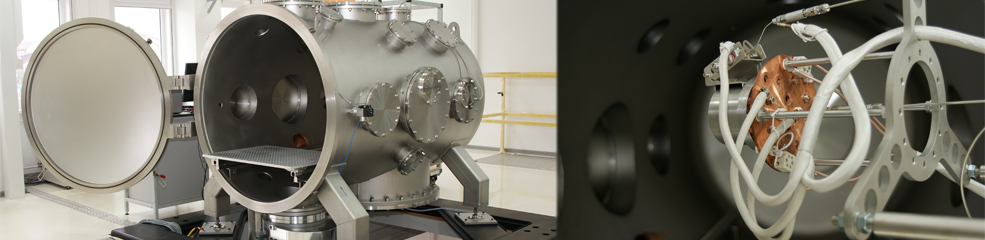
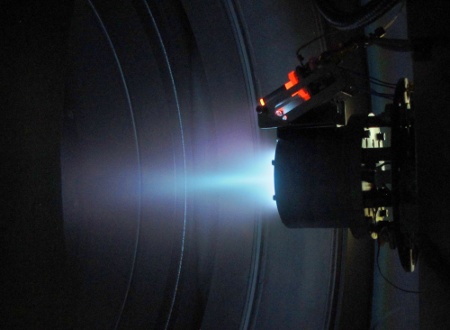
HET COLORPrototyp pierwszego polskiego silnika plazmowego do sond kosmicznych został z sukcesem przetestowany w warunkach zbliżonych do tych panujących w przestrzeni kosmicznej w laboratorium Europejskiej Agencji Kosmicznej (ESA - ESTEC) w Nordwijk (Holandia).

Grupa polskich naukowców z Instytutu Fizyki Plazmy i Laserowej Mikrosyntezy (IFPiLM) w Warszawie opracowuje specjalny silnik do napędu sond kosmicznych i satelitów, który będzie tańszy w eksploatacji od obecnie istniejących rozwiązań. - Podczas sesji eksperymentalnej silnik pracował wystarczająco długo, by zmierzyć ważne parametry (np. siłę ciągu). Można mówić o pierwszym kroku do sukcesu. Bezproblemowe uruchomienie silnika wprawiło w zaskoczenie nawet doświadczonych pracowników ESA. Z reguły pierwsze uruchomienia wymagają odpowiedniego doboru parametrów pracy układu, których ustalenie a priori jest skomplikowane - mówi dr Jacek Kurzyna z IFPiLM, kierownik zespołu.

Testowany silnik to elektryczny napęd plazmowy typu Halla. Takie silniki są już z powodzeniem użytkowane w przestrzeni kosmicznej i wykorzystywane do utrzymywania satelitów na pożądanej orbicie oraz do zmiany ich orientacji. Znalazły one zastosowanie również jako silniki napędowe w sondach dalekiego zasięgu. Ze względu na relatywnie niskie zużycie "paliwa" są poważną konkurencją dla tradycyjnych silników rakietowych. Dla takiej samej misji kosmicznej silnik rakietowy potrzebuje około dziesięć razy więcej paliwa od silników plazmowych.

Ważący 4 kg silnik ma kształt cylindra o średnicy 10 cm i długości 12 cm, a maksymalna moc z jaką może pracować wynosi około pół kilowata. Urządzenie polskich naukowców wytwarza siłę ciągu wystarczającą do pracy na satelitach o masie do około 100 kg. - Sonda SMART-1, którą ESA wysłała na orbitę Księżyca, dysponowała silnikiem ksenonowym o mocy poniżej 2 kW. Był on w stanie zwiększyć prędkość sondy o 3,6 km/s. Zatem w małych próbnikach kosmicznych również nasz napęd mógłby pełnić rolę silnika napędowego - mówi dr Serge Barral z IFPiLM.

Celem naukowców z IFPiLM jest budowa silnika typu Halla tańszego w eksploatacji od dotychczas używanych poprzez zastosowanie kryptonu jako gazu roboczego. Ten gaz szlachetny jest nawet 10-krotnie tańszy od najczęściej stosowanego ksenonu.

Podczas projektowania silnika, w celu obniżenia kosztów i zmniejszenia liczby kolejnych prototypów naukowcy z IFPiLM przeprowadzili szereg symulacji komputerowych, by ocenić jaka konfiguracja elementów silnika umożliwi uzyskanie najwyższej sprawności. Do symulacji wykorzystano program napisany przez dr Serge'a Barrala, jednego z konstruktorów silnika. Obliczona sprawność prototypowego silnika dosyć dobrze zgadza się ze wstępnymi wynikami testów wykonanych w laboratorium ESA i w optymalnych warunkach dochodzi do 50%.

Pierwszy krok - budowa prototypu silnika i jego uruchomienie - został wykonany. Po pierwszych badaniach naukowcy czekają na pełne wyniki testów opracowane przez specjalistów z ESA i jednocześnie pracują nad kolejnym prototypem. - Przez dwa tygodnie sesji eksperymentalnej dokonaliśmy wielu pomiarów. Danych zebranych w eksperymencie jest dużo, a ich rzetelna obróbka wymaga czasu. Pracownicy ESA obiecali przysłać opracowane dane już w styczniu - mówi Jan Miedzik, uczestnik projektu.

- Pierwsze testy prototypowego układu pokazały gdzie wskazane są modyfikacje. Najważniejszy i najtrudniejszy do zaprojektowania element układu - obwód magnetyczny - pracował bez zastrzeżeń, więc będziemy dążyć do uzyskania tej samej konfiguracji w kolejnym prototypie - wyjaśnia Dariusz Daniłko, członek zespołu odpowiedzialny za numeryczne modelowanie pola magnetycznego w silniku Halla. W przyszłym roku kolejny prototyp będzie przechodził testy, także w laboratorium ESA.

Najnowsze badania eksperymentalne polskich naukowców mogą przyczynić się do redukcji kosztów eksploatacji satelitów oraz sond kosmicznych, z których wszyscy korzystamy codziennie, często nieświadomie. Urządzenia montowane na satelitach służą do dokładniejszego prognozowania pogody, przesyłania sygnału telewizyjnego i do transmisji rozmów telefonicznych. Dzięki satelitom możliwe było stworzenie systemu GPS. Co ważne, przesyłanie danych, czy transmisja rozmów na duże odległości jest tańsza przy użyciu satelitów niż łącz naziemnych.

Projekt i budowa pierwszej wersji elektrycznego silnika plazmowego typu Halla zostały sfinansowane przez Instytut Fizyki Plazmy i Laserowej Mikrosyntezy. Badania w laboratorium ESA oraz budowa kolejnego prototypu są finansowane z budżetu projektu KLIMT (Krypton Large Impulse Thruster) realizowanego w ramach Porozumienia o Europejskim Państwie Współpracującym zawartego między Polską a ESA.

Prototyp pierwszego polskiego silnika plazmowego już działa – polscy naukowcy nie mieli jak dotąd własnego silnika plazmowego. Na razie służy do badań naukowych, ale w przyszłości przewidziana jest jego produkcja z udziałem partnerów przemysłowych celem wykorzystania go do zadań w przestrzeni kosmicznej. Warto wspomnieć, że w IFPiLM ten sam zespół pracuje nad drugim, dużo mniejszym silnikiem, który w przyszłości znajdzie zastosowanie na małych sondach lub satelitach takich jak polski satelita LEM.


Zapraszamy na:

http://www.youtube.com/watch?v=RP48Eb4lr54 - pierwsze uruchomienie

http://www.youtube.com/watch?v=YSD_bo65RnA - uruchomienie poprzez wyładowanie jarzeniowe


Osoba kontaktowa:

Jan Miedzik

Tel: +48 22 6381005 wew. 40; Fax: +48 22 6668372

E-mail: This email address is being protected from spambots. You need JavaScript enabled to view it.

Instytut Fizyki Plazmy i laserowej Mikrosyntezy (IFPiLM)

Oddział Plazmy w Polu Magnetycznym

Zespół Akceleratorów Plazmowych

Ul. Hery 23, 01-497 Warszawa

Źródło zdjęcia - dr Jacek Kurzyna

Local News

  • 1
  • 2
  • 3
  • 4
  • 5
Prev Next

The Polish CeNTE Consortium has been granted observer status in the DONES programme

28-04-2026

The DONES programme is one of the key European initiatives supporting the development of fusion energy and research in plasma physics. It is now entering a further stage of institutional...

Read more

IPPLM joins the Enterprise Europe Network

31-03-2026

On 23 March 2026, the Institute of Plasma Physics and Laser Microfusion (IPPLM) joined, with its technological offer, the group of entities affiliated with the Enterprise Europe Network (EEN), interested...

Read more

IPPLM as a co-creator of the exhibition "E = mc² – the formula that changed the world" at the National…

18-02-2026

IPPLM as a co-creator of the exhibition "E = mc² – the formula that changed the world" at the National Museum of Technology

On 16 February 2026, the official opening of two new permanent exhibitions took place at the National Museum of Technology in Warsaw. The Institute of Plasma Physics and Laser Microfusion...

Read more

IPPLM supports children and young people at the TPD "Helenów" Centre

22-12-2025

IPPLM supports children and young people at the TPD "Helenów" Centre

The Sylwester Kaliski Institute of Plasma Physics and Laser Microfusion (IPPLM) has for many years been actively engaged in initiatives supporting children and young people supported by the TPD "Helenów"...

Read more

IPPLM researchers took part in an experimental campaign on the GEKKO XII laser

20-11-2025

IPPLM researchers took part in an experimental campaign on the GEKKO XII laser

On 10–14 November 2025, a research team from the Sylwester Kaliski Institute of Plasma Physics and Laser Microfusion (IPPLM) – Prof. Katarzyna Batani, Dr Hanna Marchenko and Dr Agnieszka Zaraś-Szydłowska...

Read more

Register for the 18th Kudowa Summer School on Plasma Physics!

07-11-2025

Register for the 18th Kudowa Summer School on Plasma Physics!

We invite you to take part in the 18th Kudowa Summer School "Towards Fusion Energy", which will be held on 8–12 June 2026 in Kudowa-Zdrój, Poland. The event is organised...

Read more

IPPLM participated in the second technical meeting within the DONES Con-P1 project

17-10-2025

IPPLM participated in the second technical meeting within the DONES Con-P1 project

The Institute of Plasma Physics and Laser Microfusion (IPPLM) took part in the second technical meeting held as part of the DONES Consolidation Phase 1 (DONES ConP1) project, co-financed by...

Read more

Prof. Jan Badziak from IPPLM among the World’s Top 2% Scientists

15-10-2025

Prof. Jan Badziak, from the Department of Laser Plasma and Magnetized Dense Plasma Physics at the Institute of Plasma Physics and Laser Microfusion (IPPLM), has been included in the prestigious...

Read more

29th Science Festival with the participation of IPPLM

10-10-2025

29th Science Festival with the participation of IPPLM

During the 29th Science Festival in Warsaw, held on 19–28 September 2025, researchers from the Institute of Plasma Physics and Laser Microfusion (IPPLM) conducted lessons for upper-grade primary school students. The...

Read more

PLASMA 2025 and the 20th Anniversary of the Euratom–IPPLM Association – event summary

26-09-2025

PLASMA 2025 and the 20th Anniversary of the Euratom–IPPLM Association – event summary

From 15 to 19 September 2025, Warsaw hosted the international scientific conference PLASMA 2025 – International Conference on Research and Application of Plasmas, dedicated to plasma research, diagnostics, and applications....

Read more

We bid farewell with deep sorrow to Professor Jerzy Wołowski

25-09-2025

We bid farewell with deep sorrow to Professor Jerzy Wołowski

It is with great sadness that we have received the news of the passing of Professor Jerzy Wołowski (1936–2025) an outstanding physicist, long-time employee of the Institute of Plasma Physics...

Read more

20th anniversary of the Euratom–IPPLM Association (CeNTE): Celebrating two decades of fusion research coordination

16-09-2025

20th anniversary of the Euratom–IPPLM Association (CeNTE): Celebrating two decades of fusion research coordination

On 19 September 2025, during the PLASMA 2025 International Conference on Research, Diagnostics and Applications of Plasma in Warsaw, the IPPLM will mark 20th anniversary of the coordination of research on nuclear fusion...

Read more

IPPLM at the 49th Congress of Polish Physicists in Katowice

13-09-2025

IPPLM at the 49th Congress of Polish Physicists in Katowice

During the 49th Congress of Polish Physicists, held from September 5–11, 2025, in Katowice, the Institute of Plasma Physics and Laser Microfusion (IPPLM) was represented both among the speakers and...

Read more

Prof. Agata Chomiczewska appointed Deputy Director for Scientific Affairs at the IPPLM

03-09-2025

Prof. Agata Chomiczewska appointed Deputy Director for Scientific Affairs at the IPPLM

We are pleased to announce that the Minister of Energy, Mr. Miłosz Motyka, has appointed Dr. hab. Agata Chomiczewska to the position of Deputy Director for Scientific Affairs at the...

Read more

A historic milestone – the Scientific Council of the Institute confers the degree of habilitated doctor

10-07-2025

For the first time in the history of the Institute of Plasma Physics and Laser Microfusion (IPPLM), the Scientific Council has adopted a resolution to confer the degree of habilitated...

Read more

New Board of the Plasma Physics Division of the European Physical Society

04-07-2025

New Board of the Plasma Physics Division of the European Physical Society

In the first quarter of 2025, elections were held for the Board of the Plasma Physics Division of the European Physical Society (EPS Plasma Physics Division). Six candidates who received...

Read more

IPPLM researchers bring fusion expertise to 10th Central & Eastern Europe Nuclear Industry Congress 2025

12-06-2025

IPPLM researchers bring fusion expertise to 10th Central & Eastern Europe Nuclear Industry Congress 2025

Researchers from the Institute of Plasma Physics and Laser Microfusion (IPPLM), Dr. Natalia Wendler and Dr. Paweł Gąsior, recently participated in a panel discussion at the 10th Central & Eastern...

Read more

IPPLM at the 3rd edition of the "Science for Society" Congress

29-05-2025

IPPLM at the 3rd edition of the "Science for Society" Congress

On 25-26 May 2025, the 3rd edition of the "Science for Society" Congress took place in the Large Hall of the Warsaw University of Technology. The aim of the event...

Read more

Invitation to the 3rd edition of the "Science for Society" Congress with the participation of IPPLM

22-05-2025

Invitation to the 3rd edition of the "Science for Society" Congress with the participation of IPPLM

The 3rd edition of the "Science for Society" Congress will take place on 25–26 May 2025 at the Warsaw University of Technology. This unique event demonstrates that science is not...

Read more

Join the 28th Science Picnic!

07-05-2025

Join the 28th Science Picnic!

The Institute of Plasma Physics and Laser Microfusion (IPPLM) invites you to its stand on Saturday, 10 May, during the 28th Science Picnic, organized by Polish Radio and the Copernicus...

Read more

Cooperation agreement between the IPPLM and the National Museum of Technology

18-04-2025

Cooperation agreement between the IPPLM and the National Museum of Technology

On 17 April 2025, a cooperation agreement was signed between the National Museum of Technology (NMT) and the Institute of Plasma Physics and Laser Microfusion (IPPLM). The ceremonial meeting, attended by...

Read more

Polish and French researchers join forces in research on nuclear fusion

31-03-2025

Polish and French researchers join forces in research on nuclear fusion

On 24-25 March 2025, a Polish-French meeting was held at the headquarters of the Institute of Nuclear Physics of the Polish Academy of Sciences (IFJ PAN) and the French Institute...

Read more

Join us for the International Conference on Research and Application of Plasmas – PLASMA 2025!

13-03-2025

Join us for the International Conference on Research and Application of Plasmas – PLASMA 2025!

The Institute of Plasma Physics and Laser Microfusion (IPPLM) invites you to attend the PLASMA 2025 – International Conference on Research and Application of Plasmas, which will be held from...

Read more

Experimental research session in the Plasma-Focus PF1000U laboratory as part of the ICDMP collaboration

27-02-2025

Experimental research session in the Plasma-Focus PF1000U laboratory as part of the ICDMP collaboration

On February 10–21, 2025, an experimental session was held in the Plasma-Focus PF-1000U laboratory, in which, in addition to the IPPLM team, a three-person team of researchers from the Prague...

Read more

Laser demonstration on JET detects fusion fuels

11-02-2025

Laser demonstration on JET detects fusion fuels

Scientists and engineers from eight nations, including Poland, have carried out a project using lasers on the Joint European Torus (JET) to study fusion fuel retention. Laser Induced Breakdown Spectroscopy (LIBS),...

Read more

World News

  • 1
  • 2
  • 3
  • 4
  • 5
Prev Next

In Memoriam — Professor Francesco Romanelli

24-03-2026

In Memoriam — Professor Francesco Romanelli

The world of fusion research mourns the loss of Professor Francesco Romanelli, a visionary scientist whose work helped bring humanity closer to clean, limitless energy. Over four decades, he explored...

Read more

Igniting the future: Breakthroughs in inertial confinement Fusion

25-07-2025

Igniting the future: Breakthroughs in inertial confinement Fusion

In December 2022, the National Ignition Facility (NIF) at Lawrence Livermore National Laboratory (USA) marked a historic milestone in fusion science: an experiment produced 3.15 MJ of fusion energy from 2.05 MJ of laser...

Read more

Wendelstein 7-X sets new fusion performance records

04-06-2025

Wendelstein 7-X sets new fusion performance records

On May 22, 2025, the Wendelstein 7-X (W7-X) stellarator at the Max Planck Institute for Plasma Physics (IPP) in Greifswald concluded its latest experimental campaign with a major success: a...

Read more

European tokamak sets new fusion plasma record

20-02-2025

European tokamak sets new fusion plasma record

On February 12, 2025, the WEST tokamak, located at CEA Cadarache in southern France, set a new world record by sustaining fusion plasma for 1,337 seconds, or over 22 minutes....

Read more

Dr. Gianfranco Federici appointed as the new EUROfusion Programme Manager

17-12-2024

At the 49th General Assembly held in Barcelona, December 2024, Dr. Gianfranco Federici was elected as the new Programme Manager of EUROfusion. He succeeds Prof. Ambrogio Fasoli, who will return...

Read more

EUROfusion and F4E join forces for Europe’s fusion future

16-12-2024

EUROfusion and F4E join forces for Europe’s fusion future

               EUROfusion and Fusion for Energy (F4E) have signed a Memorandum of Understanding (MoU) to advance fusion research and development in Europe. This agreement reinforces cooperation in...

Read more

John J. Hopfield and Geoffrey E. Hinton awarded the 2024 Nobel Prize in Physics

08-10-2024

John J. Hopfield and Geoffrey E. Hinton awarded the 2024 Nobel Prize in Physics

John J. Hopfield and Geoffrey E. Hinton have been awarded the 2024 Nobel Prize in Physics "for foundational discoveries and inventions that enable machine learning with artificial neural networks." The Nobel...

Read more

Wendelstein 7-X begins new experimental campaign

10-09-2024

Wendelstein 7-X begins new experimental campaign

The Wendelstein 7-X, the world’s most advanced stellarator, is launching a new experimental campaign after a year of intensive maintenance and upgrades. This phase, known as OP2.2, begins on 10...

Read more

ITER's New Project Baseline: A Robust Path to Fusion Energy Research

04-07-2024

ITER's New Project Baseline: A Robust Path to Fusion Energy Research

On 3 July, ITER Director-General Pietro Barabaschi presented the new project baseline, under evaluation by the ITER Organization's governing body. This plan aims to ensure a robust start to scientific...

Read more

ITER Council Presents Updated Project Baseline

21-06-2024

ITER Council Presents Updated Project Baseline

The ITER Council convened this week for its 34th meeting, where nearly 100 attendees reviewed significant updates to the project baseline. The proposed changes aim to optimize the overall project...

Read more

Europe and Japan celebrate breakthrough in paving the way for fusion energy

01-12-2023

Europe and Japan celebrate breakthrough in paving the way for fusion energy

The prospect of harnessing fusion energy is closer. The successful operation of JT-60SA, the most powerful experimental device to date, built by Europe and Japan, is a landmark achievement for...

Read more

First plasma was successfully generated at JT-60SA

26-10-2023

First plasma was successfully generated at JT-60SA

A momentous achievement in the field of nuclear fusion has been accomplished by a collaborative team of engineers from Europe and Japan. They have successfully generated tokamak plasma for the...

Read more

The Nobel Prize in Physics 2023

03-10-2023

Pierre Agostini, Ferenc Krausz and Anne L’Huillier are the winners of this year's Nobel Prize in Physics. It was awarded "for experimental methods that generate attosecond pulses of light for...

Read more

US Lab Replicates Fusion Ignition Breakthrough

08-08-2023

The US National Ignition Facility (NIF) has achieved fusion ignition once again, building on its landmark 2022 success. This achievement, powered by hydrogen within a diamond capsule, signifies a major...

Read more

New Programme Manager Elect announced by EUROfusion

20-07-2023

Professor Ambrogio Fasoli became the new EUROfusion Programme Manager Elect. The decision was made by EUROfusion General Assembly at the meeting on 18 July 2023. His tenure will officially commence...

Read more

EUROfusion stands in solidarity with research in Ukraine

24-02-2023

EUROfusion stands in solidarity with research in Ukraine

Today, as we commemorate the anniversary of the invasion of Ukraine by Russia, the EUROfusion consortium stands in solidarity with our Ukrainian member and research colleagues. EUROfusion remains committed to supporting...

Read more

Eight-minute production of plasma with gigajoule energy turnover at Wendelstein 7-X

23-02-2023

Eight-minute production of plasma with gigajoule energy turnover at Wendelstein 7-X

Another target has been achieved only recently by the W7-X researchers, namely they managed to acquire an energy turnover of 1.3 gigajoules in the device, which is 17 times higher...

Read more

The Nobel Prize in Physics 2022

04-10-2022

The Nobel Prize in Physics 2022

Alain Aspect, John F. Clauser and Anton Zeilinger are the winners of this year's Nobel Prize in Physics. It was awarded “for experiments with entangled photons, establishing the violation of...

Read more

New experiments for fusion energy record breaker JET

27-09-2022

New experiments for fusion energy record breaker JET

A new wave of fusion energy experiments on UK Atomic Energy Authority’s record-breaking Joint European Torus (JET) started this month. EUROfusion researchers are using the famous JET machine to conduct a...

Read more

ITER appoints new Director-General

21-09-2022

Pietro Barabaschi has become the next Director-General of the ITER Organization as a result of the unanimous choice of the Council from among finalist candidates. In the transition period Dr....

Read more

Starting power plant design

07-07-2022

Starting power plant design

At a livestreamed Horizon EUROfusion event in Brussels on 5 July 2022, EUROfusion celebrated the start of conceptual design activities for Europe's first demonstration fusion power plant DEMO. This first-of-a-kind...

Read more

Celebration of achieving a crucial assembly milestone in the ITER Project

17-05-2022

Celebration of achieving a crucial assembly milestone in the ITER Project

This month, we have witnessed the successful lifting and lowering into the machine well of the first sub-section of the ITER plasma chamber. The weight of the component is the...

Read more

Burning plasma achieved in inertial fusion at the National Ignition Facility

15-02-2022

Obtaining a burning plasma is a critical step towards self-sustaining fusion energy. A burning plasma is one in which the fusion reactions themselves are the primary source of heating in...

Read more

Historic milestone reached by JET scientists

20-01-2022

Historic milestone reached by JET scientists

Iconic fusion energy machine JET – which reaches controlled temperatures 10 times hotter than the core of the sun – completed its 100,000th live pulse last night. Weighing 2,800 tonnes, the...

Read more

Horizon Europe Grant Agreement signed

20-12-2021

Horizon Europe Grant Agreement signed

15 December 2021 saw the EUROfusion consortium signing the Grant Agreement under Horizon Europe, the European Framework Programme from 2021 – 2027, in an aim to launch comprehensive R&D approach...

Read more
HiPER fusionForEnergyLogo logo EUROfusion iter Laserlab Europe Fusenet European Commission Logo MEiN

What we do

Our laboratories

Research projects carried out at the IPPLM are funded by the Polish Ministry of Education and Science, the National Science Centre and by the European Commission within the framework of EUROfusion Consortium under grant agreement No 101052200. Financial support comes also from the International Atomic Energy Agency, European Space Agency and LaserLab Consortium as well as from the Fusion for Energy Agency.

Go to top