

Urszula Woźnicka1, Łukasz Ciupiński2, Jacek Jagielski3, Monika Kubkowska4, Marek Stodulski1, Roman Zagórski4

1 The Henryk Niewodniczański Institute of Nuclear Physics Polish Academy of Sciences, Krakow, Poland, (IFJ PAN)

2 Warsaw University of Technology (WUT)

3 National Center for Nuclear Research, Otwock/Swierk, Poland (NCBJ)

4 The Institute of Plasma Physics and Laser Microfusion, Warsaw, Poland, (IPPLM)


   The Wendelstein 7-X stellarator is now being assembled at the Max Planck Institute for Plasma Physics (IPP), Greifswald, Germany. Polish involvement in the Wendelstein 7-X stellarator programme is quite large and covers many areas, started from cooperation on device assembly and development of the NBI system, structural and mechanical calculations through development of several diagnostics, like X-ray pulse height analysis PHA, C/O monitor system, neutron and microwave diagnostics, and modeling studies related to neutron MCNP calculations and 3D edge plasma simulations.

   The magnetic system of the Wendelstein 7-X consists of 20 planar and 50 non-planar superconducting coils toroidally arranged in five identical modules made of half-modules set with 2-fold rotational symmetry. Due to the complex geometry, the complex load pattern, and the nonlinear interaction between the components, the accurate analysis of the magnetic system of W7-X is only possible by numerical means.

   IPPLM Association has carried out the structural – mechanical analyses of this system since 2004. Among others, finite element parametric models of critical system elements have been developed at Warsaw University of Technology (WUT) in cooperation with the team of Structural Integrity at Max-Plank-Institute für Plasmaphysik (IPP) in Greifswald. Those models, built using ANSYS code, enabled semi-automatic numerical analyses of the connections and provided a better understanding of the structural behaviour of the joints, as well as enabled to study influences of tolerances, and to follow complex manufacture and assembly processes subjected to non-conformities after some manual modifications. Further details on these activities can be found in [1 - 3].

w7x halfmodule

A general view of the W7-X half-module FEM model.

   The Agreement on Cooperation between the Max-Planck-Institut fur Plasmaphysik in Garching and the Henryk Niewodniczański Institute of Nuclear Physics Polish Academy of Sciences in Krakow, Poland, (IFJ PAN) was signed off in 2007. According to the agreement IFJ PAN was responsible for the assembly of the bus bar system powering 70 superconducting coils on five modules of the W7-X stellarator. The bus bars are made of the NbTi superconductors in an aluminium jacket. The bus bar system is very complex and its final reliability and performance is strongly dependent on both the quality and accuracy of the assembly process.

   To complete the system it was also necessary to connect the bus bars between neighboring modules at so called Module Separation Planes (MSP). There are eight joints to be made at three MSPs and ten joints at two MSPs. The Bus Bar Assembly (BBA) team consisted of 10 to 20 technicians from IFJ PAN and IPP Greifswald headed by Responsible Officers from IFJ PAN. IFJ PAN completed the task in 2012. The bus bar systems had been assembled on all five modules of W7-X and connected together. During assembly of the bus bar system, mechanical and electrical connection of the bus bar ends and/or the coil current leads was the most crucial operation as well as electrical insulation of the joints. The IFJ PAN team made 184 joints in total. All of them passed successfully quality tests. The total effort made by IFJ PAN over six years of the collaboration amounted to more than 160 FTEs (Full Time Equivalent). More than 50 engineers and technicians were involved and trained in the assembly process of the bus bars. The results of the work performed have been presented and described in 14 reports [4 - 17].

w7x trial fin
Trial and final installation of the bus bars on a single module

w7x five mods

Five modules on the W7-X ring

w7x merkel szwed

German Chancellor A. Merkel (left) and Polish Ministry of Science and Higher Education J. Szwed (right) discussing with IFJ PAN employees.

   The collaboration between National Center for Nuclear Research, Otwock/Swierk, Poland (NCBJ) and IPP started in March 2011, when a first official kick-off meeting took place in Garching. It has been agreed, that Polish contribution into Neutral Beam Injector system will consists of: 1) Support structures for NBI boxes as well as hydraulic system for positioning and displacement of boxes, 2) Two gates valves separating the NBI boxes from the stellarator torus, 3) Cooling system ensuring the heat dissipation from ion sources, rf-generators and plasma grids and 4) Two reflection magnets. The total value of NCBJ project equals to about 5 MEUR.

   The current status of the project is the following:

   1. Support structures. Design of support structures has been completed in CATIA, the project passed static checks. Static calculations have been certified by TUV NORD company. The contracts for manufacturing have been signed with TEPRO (steel construction) and Parker-Hannifin (hydraulic system) companies. Support structures have been manufactured and hydraulic systems installed, the first acceptance tests are scheduled for April 10 in TEPRO, Koszalin, Poland. Later on the support structures will be dismounted and transported to IPP Greifswald where final acceptance tests will be performed. The formal delivery is expected for early May 2013.

   2. Gate valves. One new and one refurbished gate valve were delivered to NCBJ in 2012. Both valves were equipped with an additional blocking device, a safety system preventing the valve of being shut or open accidentally. The contract for “design and build” for the heating systems has been signed with Prevac company, Rogow, Poland. Each heating system is composed of four independent heating sectors, each of them containing two heating loops (one spare), temperature sensors, thermal protectors and controlled power supply. The distribution of temperature has been checked by using finite elements simulations. Most of elements needed for construction are already in Prevac, power supplies are tested. The delivery of gate valves and of the heating system is scheduled on July 2013.

   3. Cooling system. Several major modifications of the cooling system have been imposed by the IPP side, mainly the significant reduction in water flow. The initial project has been redesigned accordingly. The contract for cooling system manufacturing has been signed with Inss-Pol company, Wroclaw, Poland. The installation started in March 2013, final delivery is expected in May 2013.

   4. Magnets. The first, refurbished magnet should be ready in April 2013. The second, new one, in September 2013. Both magnets will be manufactured by Tesla company, Storrington, UK and will be modified with respect to the original project; new copper liners, insulation feedthroughs and several minor elements were redesigned. Final delivery of magnets to IPP Greifswald is expected in October 2013.

   Concluding, despite of several substantial modifications imposed by modifications of the W7-X project the complete delivery of Polish in-kind contribution is expected to be completed in 2013.

w7x support

Support structures for the NBI boxes.

   The Institute of Plasma Physics and Laser Microfusion in Warsaw, Poland, (IPPLM) builds of two soft X-ray diagnostics, namely PHA and MFS systems. The project is realized in the frame of cooperation agreement between IPP Greifswald and IPPLM and is a part of the contract of Association between EURATOM and IPPLM, performed within the framework of the European Fusion Development Agreement.

   A pulse height analysis (PHA) system which is planned to obtain the shape of X-ray spectrum by measurement of the energy carried by individual quanta (the height of a pulse measured is proportional to this energy) is now in manufacture phase. The intensity of radiation must be low enough to assure that the condition at which the electrical signals from the individual quanta do not overlap (no “pile-up” effect) in the electronics following the detector. The second diagnostic is a multi-foil temperature analysis system (MFS) which is a method destined to obtain the shape of the X-ray spectrum from the data recorded with the use of different semiconductor detectors. In this method the spectrum is determined by measurements of the total X-ray emission (as the effect of an interaction of many quanta) in some different ranges of energy, which are determined by the type and thickness of filters and the thickness of detectors. The MFS method is characterised by the lower spectral resolution in comparison with the PHA system.

   For designing these two diagnostic systems a numerical code for evaluation of X-ray emission from stellarator plasma, named RayX has been developed. The code simulates the composition of ionization stages for some important elements (C, Fe, O) and the intensity of free-free, free-bound and bound-bound radiation. Basing on the assumption about the configuration of the detection system and the amount of impurities, the code predicts the response of the 1-D imaging system for a given plasma density and temperature spatial profiles. The results of simulations for predicted plasma scenarios, different diagnostic geometry, different kinds of detectors and thickness of applied filters were used in designing the diagnostic systems.

   The proposed X-ray pulse height analysis system is intended to provide the spectral energy distribution with an energy resolution of about 200 eV along a central line of sight. The low energy detector response can be adjusted by interchangeable energy filters (Beryllium transmission foils). This will allow to enhance the sensitivity for particular impurity species and for the investigation of superthermal tails in the spectra. The system will consist of a set of 3 SDD (Silicon Drift Detectors) detectors operated with different filters in order to obtain a good sensitivity in a wide energy range. The combination of spectral data obtained along a single line of sight with broadband radial X-ray intensity profiles will provide a sufficiently good characterization of the impurity radiation in the plasma core. The measurements yield impurity survey spectra in the X-ray region above 0.5 keV (up to 20 keV typically) allowing to identify the line radiation from all relevant impurities and to determine their concentration in the hot plasma core. The slope of the hydrogen and low-Z continuum radiation is used to determine the central electron temperature. The intensity of the continuum radiation along with additional spectroscopic data allows to assess Zeff values in the plasma center. In addition, the presence of suprathermal electrons can be detected in the high energy region of the continuum spectrum.

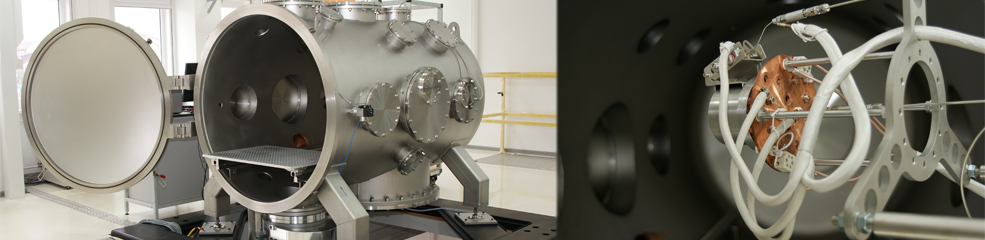
w7x vacuum

Vacuum chaber of PHA soft X-ray diagnostic designed and buit at the IPPLM, Warsaw for W7-X stellarator.

The MFS system will be realized on port AEN20 as a part of the so-called flexible SX camera system on the AEM10-AEN10-AEO10 port combination.

This diagnostics will consist of 8 detector arrays (for 5 detectors each) using different 8 filter-foils, current amplifiers and a memorising system. Basing on the simulations it was established that the distance from plasma center to pinhole should be 2.5 m and the distance from pinholes to detectors 0.20 - 0.25 m. Additionally, there will be possibility to change this distance adequately to the plasma conditions. Taking into account the influence of magnetic field on diagnostic components, the turbo molecular pump has been placed at 6 m from the plasma center. It is expected to run both diagnostics in 2014.

w7x diagsys

Design of the MFS soft X-ray diagnostic system for W7-X done by the IPPLM, Warsaw.

The collaboration between IPPLM and IPP on edge plasma modeling started already in 2003 with the aim to contribute to development of the 3D fluid code (FINDIF) for simulations of plasma parameters in the boundary region of the stellerator W7-X device. The numerical model was based on the concept of local magnetic coordinates allowing a correct discretization with mimimized numerical errors. The finite difference discretization method was used which allows the numerical simulation of energy transport in complex 3D edge geometries (in particular for W7-X) using a custom-tailored unstructured grid in local magnetic coordinates. This grid is generated by field-line tracing to guarantee an exact discretization of the dominant parallel transport. Along the magnetic field lines the standard Patankar concept was used to discretize the convection-diffusion equation, whereas in order to solve a quasi-isotropic problem in a plane (toroidal cut), the finite volume method was modified to obtain its finite difference representation with the radial fluxes on plasma cross-sections being interpolated using a constrained Delaunay triangulation. FINDIF calculations have been performed for W7-X geometry as well as for the 3D TEXTOR-DED configuration [18-23].
It is planned to continue common works on edge plasma modeling in future and to use the FINDIF code to interpret experimental results from W7-X.

w7x electron temp

Calculated 3D electron temperature solution in a W7-X configuration

Papers

1. G. Krzesiński, T. Zagrajek, P.Marek, R. Dobosz, P. Czarkowski, K.J. Kurzydłowski,FEManalysis of coil support connections in theWendelstein 7-Xmagnet system,Fusion Engineering and Design 82 (2007) 1574–1578.

2. Ł. Ciupiński, G.Krzesiński, K. Kurzydłowski, P. Marek, T. Zagrajek,V. Bykov, P. Czarkowski,W. Daenner, A. Dudek, F. Schauer, Evaluation of the mechanical behavior of W7-X central support connections bymeans of semi-automated FE analysis, Fusion Engineering and Design 84 (2009) 613–617

3. Ł. Ciupiński, G. Krzesiński, P. Marek, T. Zagrajek, J. Fellinger, V. Bykov, A. Dudek, F. Schauer, A. Panin , Limit analysis of W7-X critical magnet system components with consideration of material serration effect, Fusion Engineering and Design, Volume 86, (2011), 1501-1505

4. J. Blocki, A deformation analysis for the lower shell by FE, IPP, WENDELSTEIN 7-X, 12 Dec. 2007.

5. J.Blocki, A deformation analysis for the lower shell of the Module 1, Module 2, Module 3 and Module 4 by use of the Finite Element Method, Report 1EDH08-T0010.0, IPP Greifswald, August 15, 2008

6. J.Blocki, A deformation analysis for the upper shell of the Module 1, Module 2 Module 3 and Module 4 by use of the Finite Element Method, Report 1EDH08-T0011.0, IPP Greifswald, August 17, 2008

7. J.Blocki, A deformation analysis for the outer vessel modules supported on the platform and transported on a semi-trailer, Report 1EDH08-T0021.0, IPP Greifswald, November 27, 2008

8. A.John, L.Hajduk, Arbeitsanweisung Montage Jointklammer und Jointgehäuse, IPP Greifswald, Max-Planck-Institut für Plasmaphysik, 1-NEC- A0111.2 , 05.08.2009

9. K.Rummel, M.Stodulski, Arbeitsanweisung Installation der QD-Verdrahtungs-Boxen an den Spulenanschluss-Joints, IPP Greifswald, Max-Planck-Institut für Plasmaphysik, 1-NEC- A0292.1, July 2009

10. M.Stodulski, Samples of repaired QD wires needed to qualify the procedure, Written Note, August 12, 2009

11. Z.Sulek, L.Hajduk, M.Stodulski, Contribution to the WENDELSTEIN 7-X stellarator construction, EUROATOM Mobility – EUROATOM Annual Report 2008, 2009

12. Z.Sulek, L.Hajduk, M.Stodulski, Contribution to the WENDELSTEIN 7-X stellarator construction, EUROATOM Mobility - EUROATOM Annual Report 2009, 2010

13. J.Blocki, L.Hajduk, J.Kotula, M.Stodulski, Z.Sulek, Contribution IFJ PAN to the construction of the WENDELSTEIN 7-X stellarator (2008 – 2009), IFJ Report 2039/PP, (2010)

14. Z.Sułek, L.Hajduk, E.Górnicki, B.Dzieża, M.Stodulski, Contribution to the WENDELSTEIN 7-X stellarator construction, EUROATOM Annual Report 20010, 2011

15. B.Dzieża, E.Górnicki, L.Hajduk, M.Stodulski, Z.Sułek, Contribution to W7-X assembly process, EUROATOM Annual Report 20011, 2012

16. L.Hajduk, M.Stodulski, Z.Sułek, Contribution to W7-X assembly process, EUROATOM Annual Report 20012, 2013,

17. B.Dzieża, E.Górnicki, L.Hajduk, J.Kotuła, M.Stodulski, Z.Sułek, Contribution IFJ PAN to the construction of the WENDELSTEIN 7-X stellarator (2010 – 2012), IFJ Report 2059/PP, (2013)

18. R. Zagórski, M.W. Jakubowski, A. Kalentev, O. Schmitz, R. Schneider and W. Stępniewski, 3D numerical simulations of energy transport in the stochastic boundary of TEXTOR-DED with a finite difference method, Nucl. Fusion 48 (2008) 1-9

19. Zagórski, M. Jakubowski, N. McTaggart, R. Schneider, W. Stępniewski, P. Xanthopoulos, “Application of the 3D Finite Difference Scheme to the TEXTOR-DED Geometry”, Contrib. Plasma Phys. 46, No. 7-9, 563 – 569 (2006)

20. N. McTaggart, R. Zagórski, X. Bonnin, A. Runov, R. Schneider, T.Kaiser, T.Rognlien, M.Umansky, “3D Edge Energy Transport in Stellarator Configurations J. Nucl. Materials, vol. 337-339, (2005) p.221

21. N. McTaggart, R. Zagórski, X. Bonnin, A. Runov, R. Schneider, “Finite Difference Scheme for Solving General 3D Convection-Diffusion Equation”, Comput. Phys. Comm., 164:318-329, 2004.

22. A.Runov, S.V.Kasilov, N. McTaggart, , R.Schneider, X.Bonnin, R. Zagórski and D.Reiter, “Transport modelling for ergodic configurations”, Nucl.Fusion, vol.44 (2004) S74-S82

23. N. McTaggart, X.Bonnin, A.Runov, R.Schneider, and R. Zagórski, “Energy transport modelling including ergodic effects”, Contrib. To Plasma Physics, vol.44 No.1-3 (2004) 31-34


Local News

  • 1
  • 2
  • 3
  • 4
  • 5
Prev Next

The Polish CeNTE Consortium has been granted observer status in the DONES programme

28-04-2026

The DONES programme is one of the key European initiatives supporting the development of fusion energy and research in plasma physics. It is now entering a further stage of institutional...

Read more

IPPLM joins the Enterprise Europe Network

31-03-2026

On 23 March 2026, the Institute of Plasma Physics and Laser Microfusion (IPPLM) joined, with its technological offer, the group of entities affiliated with the Enterprise Europe Network (EEN), interested...

Read more

IPPLM as a co-creator of the exhibition "E = mc² – the formula that changed the world" at the National…

18-02-2026

IPPLM as a co-creator of the exhibition "E = mc² – the formula that changed the world" at the National Museum of Technology

On 16 February 2026, the official opening of two new permanent exhibitions took place at the National Museum of Technology in Warsaw. The Institute of Plasma Physics and Laser Microfusion...

Read more

IPPLM supports children and young people at the TPD "Helenów" Centre

22-12-2025

IPPLM supports children and young people at the TPD "Helenów" Centre

The Sylwester Kaliski Institute of Plasma Physics and Laser Microfusion (IPPLM) has for many years been actively engaged in initiatives supporting children and young people supported by the TPD "Helenów"...

Read more

IPPLM researchers took part in an experimental campaign on the GEKKO XII laser

20-11-2025

IPPLM researchers took part in an experimental campaign on the GEKKO XII laser

On 10–14 November 2025, a research team from the Sylwester Kaliski Institute of Plasma Physics and Laser Microfusion (IPPLM) – Prof. Katarzyna Batani, Dr Hanna Marchenko and Dr Agnieszka Zaraś-Szydłowska...

Read more

Register for the 18th Kudowa Summer School on Plasma Physics!

07-11-2025

Register for the 18th Kudowa Summer School on Plasma Physics!

We invite you to take part in the 18th Kudowa Summer School "Towards Fusion Energy", which will be held on 8–12 June 2026 in Kudowa-Zdrój, Poland. The event is organised...

Read more

IPPLM participated in the second technical meeting within the DONES Con-P1 project

17-10-2025

IPPLM participated in the second technical meeting within the DONES Con-P1 project

The Institute of Plasma Physics and Laser Microfusion (IPPLM) took part in the second technical meeting held as part of the DONES Consolidation Phase 1 (DONES ConP1) project, co-financed by...

Read more

Prof. Jan Badziak from IPPLM among the World’s Top 2% Scientists

15-10-2025

Prof. Jan Badziak, from the Department of Laser Plasma and Magnetized Dense Plasma Physics at the Institute of Plasma Physics and Laser Microfusion (IPPLM), has been included in the prestigious...

Read more

29th Science Festival with the participation of IPPLM

10-10-2025

29th Science Festival with the participation of IPPLM

During the 29th Science Festival in Warsaw, held on 19–28 September 2025, researchers from the Institute of Plasma Physics and Laser Microfusion (IPPLM) conducted lessons for upper-grade primary school students. The...

Read more

PLASMA 2025 and the 20th Anniversary of the Euratom–IPPLM Association – event summary

26-09-2025

PLASMA 2025 and the 20th Anniversary of the Euratom–IPPLM Association – event summary

From 15 to 19 September 2025, Warsaw hosted the international scientific conference PLASMA 2025 – International Conference on Research and Application of Plasmas, dedicated to plasma research, diagnostics, and applications....

Read more

We bid farewell with deep sorrow to Professor Jerzy Wołowski

25-09-2025

We bid farewell with deep sorrow to Professor Jerzy Wołowski

It is with great sadness that we have received the news of the passing of Professor Jerzy Wołowski (1936–2025) an outstanding physicist, long-time employee of the Institute of Plasma Physics...

Read more

20th anniversary of the Euratom–IPPLM Association (CeNTE): Celebrating two decades of fusion research coordination

16-09-2025

20th anniversary of the Euratom–IPPLM Association (CeNTE): Celebrating two decades of fusion research coordination

On 19 September 2025, during the PLASMA 2025 International Conference on Research, Diagnostics and Applications of Plasma in Warsaw, the IPPLM will mark 20th anniversary of the coordination of research on nuclear fusion...

Read more

IPPLM at the 49th Congress of Polish Physicists in Katowice

13-09-2025

IPPLM at the 49th Congress of Polish Physicists in Katowice

During the 49th Congress of Polish Physicists, held from September 5–11, 2025, in Katowice, the Institute of Plasma Physics and Laser Microfusion (IPPLM) was represented both among the speakers and...

Read more

Prof. Agata Chomiczewska appointed Deputy Director for Scientific Affairs at the IPPLM

03-09-2025

Prof. Agata Chomiczewska appointed Deputy Director for Scientific Affairs at the IPPLM

We are pleased to announce that the Minister of Energy, Mr. Miłosz Motyka, has appointed Dr. hab. Agata Chomiczewska to the position of Deputy Director for Scientific Affairs at the...

Read more

A historic milestone – the Scientific Council of the Institute confers the degree of habilitated doctor

10-07-2025

For the first time in the history of the Institute of Plasma Physics and Laser Microfusion (IPPLM), the Scientific Council has adopted a resolution to confer the degree of habilitated...

Read more

New Board of the Plasma Physics Division of the European Physical Society

04-07-2025

New Board of the Plasma Physics Division of the European Physical Society

In the first quarter of 2025, elections were held for the Board of the Plasma Physics Division of the European Physical Society (EPS Plasma Physics Division). Six candidates who received...

Read more

IPPLM researchers bring fusion expertise to 10th Central & Eastern Europe Nuclear Industry Congress 2025

12-06-2025

IPPLM researchers bring fusion expertise to 10th Central & Eastern Europe Nuclear Industry Congress 2025

Researchers from the Institute of Plasma Physics and Laser Microfusion (IPPLM), Dr. Natalia Wendler and Dr. Paweł Gąsior, recently participated in a panel discussion at the 10th Central & Eastern...

Read more

IPPLM at the 3rd edition of the "Science for Society" Congress

29-05-2025

IPPLM at the 3rd edition of the "Science for Society" Congress

On 25-26 May 2025, the 3rd edition of the "Science for Society" Congress took place in the Large Hall of the Warsaw University of Technology. The aim of the event...

Read more

Invitation to the 3rd edition of the "Science for Society" Congress with the participation of IPPLM

22-05-2025

Invitation to the 3rd edition of the "Science for Society" Congress with the participation of IPPLM

The 3rd edition of the "Science for Society" Congress will take place on 25–26 May 2025 at the Warsaw University of Technology. This unique event demonstrates that science is not...

Read more

Join the 28th Science Picnic!

07-05-2025

Join the 28th Science Picnic!

The Institute of Plasma Physics and Laser Microfusion (IPPLM) invites you to its stand on Saturday, 10 May, during the 28th Science Picnic, organized by Polish Radio and the Copernicus...

Read more

Cooperation agreement between the IPPLM and the National Museum of Technology

18-04-2025

Cooperation agreement between the IPPLM and the National Museum of Technology

On 17 April 2025, a cooperation agreement was signed between the National Museum of Technology (NMT) and the Institute of Plasma Physics and Laser Microfusion (IPPLM). The ceremonial meeting, attended by...

Read more

Polish and French researchers join forces in research on nuclear fusion

31-03-2025

Polish and French researchers join forces in research on nuclear fusion

On 24-25 March 2025, a Polish-French meeting was held at the headquarters of the Institute of Nuclear Physics of the Polish Academy of Sciences (IFJ PAN) and the French Institute...

Read more

Join us for the International Conference on Research and Application of Plasmas – PLASMA 2025!

13-03-2025

Join us for the International Conference on Research and Application of Plasmas – PLASMA 2025!

The Institute of Plasma Physics and Laser Microfusion (IPPLM) invites you to attend the PLASMA 2025 – International Conference on Research and Application of Plasmas, which will be held from...

Read more

Experimental research session in the Plasma-Focus PF1000U laboratory as part of the ICDMP collaboration

27-02-2025

Experimental research session in the Plasma-Focus PF1000U laboratory as part of the ICDMP collaboration

On February 10–21, 2025, an experimental session was held in the Plasma-Focus PF-1000U laboratory, in which, in addition to the IPPLM team, a three-person team of researchers from the Prague...

Read more

Laser demonstration on JET detects fusion fuels

11-02-2025

Laser demonstration on JET detects fusion fuels

Scientists and engineers from eight nations, including Poland, have carried out a project using lasers on the Joint European Torus (JET) to study fusion fuel retention. Laser Induced Breakdown Spectroscopy (LIBS),...

Read more

World News

  • 1
  • 2
  • 3
  • 4
  • 5
Prev Next

In Memoriam — Professor Francesco Romanelli

24-03-2026

In Memoriam — Professor Francesco Romanelli

The world of fusion research mourns the loss of Professor Francesco Romanelli, a visionary scientist whose work helped bring humanity closer to clean, limitless energy. Over four decades, he explored...

Read more

Igniting the future: Breakthroughs in inertial confinement Fusion

25-07-2025

Igniting the future: Breakthroughs in inertial confinement Fusion

In December 2022, the National Ignition Facility (NIF) at Lawrence Livermore National Laboratory (USA) marked a historic milestone in fusion science: an experiment produced 3.15 MJ of fusion energy from 2.05 MJ of laser...

Read more

Wendelstein 7-X sets new fusion performance records

04-06-2025

Wendelstein 7-X sets new fusion performance records

On May 22, 2025, the Wendelstein 7-X (W7-X) stellarator at the Max Planck Institute for Plasma Physics (IPP) in Greifswald concluded its latest experimental campaign with a major success: a...

Read more

European tokamak sets new fusion plasma record

20-02-2025

European tokamak sets new fusion plasma record

On February 12, 2025, the WEST tokamak, located at CEA Cadarache in southern France, set a new world record by sustaining fusion plasma for 1,337 seconds, or over 22 minutes....

Read more

Dr. Gianfranco Federici appointed as the new EUROfusion Programme Manager

17-12-2024

At the 49th General Assembly held in Barcelona, December 2024, Dr. Gianfranco Federici was elected as the new Programme Manager of EUROfusion. He succeeds Prof. Ambrogio Fasoli, who will return...

Read more

EUROfusion and F4E join forces for Europe’s fusion future

16-12-2024

EUROfusion and F4E join forces for Europe’s fusion future

               EUROfusion and Fusion for Energy (F4E) have signed a Memorandum of Understanding (MoU) to advance fusion research and development in Europe. This agreement reinforces cooperation in...

Read more

John J. Hopfield and Geoffrey E. Hinton awarded the 2024 Nobel Prize in Physics

08-10-2024

John J. Hopfield and Geoffrey E. Hinton awarded the 2024 Nobel Prize in Physics

John J. Hopfield and Geoffrey E. Hinton have been awarded the 2024 Nobel Prize in Physics "for foundational discoveries and inventions that enable machine learning with artificial neural networks." The Nobel...

Read more

Wendelstein 7-X begins new experimental campaign

10-09-2024

Wendelstein 7-X begins new experimental campaign

The Wendelstein 7-X, the world’s most advanced stellarator, is launching a new experimental campaign after a year of intensive maintenance and upgrades. This phase, known as OP2.2, begins on 10...

Read more

ITER's New Project Baseline: A Robust Path to Fusion Energy Research

04-07-2024

ITER's New Project Baseline: A Robust Path to Fusion Energy Research

On 3 July, ITER Director-General Pietro Barabaschi presented the new project baseline, under evaluation by the ITER Organization's governing body. This plan aims to ensure a robust start to scientific...

Read more

ITER Council Presents Updated Project Baseline

21-06-2024

ITER Council Presents Updated Project Baseline

The ITER Council convened this week for its 34th meeting, where nearly 100 attendees reviewed significant updates to the project baseline. The proposed changes aim to optimize the overall project...

Read more

Europe and Japan celebrate breakthrough in paving the way for fusion energy

01-12-2023

Europe and Japan celebrate breakthrough in paving the way for fusion energy

The prospect of harnessing fusion energy is closer. The successful operation of JT-60SA, the most powerful experimental device to date, built by Europe and Japan, is a landmark achievement for...

Read more

First plasma was successfully generated at JT-60SA

26-10-2023

First plasma was successfully generated at JT-60SA

A momentous achievement in the field of nuclear fusion has been accomplished by a collaborative team of engineers from Europe and Japan. They have successfully generated tokamak plasma for the...

Read more

The Nobel Prize in Physics 2023

03-10-2023

Pierre Agostini, Ferenc Krausz and Anne L’Huillier are the winners of this year's Nobel Prize in Physics. It was awarded "for experimental methods that generate attosecond pulses of light for...

Read more

US Lab Replicates Fusion Ignition Breakthrough

08-08-2023

The US National Ignition Facility (NIF) has achieved fusion ignition once again, building on its landmark 2022 success. This achievement, powered by hydrogen within a diamond capsule, signifies a major...

Read more

New Programme Manager Elect announced by EUROfusion

20-07-2023

Professor Ambrogio Fasoli became the new EUROfusion Programme Manager Elect. The decision was made by EUROfusion General Assembly at the meeting on 18 July 2023. His tenure will officially commence...

Read more

EUROfusion stands in solidarity with research in Ukraine

24-02-2023

EUROfusion stands in solidarity with research in Ukraine

Today, as we commemorate the anniversary of the invasion of Ukraine by Russia, the EUROfusion consortium stands in solidarity with our Ukrainian member and research colleagues. EUROfusion remains committed to supporting...

Read more

Eight-minute production of plasma with gigajoule energy turnover at Wendelstein 7-X

23-02-2023

Eight-minute production of plasma with gigajoule energy turnover at Wendelstein 7-X

Another target has been achieved only recently by the W7-X researchers, namely they managed to acquire an energy turnover of 1.3 gigajoules in the device, which is 17 times higher...

Read more

The Nobel Prize in Physics 2022

04-10-2022

The Nobel Prize in Physics 2022

Alain Aspect, John F. Clauser and Anton Zeilinger are the winners of this year's Nobel Prize in Physics. It was awarded “for experiments with entangled photons, establishing the violation of...

Read more

New experiments for fusion energy record breaker JET

27-09-2022

New experiments for fusion energy record breaker JET

A new wave of fusion energy experiments on UK Atomic Energy Authority’s record-breaking Joint European Torus (JET) started this month. EUROfusion researchers are using the famous JET machine to conduct a...

Read more

ITER appoints new Director-General

21-09-2022

Pietro Barabaschi has become the next Director-General of the ITER Organization as a result of the unanimous choice of the Council from among finalist candidates. In the transition period Dr....

Read more

Starting power plant design

07-07-2022

Starting power plant design

At a livestreamed Horizon EUROfusion event in Brussels on 5 July 2022, EUROfusion celebrated the start of conceptual design activities for Europe's first demonstration fusion power plant DEMO. This first-of-a-kind...

Read more

Celebration of achieving a crucial assembly milestone in the ITER Project

17-05-2022

Celebration of achieving a crucial assembly milestone in the ITER Project

This month, we have witnessed the successful lifting and lowering into the machine well of the first sub-section of the ITER plasma chamber. The weight of the component is the...

Read more

Burning plasma achieved in inertial fusion at the National Ignition Facility

15-02-2022

Obtaining a burning plasma is a critical step towards self-sustaining fusion energy. A burning plasma is one in which the fusion reactions themselves are the primary source of heating in...

Read more

Historic milestone reached by JET scientists

20-01-2022

Historic milestone reached by JET scientists

Iconic fusion energy machine JET – which reaches controlled temperatures 10 times hotter than the core of the sun – completed its 100,000th live pulse last night. Weighing 2,800 tonnes, the...

Read more

Horizon Europe Grant Agreement signed

20-12-2021

Horizon Europe Grant Agreement signed

15 December 2021 saw the EUROfusion consortium signing the Grant Agreement under Horizon Europe, the European Framework Programme from 2021 – 2027, in an aim to launch comprehensive R&D approach...

Read more
HiPER fusionForEnergyLogo logo EUROfusion iter Laserlab Europe Fusenet European Commission Logo MEiN

What we do

Our laboratories

Research projects carried out at the IPPLM are funded by the Polish Ministry of Education and Science, the National Science Centre and by the European Commission within the framework of EUROfusion Consortium under grant agreement No 101052200. Financial support comes also from the International Atomic Energy Agency, European Space Agency and LaserLab Consortium as well as from the Fusion for Energy Agency.

Go to top