





Zestaw obrazów 2019
zdjecie1.jpg
zdjecie2.jpg
zdjecie3.jpg
zdjecie4.jpg
zdjecie5.jpg
zdjecie6.jpg
2019_1.JPG
2019_2.JPG
2019_4.JPG
Laboratorium Napędów Satelitarnych
European Space Agency: https://www.esa.int
Progresja Space Sp. z o.o.: http://progresja.space
Vacuum facility
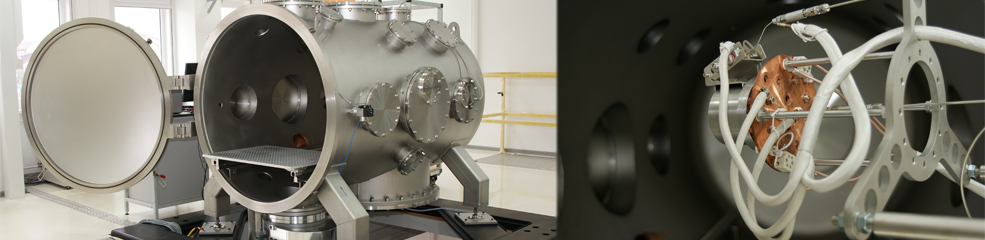
The basic piece of infrastructure is the main vacuum chamber for simulating of space environment, with volume of about 2.5 m3 and diameter of Ø1.2 m equipped with a system of oil-free vacuum pumps: Roots pump with efficiency of up to 450 m3/h, turbomolecular pump with efficiency of about 3000 l/s and a two-stage cryogenic pump with pumping speed of about 30000 l/s for nitrogen, 34000 l/s for xenon and 43000 l/s for krypton (catalog data) – see table below. This system allows to study both Pulsed Plasma Thrusters and Hall Thrusters while supplied with 3-5 mg/s of xenon, dynamically maintaining pressure in the chamber at the level of 5x10⁻⁵ mbar, which is enough to carry out relevant research.
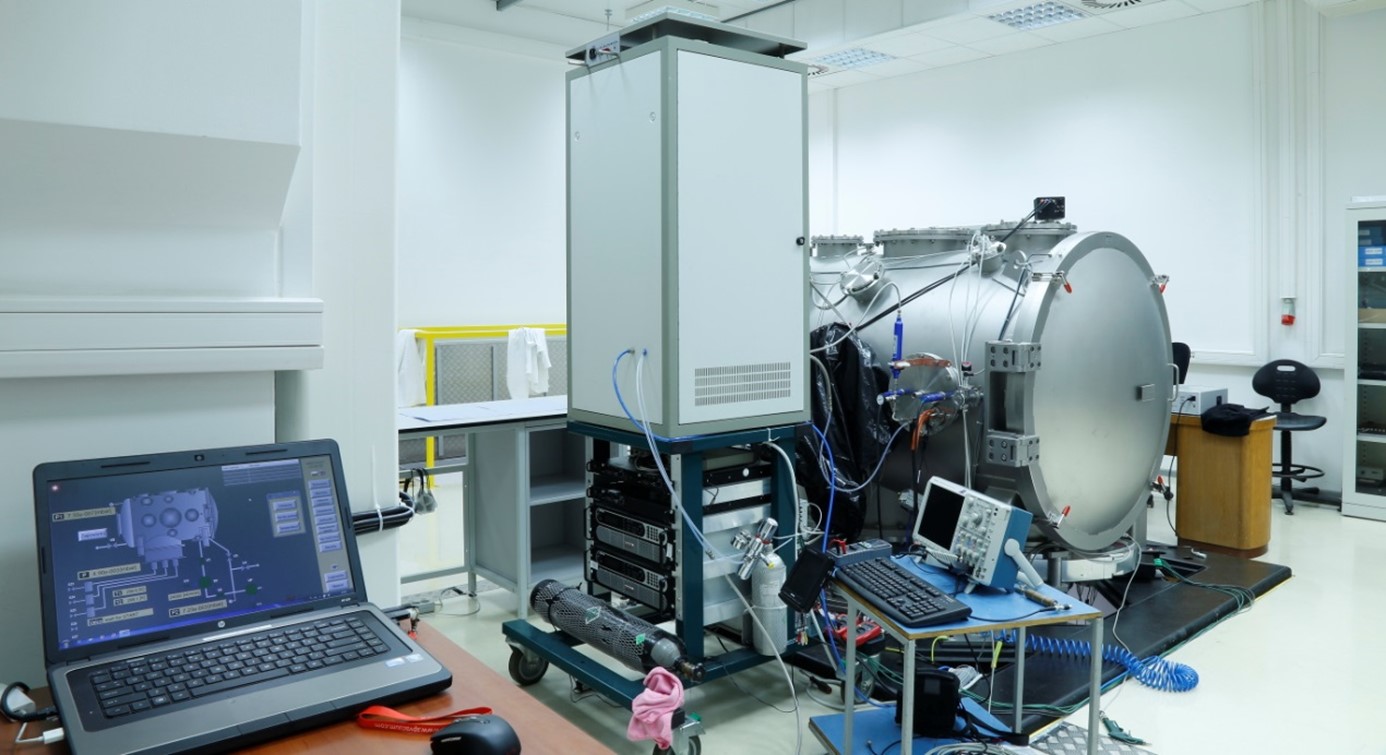 |
| Photograph of IPPLM’s vacuum facility for simulating space vacuum for experiments with PPT and HET plasma thrusters. |
Main parameters of the vacuum facility
|
Main vacuum chamber |
|||
|
Length |
2.3 m |
||
|
Diameter |
1.2 m |
||
|
Volume |
2.5 m3 |
||
|
Pump |
Rate |
Gas |
|
|
Backing pump |
Adixen ACG 600 |
450 m3/h |
Air |
|
TM pump |
Pfeiffer HiPace 3400 MC |
2.8 m3/s |
Air |
|
Cryogenic pump |
HSR Velco 900Xe |
36 m3/s |
Air (N2) |
|
34 m3/s |
Xe |
||
|
43 m3/s |
Kr |
||
Dynamic efficiency of the whole pumping system while working with krypton and xenon is, respectively, 18 m3/s and 14 m3/s, and linearity of the system is illustrated in the plot below, where the ultimate pressure is shown as a function of mass flow rate supplied into the chamber (as with working thruster). With no mass flow rate the vacuum goes down to about 3-5×10⁻⁸ mbar when all pumps are operating, and without the cryogenic pump it rises to about 2-4×10⁻⁷ mbar.
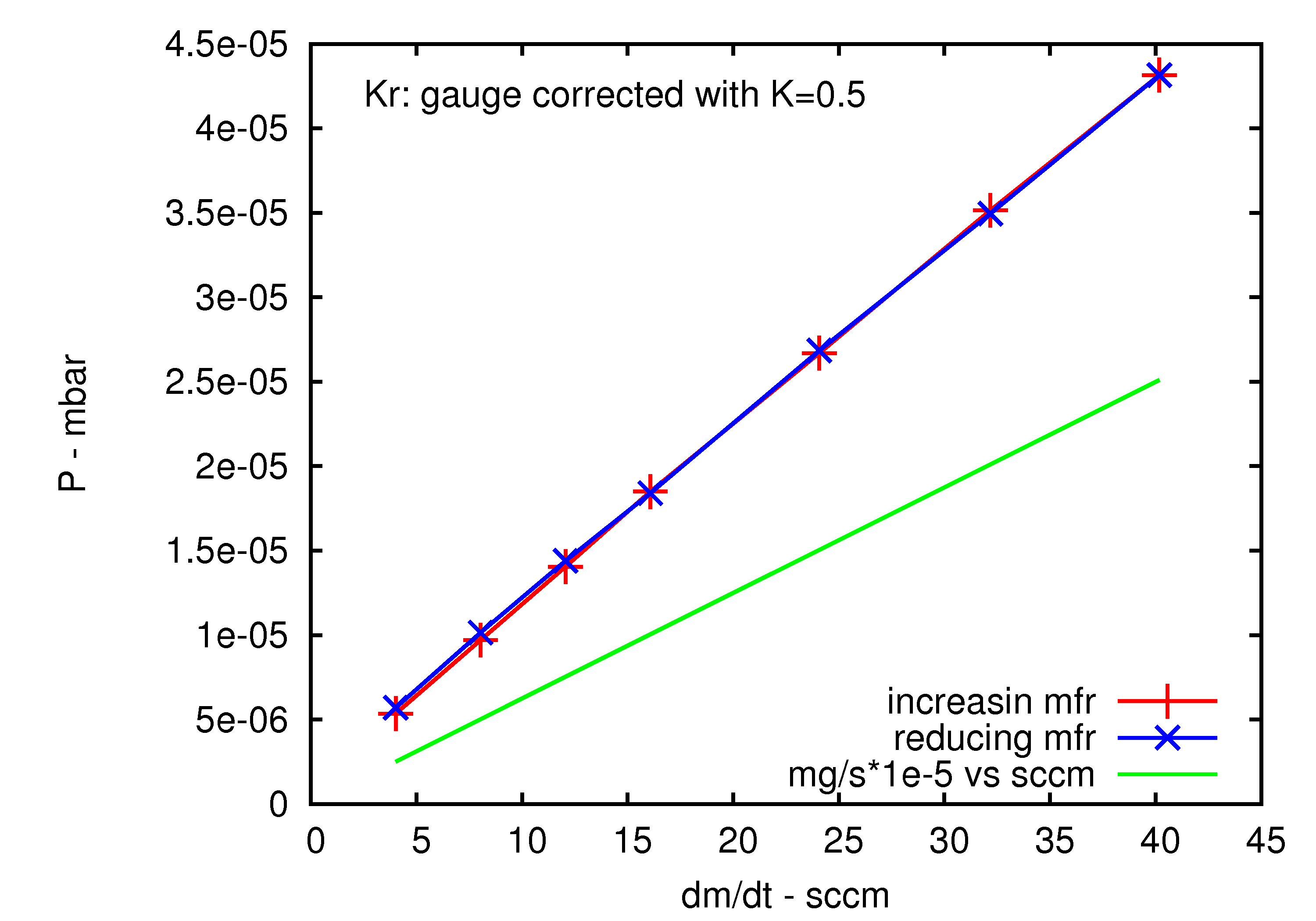 |
| Ultimate pressure in IPPLM’s chamber as a function of krypton mass flow rate supplied into the chamber (measurement with ionization gauge Oerlikon-Leybold ITR 90 Ionivac krypton-corrected) |
Besides the main vacuum chamber, the Laboratory also owns an auxiliary vacuum facility consisting of a chamber with volume of 0.035 m3 and a two-stage pumping system capable of creating vacuum at the level of 5x10⁻⁷ mbar.
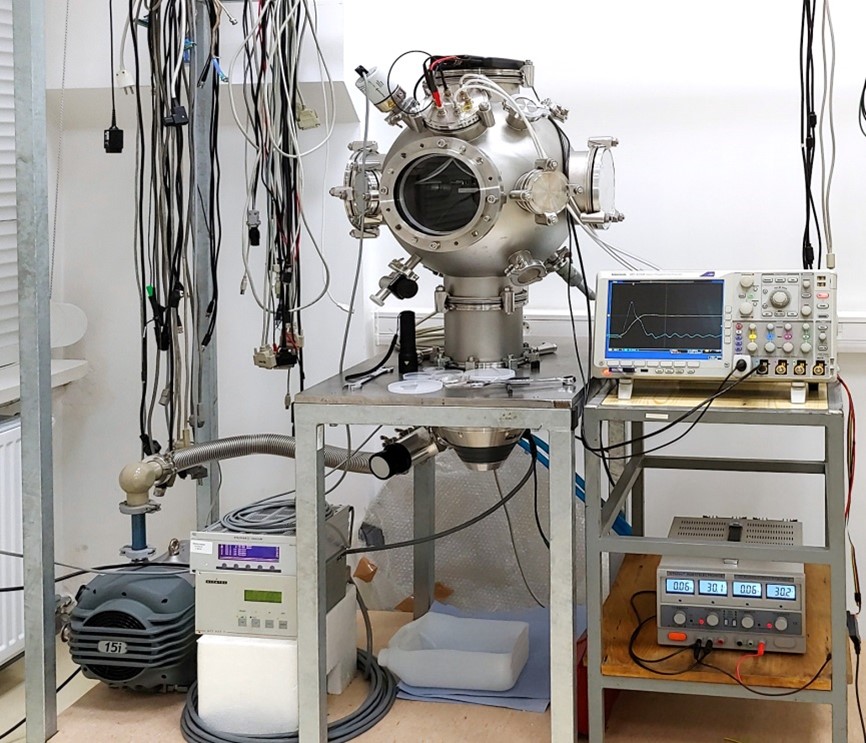 |
| Auxiliary vacuum facility. |
Gas and power supply system
For testing of Hall Thrusters a gas supply system was created relying on mass flow controllers Sierra-Instruments Smart-Trak C100L which can be used for most of inert gases. The range of chosen controllers match the needs of anode and cathode of studied Hall Thrusters (0-50 sccm and 0-6 sccm).
For supplying of the Hall Thruster with electrical power commercial power supplies are used:
Power system
|
Power unit to supply |
Voltage range [V] |
Current range [A] |
|
|
Anode |
Sorensen SGI-1000/5 |
0-800 |
0-6 |
|
Keeper |
Sorensen SGI-800/6 |
0-1000 |
0-5 |
|
Cathode heater |
Sorensen XG 40-21 |
0-21 |
0-40 |
|
Coils |
2x Sorensen XG 20-40 |
0-40 |
0-20 |
|
Filter & protecting diodes |
homemade units |
||
Diagnostics
PlaNS is equipped with a range of diagnostics allowing to comprehensively measure plasma thrusters.
The main one is the thrust balance (produced in the scope of LμPPT project by a Swiss company MECARTEX) operating on the principle of a precise dynamometer. The device is able to measure both thrust in mN range and impulse bits in μNs range by monitoring displacement of the balance and comparing it with calibrating signal.
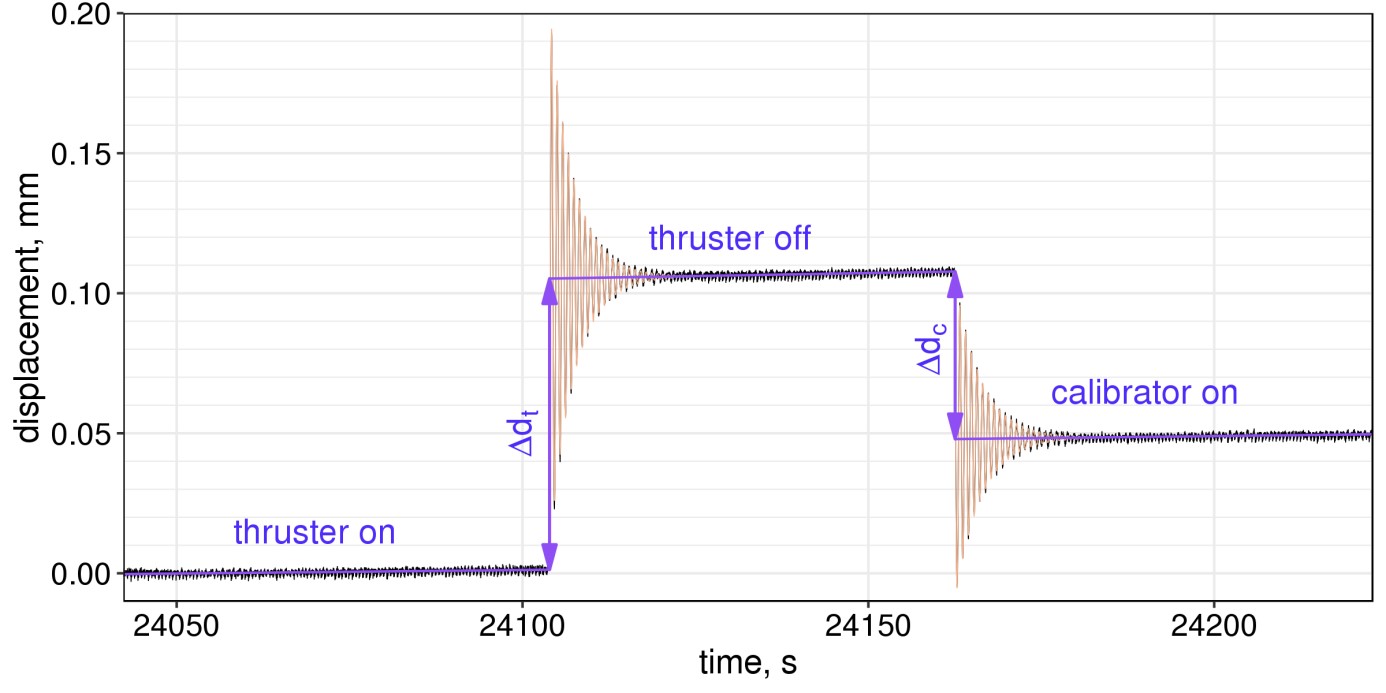 |
| Thrust measurement for Hall Thruster. |
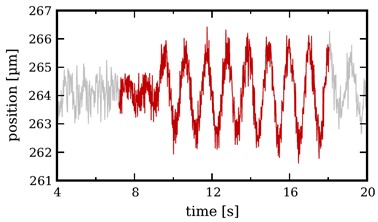 |
| Impulse bit measurement for PPT. |
Apart from that the Laboratory has also plasma diagnostics including Faraday probe, Langmuir probe and Retarding Potential Analyzer. They can be mounted on a special manipulator which allows to carry out measurements of the emitted plasma beam in range from -90o to +90o.
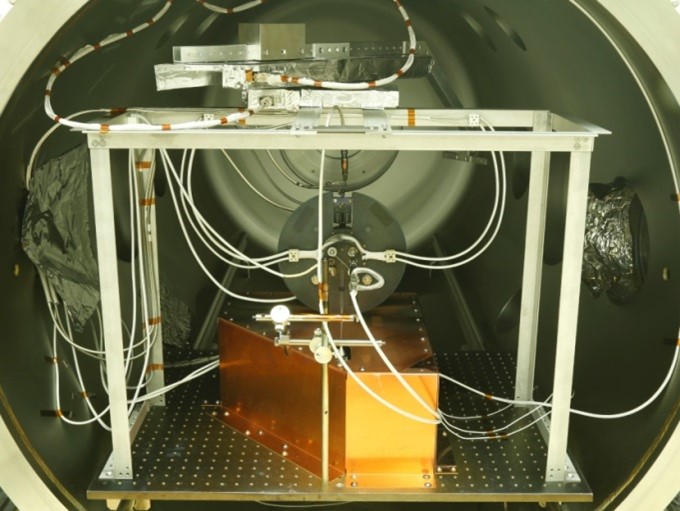 |
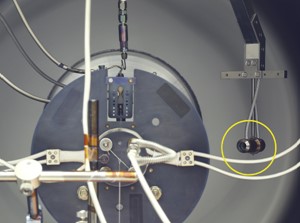 |
| Hall Thruster installed inside the vacuum chamber on the thrust balance. The scaffolding supporting the manipulator for the diagnostics is also visible. |
|
HiPER High Power Electric propulsion: a Roadmap for future
EC/FP7 GA no. 218859
Duration: 1.10.2008 – 31.01.2012
It was a large project with 20 European entities coordinated by Alta SpA, in the scope of which a large 20 kW Hall Thruster with approximately 1 N of thruster was built. The task of the IPPLM was to create a numerical tool HETMAn for simulations of the thruster and to carry out numerical analyses in a wide range of operating parameters of the thruster. Validity of the model was confirmed by experimental results.
LµPPT Innovative Liquid Micro Pulsed Plasma Thruster system for nanosatellites
EC/FP7 GA no. 283279
Duration: 1.11.2011 – 31.10.2014
In the project coordinated by a Spanish company JMP INGENIEROS an innovative method of supplying PPT with liquid, non-volatile propellant was proposed. Two prototypes of laboratory thruster were built and a large increase of performance was demonstrated – almost double improvement of efficiency with respect to similar systems fueled with solid Teflon, with specific impulse of 1000 s and more. Full confirmation of the validity of the concept was obtained, thus ending the project at TRL 3.
Related publications:
(1) S. Barral, J. Kurzyna, E. Remírez, R. Martin, P. Ortiz, J. Alonso, S. Bottinelli, Y. Mabillard, A. Zaldívar, P. Rangsten, C. R. Koppel (2013). Development Status of an Open Capillary Pulsed Plasma Thruster with Non-Volatile Liquid Propellant. 33rd International Electric Propulsion Conference, IEPC-2013-291.
(2) S. Barral, J. Kurzyna, A. Szelecka, H. Rachubiński, E. Remírez, R. Martin, P. Ortiz, J. Alonso, Y. Mabillard, S. Bottinelli, A. Zaldívar, P. Rangsten, C. R. Koppel (2014). First Experimental Characterization of a Pulsed Plasma Thruster with Non-Volatile Liquid Propellant. Space Propulsion Conference 2014, 2980924.
(3) S. Barral, J. Kurzyna, A. Szelecka, H. Rachubiński, D. Daniłko, R. Martín, E. Remírez, P. Ortiz, J. Alonso, Y. Mabillard, S. Bottinelli, A. Zaldívar, P. Rangsten, C. R. Koppel (2015). Time-Of-Flight Spectrometry and Performance of a Pulsed Plasma Thruster with Non-Volatile Propellant. Joint Conference of 30th International Symposium on Space Technology and Science, 34th International Electric Propulsion Conference and 6th Nano-satellite Symposium, IEPC-2015-141/ISTS-2015-b-141.
(4) A. Szelecka, J. Kurzyna, D. Daniłko, S. Barral (2015). Liquid micro pulsed plasma thruster. NUKLEONIKA 60(2):257-261. doi: 10.1515/nuka-2015-0057.
(5) Z. Peradzyński, K. Makowski, J. Kurzyna (2019). Early stage of the discharge in ablative pulsed plasma thrusters. Plasma Sources Sci. Technol. 28, 024001. doi: 10.1088/1361-6595/aaf95e.
KLIMT Krypton Large Impulse Thruster
ESA/PECS GA no. 4000107746/3/Nl/KML
Duration: 1.03.2013 – 15.06.2016
Three subsequent laboratory versions of a 500 W krypton Hall Thruster were created. The tests demonstrated stable work and performance in line with devices of this size and power, both for krypton and xenon. TRL 3 was achieved.
Related publications:
(1) J. Kurzyna, D. Daniłko (2011). IPPLM Hall Effect Thruster – design guidelines and preliminary tests. 32nd International Electric Propulsion Conference, IEPC-2011-221.
(2) J. Kurzyna (2014). Numerical investigation of the Krypton Large IMpulse Thruster. Phys. Scr. 014051. doi: 10.1088/0031-8949/2014/T161/014051.
(3) J. Kurzyna, S. Barral, D. Daniłko, J. Miedzik, A. Bulit, K. Dannenmayer (2014). First Tests of the KLIMT Thruster with Xenon Propellant at the ESA Propulsion Laboratory. Space Propulsion Conference 2014, 2980923.
(4) J. Kurzyna, A. Szelecka, D. Daniłko, S. Barral, K. Dannenmayer, E. Bosch Borras, T. Schönherr (2016). Testing KLIMT prototypes at IPPLM and ESA Propulsion Laboratories. Space Propulsion Conference 2016, 3125256.
(5) A. Szelecka, J. Kurzyna, L. Bourdain (2017). Thermal stability of the krypton Hall effect thruster. NUKLEONIKA 62(1):9-15. doi: 10.1515/nuka-2017-0002.
(6) J. Kurzyna, M. Jakubczak, A. Szelecka, K. Dannenmayer (2018). Performance tests of IPPLM’s krypton Hall thruster. Laser and Particle Beams 36, 105–114. doi: 10.1017/S0263034618000046.
(7) A. Szelecka, M. Jakubczak, J. Kurzyna (2018). Plasma beam structure diagnostics in krypton Hall thruster. Laser and Particle Beams 36, 219–225. doi: 10.1017/S0263034618000198.
HIKHET – 0.5 kW class HET for operation at high voltage with krypton propellant
ESA/PLIIS GA no. 4000122415/17/NL/GE
Duration: 12.01.2018 – 30.04.2021
Project HIKHET – High Impulse Krypton Hall Effect Thruster (funded by the European Space Agency in the scope of Polish Industry Incentive Scheme programme), was aimed to develop a high specific impulse version of the IPPLM’s 500 W class Hall plasma thruster operated with krypton propellant.
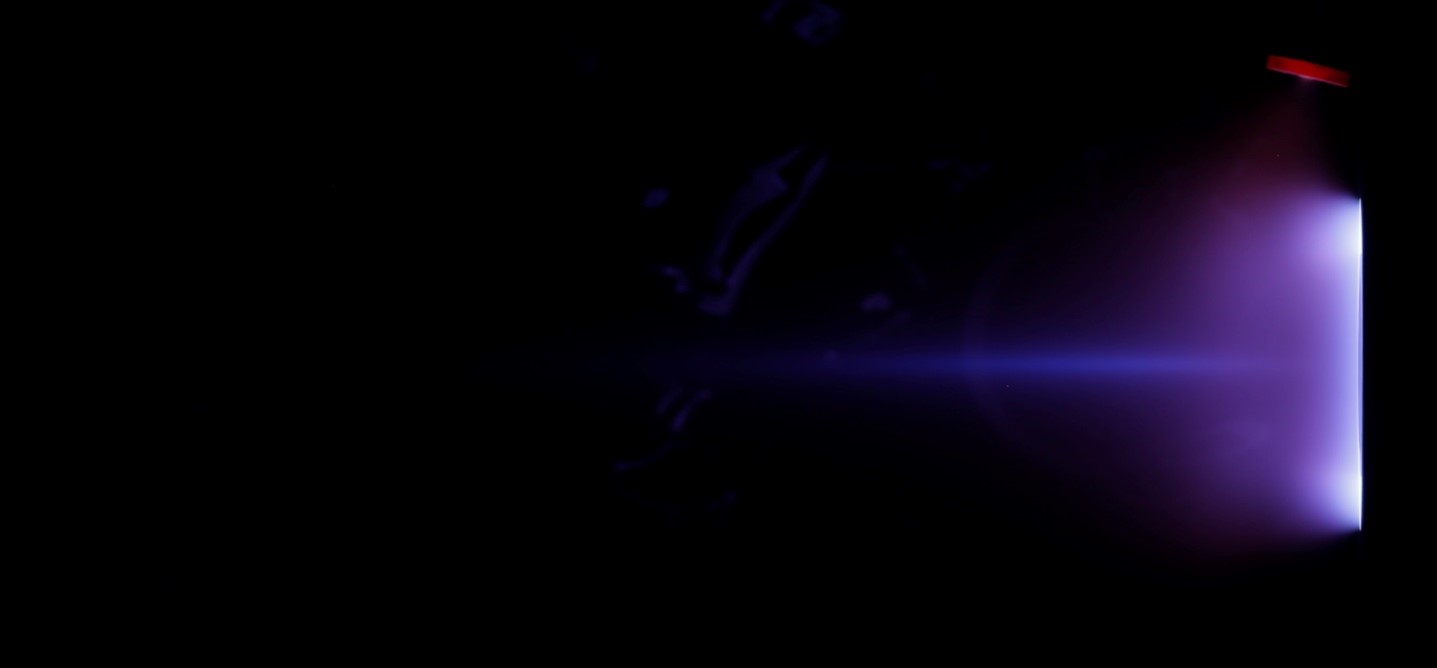 |
| Hall thruster fed with krypton and working in PlaNS Laboratory. |
Specific impulse, i.e. the impulse per one kilogram of the propellant, is a measure of how effectively the propellant available onboard of a satellite is utilized. Since almost all of the new satellites are equipped with a propulsion system which allows them to carry out orbital maneuvers to extend their mission and to finally deorbit, it is the amount of available propellant onboard which largely determines the lifetime of the satellite.
During the 3 years of the project, in PlaNS Laboratory the initial version of the thruster (developed in the scope of the earlier KLIMT project) was enhanced and extensively tested, new diagnostics of the emitted plasma beam were implemented (Faraday Cup and Retarding Potential Analyzer), and an entirely new thruster was designed relying on the results from magnetic field modelling and thermal simulations. The final version of the thruster was tested in a wide range of operating parameters (type of propellant, mass flow rate, discharge voltage, magnetic field strength), showing an increase of the specific impulse from 1400 s to 2600 s and simultaneous efficiency improvement from 20% to 34% (for krypton). Moreover, the new design resulted in operating temperature lower by 100oC and mass reduced by 30%. The achieved performance allows to compete with other Hall thruster of similar power, and makes the IPPLM’s thruster unique in the way of specific impulse production.
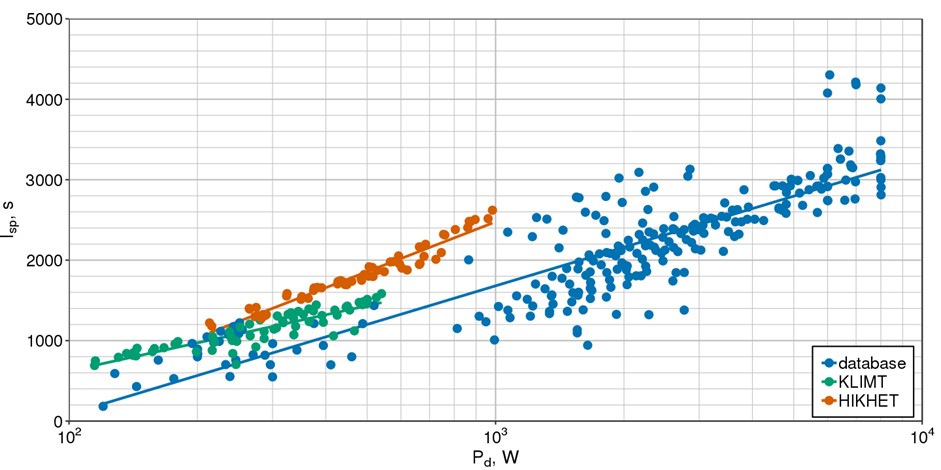 |
| Specific impulse as a function of discharge power – comparison of KLIMT and HIKHET thrusters with other Hall thrusters described in literature (data for krypton). |
Related publications:
(1) J. Kurzyna, M. Jakubczak, A. Szelecka, A. Riazantsev (2019). Preliminary Tests of HIKHET Laboratory Model at IFPiLM. 36th International Electric Propulsion Conference, IEPC-2019-591.
(2) A. Szelecka, M. Jakubczak, A. Riazantsev, A. Jardin, P. Lubiński, J. Kurzyna (2021). Searching for chaotic behavior in the ion current waveforms of a Hall effect thruster. Space Propulsion Conference 2020+1, SP2020_#218.
(3) A. Szelecka, M. Jakubczak, A. Riazantsev, J. Kurzyna (2021), Study of plasma dynamics in HET relying on global thruster characteristics parameterized with discharge voltage, The European Physical Journal Plus 136:782, doi: 10.1140/epjp/s13360-021-01734-z.
(4) M. Jakubczak, J. Kurzyna, A. Riazantsev (2021). Experimental Verification of the Magnetic Field Topography inside a small Hall Thruster. Measurement Science Review 21, 5. doi: 10.2478/msr-2021-0021.
(5) A. Jardin, M. Jakubczak, A. Riazantsev, A. Jardin, J. Kurzyna, P. Lubiński (2022). Searching for Chaotic Behavior in the Ion Current Waveforms of a Hall Effect Thruster. Journal of Fusion Energy 41:20. doi: 10.1007/s10894-022-00331-x.
(6) M. Jakubczak, A. Riazantsev, A. Jardin, J. Kurzyna (2022). Experimental Optimization of Small Krypton Hall Thruster for Operation at High Voltage. 37th International Electric Propulsion Conference, IEPC-2022-360.
(7) A. Riazantsev, Z. Peradzyński, K. Makowski (2022). Parametric Study of Debye Sheath Emergence Using Kinetic Simulations. 37th International Electric Propulsion Conference, IEPC-2022-385.
(8) O. Cichorek, Z. Peradzyński (2025). High and low efficiency subregimes of breathing mode oscillations in Hall thrusters. Physics of Plasmas 32, 022113. doi: 10.1063/5.0232441.
Pulsed plasma thruster for nano and micro satellites
NCBR/POIR umowa nr POIR.01.01.01-00-0857/19
Duration: 01.04.2020 – 31.10.2023
Together with a Polish company Liftero Sp. z o.o. (formerly Progresja Space Sp. z o.o.), IFPiLM took the successful proof-of-concept of the liquid-fed pulsed plasma thruster and developed it further towards commercialization. Designed for nanosatellites, the whole propulsion unit had volume of only 0.5U (electronics and propellant tank included) and power consumption of about 2 W. The performance of the last version was: impulse bit of 18.8 μNs, specific impulse 410 s, thruster efficiency of 3.5% (at 1 J). The thruster successfully carried out almost 1.5 milion discharges.
 |
| Pulsed plasma thruster in 0.5U form and long-exposure photo of its discharge. |
Related publications:
(1) M. Jakubczak, A. Jardin, J. Kurzyna (2024). Analysis of composition and dynamics of the plasma plume emitted by a 1 J pulsed plasma thruster fed with polytetrafluoroethylene and determination of thruster efficiency components. Physics of Plasmas 31, 053501. doi: 10.1063/5.0189700.
(2) A. Riazantsev, M. Jakubczak, O. Cichorek, J. Kurzyna (2024) Side and front fast imaging of solid and liquid fed ablative pulsed plasma thruster’s discharge. Acta Astronautica 225, 583-594. doi: 10.1016/j.actaastro.2024.09.025.
(3) M. Jakubczak, A. Jardin, J. Kurzyna (2024) Plasma plume composition of a pulsed plasma thruster fed with perfluoropolyether, 38th International Electric Propulsion Conference, IEPC-2024-336.
(4) M. Jakubczak, A. Riazantsev, O. Cichorek, A. Jardin, J. Kurzyna, P. Drożdż, T. Palacz, M. Chuchla, R. Łabuz, G. Bywalec (2024) 1J-class Pulsed Plasma Thruster with Non-Volatile Propellant – Revisited. 38th International Electric Propulsion Conference, IEPC-2024-388.
(5) A. Riazantsev, M. Jakubczak, J. Kurzyna (2024) On Retrieval of Inductance and Resistance Dynamics from Experimental Waveforms of a 1 J-class PPT Discharge. 38th International Electric Propulsion Conference, IEPC-2024-797.
(6) M. Jakubczak, A. Riazantsev, O. Cichorek, A. Jardin, J. Kurzyna, P. Drożdż, T. Palacz, M. Chuchla, R. Łabuz, G. Bywalec (2025) Design and performance of a 1 J ablative pulsed plasma thruster fed with non-volatile liquid propellant. Acta Astronautica 228, 813-827. doi: 10.1016/j.actaastro.2024.12.039.
(7) M. Jakubczak, A. Jardin, J. Kurzyna (2025) Plume measurements of a 1 J ablative pulsed plasma thruster fed with non-volatile liquid propellant. Plasma Sources Science and Technology 34, 015010. doi: 10.1088/1361-6595/ada6fe.
Hall Thrusters
Ion Gridded Thrusters and Hall Thrusters are becoming the standard propulsion systems for relatively large satellites (micro and bigger) and have already made a big impact on space exploration in Smart-1 or Deep Space 1 missions, to name only a few. Currently, both technologies utilize xenon as propellant, which is chemically inert, easy to store and handle, and has low ionization cost with respect to other gases. However, for long-term missions the high cost of xenon is problematic, which prompts ESA (and others) to search for alternative propellant with better cost to efficiency ratio. Krypton (which was first suggested more than 20 years ago) shares many of the advantages with xenon, with only slightly higher ionization cost. However, despite several times lower market price, krypton has been used only experimentally because of the relatively poor efficiency of the thrusters in laboratory tests. Procurement of a krypton Hall thruster with increased efficiency would be no small achievement, which could allow the use of plasma thrusters in large interplanetary missions. In the light of current research the improvement of krypton Hall Thruster performance is possible with increased discharge voltage that also results in higher specific impulse which is a goal of its own due to propellant mass savings.
IPPLM’s Hall Thruster with nominal power of 500 W from the beginning had been designed with krypton propellant in mind and all that comes with it, for example the increased thermal loads in comparison with xenon. The reference thruster is the known and considered state-of-the-art SPT-100 with nominal power of 1350 W and discharge channel outer diameter of 100 mm.
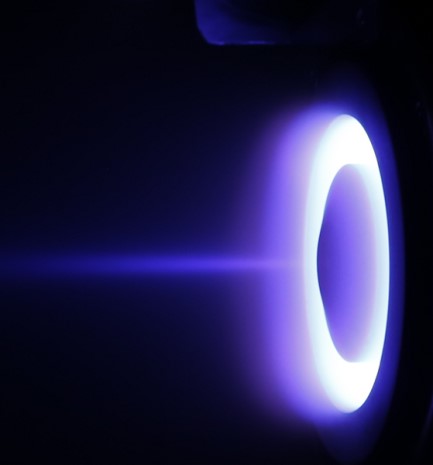
Hall Thrusters belong to the group of electrostatic thrusters operated in continuous manner, for which effective gas ionization and ion acceleration requires a static magnetic field. Neutral gas is supplied through the anode making one end of an annular ceramic channel. The other end of the discharge channel is open. The cathode is positioned outside of the channel so that an axial (mainly) electric field E is produced inside the channel. Gas density is so small that mean ionization length of the atoms is much bigger than the dimensions of the device, which prohibits effective ionization. To remedy this, a radial magnetic field B is produced near the channel exit. Electrons are “trapped” in it and drift azimuthally in the crossed fields E×B (a Hall current is induced), which allows effective ionization of the atoms by collisions with the electrons supplied by an efficient cathode (usually of the hollow type, with its own arc discharge) located outside the channel. Despite the magnetic field, the collisions allow diffusive flow of an electron current towards the anode. However, the magnetic field is weak enough not to noticeably modify the trajectories of the ions, which allows them to obtain in the electric field axial velocities 15-25 km/s. Outside the channel the ions are neutralized by the additional electrons emitted from the same cathode, and in this way travel on as a quasi-neutral plasma stream, preventing the thruster and the satellite from charging. The thruster operates for as long as it is supplied with gas and voltage. The Hall Thruster shown in the photograph is the third version developed in the scope of the KLIMT project and the starting point for the HIKHET project.
|
|
|
 |
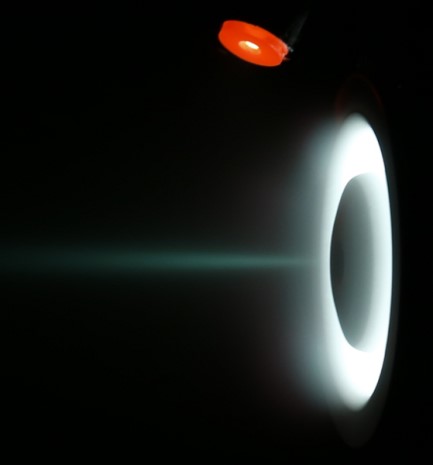 |
| Top: photograph of the third version of KLIMT. Attached is a commercial HeatWaveLabs cathode. Outer diameter of the discharge channel is 50 mm, channel width is 8 mm. Nominal power 500 W. Mass approximately 3 kg. Below is the thruster operating with krypton (left) and xenon (right). |
|
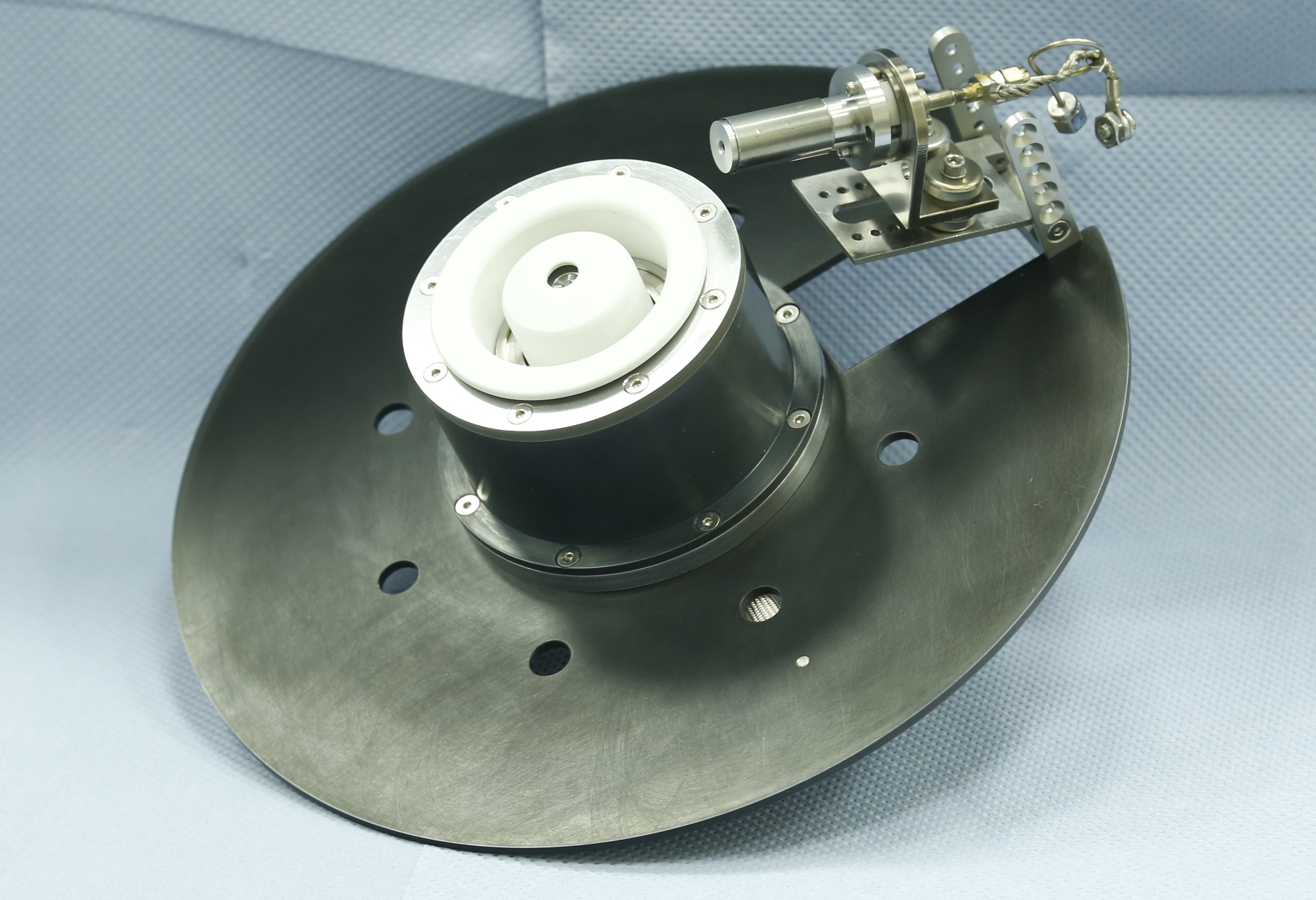


Pulsed Plasma Thrusters
The long-term progress of the smallest satellites assumes that they should have their own means of propulsion allowing for residual drag compensation (they are usually placed in LEO orbits), attitude changes and even orbit changes (spiral orbit rising, deorbit), so should possess functionality available in large satellites for a long time. Due to the limited mass and onboard power (several W) of a nanosatellite on one hand, and the potential total velocity change (ΔV) on the other, choosing the right propulsion type is critical. According to current knowledge, the Pulsed Plasma Thrusters are a good candidate for extending the lifetime of nanosatellites and providing maneuverability, and the thrusters themselves can be improved. It is worth noting that due to the very precise dosage of impulse bits (through repetition) the thrusters of this type can be used also in larger spacecraft when positioning accuracy is important.
Pulsed Plasma Thrusters belong to the group of electromagnetic thrusters in which the mass ablated (pre-ionized cloud of gas) from an insulator (usually Teflon) is accelerated by Ampere force f=j×B acting on current of density j flowing through the plasma produced by electrical discharge between two electrodes supplied from a battery of capacitors. The magnetic field B required to create the force stems from the same discharge current which flows in the circuit. The effectiveness of acceleration of the mass depends on physical properties of the propellant (molecular mass, ionization potential etc.) and its utilization is described by the ratio of accelerated mass to supplied mass.
Innovation of the solution proposed in the scope of the L-μPPT project consist mainly of the use of a liquid fluoropolymer as the propellant with very low vapor pressure (1e-9 mbar) and chemical composition very similar to Teflon that is typically used. Thanks to this it was possible to greatly simplify the design with respect to other devices fed with liquid propellant (water, alcohols and other volatile organic liquids have been proposed), increase the precision of the dispensing unit by using open systems (capillary pumping in open channels), better localize the ablation zone and increase the total mass of the propellant with respect to thrusters using solid polymer. It is also possible to increase the total impulse in comparison to classical systems by increasing utilization of the propellant participating in the discharge. A big advantage is also the possibility to use a common fuel tank for several thrusters when several degrees of motion need to be considered for attitude control. This aspect is mostly interesting in comparison with the systems with solid polymers, where each thruster needs its own block of fuel, which does not allow to compensate its uneven loss in case of unequal demand of the thrusters. Moreover, constant supplying of the propellant into the discharge region prevents changing of the thruster efficiency due to consumption of the Teflon block.
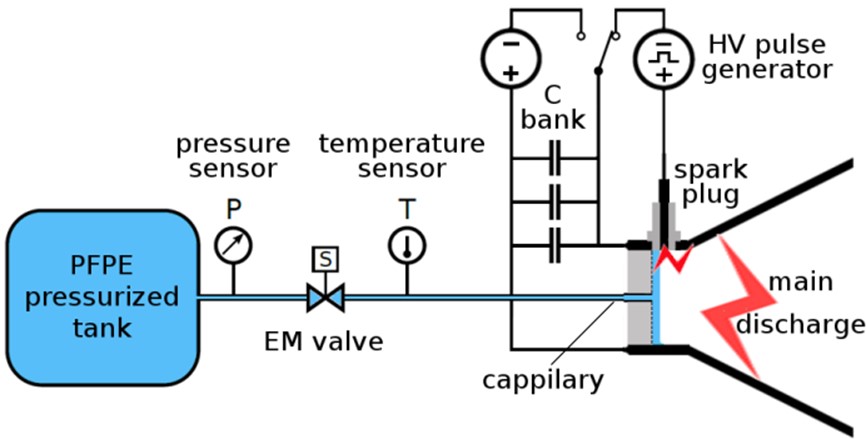
The general scheme of L-μPPT is presented in the figure below. Diverging electrodes of convergent shape are connected to a battery of capacitors and are separated by a ceramic insulator with surface of approximately 1 cm2. Open channel grooved in the insulator connects both electrodes. This channel is filled with fuel (PFPE) through a capillary which constitute the end of the supply system consisting of a tank, a micro-pump and a valve. In the figure, there are also shown temperature and pressure sensors. The voltage to which the battery is charged (750-1500 V) is insufficient to ignite the discharge on the surface of the propellant filling the channel. That is why to initiate the main discharge an additional igniter system is used, supplied from a pulsed high voltage generator (10-20 kV), like in classical Teflon thrusters. Therefore, the use of the igniter allows one to control the initiation of the discharge according to the demand, whereas the provided propellant, together with a fully charged battery, awaits in the channel without outgassing (like in thrusters with solid polymer).
 |
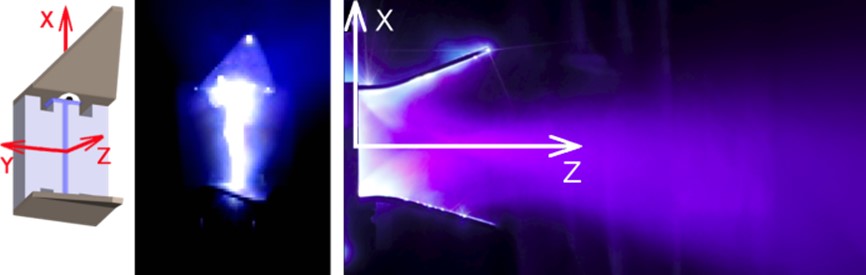 |
| Scheme of L-μPPT, view of the electrodes and the channel filled with propellant and photographs of discharge on the insulator surface and the propagating plasma. |
Local News
- 1
- 2
- 3
- 4
- 5
ITER included in the Polish Roadmap for Research Infrastructures
11-08-2026

The Ministry of Science and Higher Education has published an updated Polish Roadmap for Research Infrastructures, which now includes ITER. The application for this international research infrastructure to be included...
Read moreProf. Toshimori Sekine visits IPPLM
07-08-2026

On 30 July 2026, the Institute of Plasma Physics and Laser Microfusion (IPPLM) welcomed Prof. Toshimori Sekine, affiliated with the Center for High Pressure Science and Technology Advanced Research (HPSTAR)...
Read moreIPPLM launches a new science outreach project
23-07-2026

In July 2026, the Institute of Plasma Physics and Laser Microfusion (IPPLM) signed an agreement with the Ministry of Science and Higher Education to implement the project "Fusion: Science Powering...
Read moreMinistry of Energy delegation visits IPPLM
20-07-2026

On 16 July 2026, a delegation from the Ministry of Energy visited the Institute of Plasma Physics and Laser Microfusion (IPPLM) as part of the quarterly meetings between the Institute’s...
Read moreIPPLM research visit to Japan’s National Institute for Fusion Science
10-07-2026

From 13 to 23 June 2026, IPPLM Director Dr hab. Monika Kubkowska, Dr Tomasz Fornal and Dr Łukasz Syrocki took part in a research visit to Japan’s National Institute for...
Read moreIPPLM researchers visit IPPL in Greece
26-06-2026

From 25 May to 3 June 2026, researchers from the Institute of Plasma Physics and Laser Microfusion (IPPLM) took part in a research visit to the Institute of Plasma Physics...
Read moreIPPLM at the 4th "Science for Society – Society for Science" Congress
23-06-2026

On 14–15 June 2026, the University of Warsaw hosted the 4th edition of the "Science for Society" Congress, held under the theme "Society for Science". The event brought together representatives...
Read moreIPPLM involved in the development of diagnostics for the JT-60SA tokamak
19-06-2026
We are pleased to celebrate an important step in international scientific cooperation: the successful delivery of the advanced Divertor Vacuum Ultra Violet (DivVUV) spectrometer system for the JT-60SA tokamak in...
Read moreInternational Fusion Community Meets at the 18th Kudowa Summer School
18-06-2026

The 18th Kudowa Summer School "Towards Fusion Energy", organised every two years by the Institute of Plasma Physics and Laser Microfusion (IPPLM) and the National Contact Point EURATOM-FUSION, has come...
Read moreDr Agnieszka Jardin from IPPLM awarded NCN SONATA 21 grant
17-06-2026

Dr Agnieszka Jardin from the Department of Thermonuclear Plasma Research and Space Technologies has been awarded a grant from the National Science Centre, Poland, under the SONATA 21 call for...
Read moreIPPLM employee joins the Management Committee of COST Action CA23151
01-06-2026
Dr hab. Katarzyna Batani from the Institute of Plasma Physics and Laser Microfusion (IPPLM) has become a member of the Management Committee of COST Action CA23151 – Mediterranean Cancer Screening...
Read moreThe Polish CeNTE Consortium has been granted observer status in the DONES programme
28-04-2026
The DONES programme is one of the key European initiatives supporting the development of fusion energy and research in plasma physics. It is now entering a further stage of institutional...
Read moreIPPLM joins the Enterprise Europe Network
31-03-2026
On 23 March 2026, the Institute of Plasma Physics and Laser Microfusion (IPPLM) joined, with its technological offer, the group of entities affiliated with the Enterprise Europe Network (EEN), interested...
Read moreIPPLM as a co-creator of the exhibition "E = mc² – the formula that changed the world" at the National…
18-02-2026

On 16 February 2026, the official opening of two new permanent exhibitions took place at the National Museum of Technology in Warsaw. The Institute of Plasma Physics and Laser Microfusion...
Read moreIPPLM supports children and young people at the TPD "Helenów" Centre
22-12-2025

The Sylwester Kaliski Institute of Plasma Physics and Laser Microfusion (IPPLM) has for many years been actively engaged in initiatives supporting children and young people supported by the TPD "Helenów"...
Read moreIPPLM researchers took part in an experimental campaign on the GEKKO XII laser
20-11-2025

On 10–14 November 2025, a research team from the Sylwester Kaliski Institute of Plasma Physics and Laser Microfusion (IPPLM) – Prof. Katarzyna Batani, Dr Hanna Marchenko and Dr Agnieszka Zaraś-Szydłowska...
Read moreRegister for the 18th Kudowa Summer School on Plasma Physics!
07-11-2025

We invite you to take part in the 18th Kudowa Summer School "Towards Fusion Energy", which will be held on 8–12 June 2026 in Kudowa-Zdrój, Poland. The event is organised...
Read moreIPPLM participated in the second technical meeting within the DONES Con-P1 project
17-10-2025
The Institute of Plasma Physics and Laser Microfusion (IPPLM) took part in the second technical meeting held as part of the DONES Consolidation Phase 1 (DONES ConP1) project, co-financed by...
Read moreProf. Jan Badziak from IPPLM among the World’s Top 2% Scientists
15-10-2025
Prof. Jan Badziak, from the Department of Laser Plasma and Magnetized Dense Plasma Physics at the Institute of Plasma Physics and Laser Microfusion (IPPLM), has been included in the prestigious...
Read more29th Science Festival with the participation of IPPLM
10-10-2025

During the 29th Science Festival in Warsaw, held on 19–28 September 2025, researchers from the Institute of Plasma Physics and Laser Microfusion (IPPLM) conducted lessons for upper-grade primary school students. The...
Read morePLASMA 2025 and the 20th Anniversary of the Euratom–IPPLM Association – event summary
26-09-2025

From 15 to 19 September 2025, Warsaw hosted the international scientific conference PLASMA 2025 – International Conference on Research and Application of Plasmas, dedicated to plasma research, diagnostics, and applications....
Read moreWe bid farewell with deep sorrow to Professor Jerzy Wołowski
25-09-2025

It is with great sadness that we have received the news of the passing of Professor Jerzy Wołowski (1936–2025) an outstanding physicist, long-time employee of the Institute of Plasma Physics...
Read more20th anniversary of the Euratom–IPPLM Association (CeNTE): Celebrating two decades of fusion research coordination
16-09-2025

On 19 September 2025, during the PLASMA 2025 International Conference on Research, Diagnostics and Applications of Plasma in Warsaw, the IPPLM will mark 20th anniversary of the coordination of research on nuclear fusion...
Read moreIPPLM at the 49th Congress of Polish Physicists in Katowice
13-09-2025
During the 49th Congress of Polish Physicists, held from September 5–11, 2025, in Katowice, the Institute of Plasma Physics and Laser Microfusion (IPPLM) was represented both among the speakers and...
Read moreProf. Agata Chomiczewska appointed Deputy Director for Scientific Affairs at the IPPLM
03-09-2025

We are pleased to announce that the Minister of Energy, Mr. Miłosz Motyka, has appointed Dr. hab. Agata Chomiczewska to the position of Deputy Director for Scientific Affairs at the...
Read moreWorld News
- 1
- 2
- 3
- 4
- 5
In Memoriam — Professor Francesco Romanelli
24-03-2026

The world of fusion research mourns the loss of Professor Francesco Romanelli, a visionary scientist whose work helped bring humanity closer to clean, limitless energy. Over four decades, he explored...
Read moreIgniting the future: Breakthroughs in inertial confinement Fusion
25-07-2025

In December 2022, the National Ignition Facility (NIF) at Lawrence Livermore National Laboratory (USA) marked a historic milestone in fusion science: an experiment produced 3.15 MJ of fusion energy from 2.05 MJ of laser...
Read moreWendelstein 7-X sets new fusion performance records
04-06-2025

On May 22, 2025, the Wendelstein 7-X (W7-X) stellarator at the Max Planck Institute for Plasma Physics (IPP) in Greifswald concluded its latest experimental campaign with a major success: a...
Read moreEuropean tokamak sets new fusion plasma record
20-02-2025

On February 12, 2025, the WEST tokamak, located at CEA Cadarache in southern France, set a new world record by sustaining fusion plasma for 1,337 seconds, or over 22 minutes....
Read moreDr. Gianfranco Federici appointed as the new EUROfusion Programme Manager
17-12-2024
At the 49th General Assembly held in Barcelona, December 2024, Dr. Gianfranco Federici was elected as the new Programme Manager of EUROfusion. He succeeds Prof. Ambrogio Fasoli, who will return...
Read moreEUROfusion and F4E join forces for Europe’s fusion future
16-12-2024

EUROfusion and Fusion for Energy (F4E) have signed a Memorandum of Understanding (MoU) to advance fusion research and development in Europe. This agreement reinforces cooperation in...
Read moreJohn J. Hopfield and Geoffrey E. Hinton awarded the 2024 Nobel Prize in Physics
08-10-2024

John J. Hopfield and Geoffrey E. Hinton have been awarded the 2024 Nobel Prize in Physics "for foundational discoveries and inventions that enable machine learning with artificial neural networks." The Nobel...
Read moreWendelstein 7-X begins new experimental campaign
10-09-2024

The Wendelstein 7-X, the world’s most advanced stellarator, is launching a new experimental campaign after a year of intensive maintenance and upgrades. This phase, known as OP2.2, begins on 10...
Read moreITER's New Project Baseline: A Robust Path to Fusion Energy Research
04-07-2024

On 3 July, ITER Director-General Pietro Barabaschi presented the new project baseline, under evaluation by the ITER Organization's governing body. This plan aims to ensure a robust start to scientific...
Read moreITER Council Presents Updated Project Baseline
21-06-2024

The ITER Council convened this week for its 34th meeting, where nearly 100 attendees reviewed significant updates to the project baseline. The proposed changes aim to optimize the overall project...
Read moreEurope and Japan celebrate breakthrough in paving the way for fusion energy
01-12-2023

The prospect of harnessing fusion energy is closer. The successful operation of JT-60SA, the most powerful experimental device to date, built by Europe and Japan, is a landmark achievement for...
Read moreFirst plasma was successfully generated at JT-60SA
26-10-2023

A momentous achievement in the field of nuclear fusion has been accomplished by a collaborative team of engineers from Europe and Japan. They have successfully generated tokamak plasma for the...
Read moreThe Nobel Prize in Physics 2023
03-10-2023
Pierre Agostini, Ferenc Krausz and Anne L’Huillier are the winners of this year's Nobel Prize in Physics. It was awarded "for experimental methods that generate attosecond pulses of light for...
Read moreUS Lab Replicates Fusion Ignition Breakthrough
08-08-2023
The US National Ignition Facility (NIF) has achieved fusion ignition once again, building on its landmark 2022 success. This achievement, powered by hydrogen within a diamond capsule, signifies a major...
Read moreNew Programme Manager Elect announced by EUROfusion
20-07-2023
Professor Ambrogio Fasoli became the new EUROfusion Programme Manager Elect. The decision was made by EUROfusion General Assembly at the meeting on 18 July 2023. His tenure will officially commence...
Read moreEUROfusion stands in solidarity with research in Ukraine
24-02-2023

Today, as we commemorate the anniversary of the invasion of Ukraine by Russia, the EUROfusion consortium stands in solidarity with our Ukrainian member and research colleagues. EUROfusion remains committed to supporting...
Read moreEight-minute production of plasma with gigajoule energy turnover at Wendelstein 7-X
23-02-2023

Another target has been achieved only recently by the W7-X researchers, namely they managed to acquire an energy turnover of 1.3 gigajoules in the device, which is 17 times higher...
Read moreThe Nobel Prize in Physics 2022
04-10-2022

Alain Aspect, John F. Clauser and Anton Zeilinger are the winners of this year's Nobel Prize in Physics. It was awarded “for experiments with entangled photons, establishing the violation of...
Read moreNew experiments for fusion energy record breaker JET
27-09-2022

A new wave of fusion energy experiments on UK Atomic Energy Authority’s record-breaking Joint European Torus (JET) started this month. EUROfusion researchers are using the famous JET machine to conduct a...
Read moreITER appoints new Director-General
21-09-2022
Pietro Barabaschi has become the next Director-General of the ITER Organization as a result of the unanimous choice of the Council from among finalist candidates. In the transition period Dr....
Read moreStarting power plant design
07-07-2022

At a livestreamed Horizon EUROfusion event in Brussels on 5 July 2022, EUROfusion celebrated the start of conceptual design activities for Europe's first demonstration fusion power plant DEMO. This first-of-a-kind...
Read moreCelebration of achieving a crucial assembly milestone in the ITER Project
17-05-2022

This month, we have witnessed the successful lifting and lowering into the machine well of the first sub-section of the ITER plasma chamber. The weight of the component is the...
Read moreBurning plasma achieved in inertial fusion at the National Ignition Facility
15-02-2022
Obtaining a burning plasma is a critical step towards self-sustaining fusion energy. A burning plasma is one in which the fusion reactions themselves are the primary source of heating in...
Read moreHistoric milestone reached by JET scientists
20-01-2022

Iconic fusion energy machine JET – which reaches controlled temperatures 10 times hotter than the core of the sun – completed its 100,000th live pulse last night. Weighing 2,800 tonnes, the...
Read moreHorizon Europe Grant Agreement signed
20-12-2021

15 December 2021 saw the EUROfusion consortium signing the Grant Agreement under Horizon Europe, the European Framework Programme from 2021 – 2027, in an aim to launch comprehensive R&D approach...
Read more |
 |
 |
 |
 |
 |
 |
 |
What we do
Our laboratories
Online seminars
| Tuesday, 20 Oct 2026, godz. 11.00 Seminarium Sekcji Fizyki Plazmy PTF: "Unified scaling for far-SOL density decay in JET H-mode plasmas", dr Christian Perez von Thun, IFPiLM |
| Thursday, 22 Oct 2026, godz. 13.00 Seminarium instytutowe: "Integrated Modelling of H-mode Plasma in COMPASS Upgrade with a Liquid Gallium Divertor", dr Michał Poradziński, IFPiLM |


Research projects carried out at the IPPLM are funded by the Polish Ministry of Education and Science, the National Science Centre and by the European Commission within the framework of EUROfusion Consortium under grant agreement No 101052200. Financial support comes also from the International Atomic Energy Agency, European Space Agency and LaserLab Consortium as well as from the Fusion for Energy Agency.