





Zestaw obrazów 2019
zdjecie1.jpg
zdjecie2.jpg
zdjecie3.jpg
zdjecie4.jpg
zdjecie5.jpg
zdjecie6.jpg
2019_1.JPG
2019_2.JPG
2019_4.JPG

Gallery
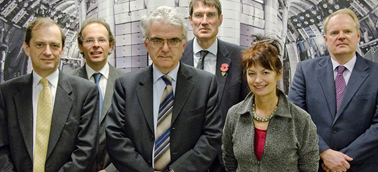 The European Commission’s Chief Scientific Advisor has praised JET’s achievements during a visit there last week. Professor Anne Glover, a biologist by training, commented that she “very much enjoyed my visit to Culham and found the tour of the torus hall inspirational.” Professor Glover is particularly passionate about public engagement – the perception of scientists by the public, and the need for inspiring stories were some of the many topics of discussion with the hosts from JET, Francesco Romanelli, Steve Cowley, Tim Jones, Lorne Horton and Duarte Borba. “Bringing the Sun down to Earth is a good example of the amazing achievements of science,” said Professor Glover, “and we can all be inspired by these outstanding advances in delivering fusion energy.”
Source: EFDA
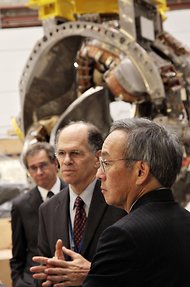 Stewart C. Prager, the director of the Department of Energy’s Princeton Plasma Physics Laboratory and a professor of astrophysical sciences at Princeton University, here offers a fresh defense of continued substantial support for research on extracting usable energy from nuclear fusion.
His “Your Dot” contribution builds on a recent fusion post by Burton Richter, a Nobelist in physics and author of a valuable book on energy, and another from Robert L. Hirsch, who directed the country’s fusion energy program in the 1970s. Here’s Prager’s post:
The Way Forward with Magnetic Fusion Energy
By Stewart C. Prager, Princeton Plasma Physics Laboratory
As budget negotiations heat up, so does the debate over the balance between investments in the long-term future and short-term necessities. Fusion is a long-term opportunity that will transform how we energize our society. The fact that ignition in a large American experimental inertial confinement fusion facility did not occur as hoped by Sept. 30 has sadly raised questions about the scientific legitimacy of that pursuit. That the scientists did not meet their goal by that day probably has little bearing on that field’s ultimate success. Importantly, this non-event should not bear any relation to the fate of other vital work centering on an entirely different approach known as magnetic fusion.
We need to keep our eyes on fusion as a transformative source of energy for the world. There are many powerful reasons why we need to forge ahead.
The magnificent lasers at the Lawrence Livermore National Laboratory’s National Ignition Facility are aimed to compress a pellet of fusion fuel such that it “ignites” – converts the energy of the lasers that bombard the pellet into fusion energy. The lasers work spectacularly well but the problem of fusion ignition is scientifically rich and complex. So far at least, the pellets have not yet behaved as expected and the milestone of ignition has not yet been achieved. This, of course, should not dull interest in the American inertial confinement fusion program: Not achieving a major scientific result by a pre-determined and artificial deadline is far from a failure.
Further, the fact that conquering this complex problem in laser fusion has not been “on schedule” has nothing to say about progress in magnetic fusion – it has been and continues to be remarkable.
Those with a long memory will recall the very early optimism about fusion energy that existed in the late 1950s and 1960s. On the heels of the quick success in moving fission energy forward, it was thought practical fusion would follow closely behind. Instead, the world’s scientists ran into an unexpected barrier — the immense physics complexity and seeming impossibility of taming fusion plasmas.
The ensuing decades have seen an intense scientific focus on what is truly a grand scientific challenge. Scientists now are teasing out the secrets of complex multi-scaled layers of turbulence in plasmas, the movement of particles through those plasmas, their interaction with magnetic fields, and numerous other phenomena that impact the plasma’s ability to be harnessed as an energy source. This focus in magnetic fusion has driven the development of a new scientific field, plasma physics, with huge benefits for science in general – from understanding cosmic plasmas to employing these hot, ionized gases for computer chip manufacturing.
On the energy front, we have advanced from fusion energy production of milliwatts in the 1970s to 16 megawatts (for a duration of 1 second) in the 1990s. With our existing underpowered machines, magnetic fusion scientists are producing and producing close to fusion energy-grade plasmas around the world on a daily basis. We are confident that abundant fusion energy can be produced on a very large scale and are now focused on the remaining physics and engineering challenges to make it practical and attractive.
The next major experimental step in magnetic fusion is ITER – the international experiment that will generate 500 megawatts of fusion power, at a physical scale of a power plant. Under construction in France, ITER will begin operation within ten years. It involves participation of the entire developed world, with the ITER partners representing the governments of half the world’s population. The scientific basis for ITER was separately scrutinized and approved by scientific panels in each of these nations. ITER is large, complex, and full of challenges. But, the likelihood of scientific success is high.
Most nations involved in ITER have robust fusion research programs that are essential to tackle other key scientific and technical issues. With these accompanying programs, we would be ready to operate a demonstration fusion power plant following ITER about 25 years from today.
The charge by some that both inertial and magnetic fusion have been beset with failure is unwarranted. These include remarks in a commentary by Dr. Burton Richter in the Oct. 18 Dot Earth blog: “Both approaches have gone from failure to ever larger failure, but each time a great deal has been learned…”
In fairness, the comment is preceded by brief, informative technical capsules. As a fusion-knowledgeable scientist who does not work in fusion energy research, Dr. Richter includes some supportive comments for the fusion program, tempered by discerning skepticism. But, for fusion scientists, Dr. Richter’s comments on failure are difficult to understand. We are unaware of any major project failures in magnetic fusion research. Quite the opposite: One of the key reasons that ITER was funded across the world is that a series of ever larger experiments have been so successful as to provide confidence that the yet larger ITER will be similarly successful.
Other commentary has appeared, offering incorrect information. In a separate Dot Earth commentaryconcerning magnetic fusion on Oct. 19, Dr. Robert Hirsch, an administrator of the fusion energy program at the U.S. Atomic Energy Commission in the 1970s, offers views reflecting the state of the field at the time of his departure from the AEC some 35 years ago. His view is framed by stating that fusion must be made practical, which means economically and technologically attractive. This is certainly correct and indeed, the criteria for such practicality have provided significant guidance to fusion research for decades. Dr. Hirsch cites a series of challenges that he thinks are roadblocks, but are not. He worries that the energy stored by superconducting magnets poses a serious threat and regulatory burden. This is not so. ITER has proven otherwise. France’s strict nuclear regulatory authorities have concluded the magnets pose no radiological safety concerns for the public. Dr. Hirsch states that the radioactive materials of a fusion reactor will be a major problem. This also is not so. The amount and toxicity is orders of magnitude less than for fission. Dr. Hirsch would be interested to learn that the rigorous French licensing regime is very successfully nearing completion. Licensing, although requiring significant efforts, will not be a barrier to fusion.
Some, like Dr Hirsch, have suggested that fusion machines are so large and complex that they will never be cost competitive. No one knows the ultimate costs, but our best engineering analyses indicate that, with some luck, fusion can indeed be cost- competitive. As an alternative to the mainline approaches to fusion energy, Dr. Hirsch puts forth his research idea from the 1970s of inertial electrostatic confinement (IEC). I agree that the fusion program very much needs to pursue multiple approaches, even within magnetic fusion. But extensive peer review has found IEC far more difficult to achieve than the ITER and related approaches in magnetic fusion.
Fusion is a nearly ideal energy source – essentially inexhaustible, clean, safe, and likely available to all nations. When proven practical, it will transform our energy future. At this moment, research investment by the rest of the world – China, Korea, the EU – is surging in magnetic fusion, while the U.S. investment is stagnating. The U.S. is at a turning point. We either maintain our long-developed leadership position in this energy and science frontier, or slip behind as other nations take the fruit of decades of scientific research – much of it from the U.S. – and convert it into a practical energy source for powering the world.
Source: The New York Times
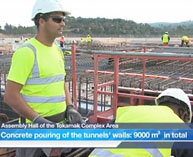 Our October clip offering an overview of the works carried out on the ITER construction site has just been released. We report on the progress of the site adaptation works and the Assembly Hall of the Tokamak complex area.
The excavation works for the sanitary and secondary precipitation drainage systems are advancing according to schedule together with the foundations of the modular buildings. The the Assembly Hall of the Tokamak area, with a slab measuring 5,400m2 and a volume of 1,400 tonnes of steel in total for reinforcement activities, are also documented.
Source: F4E
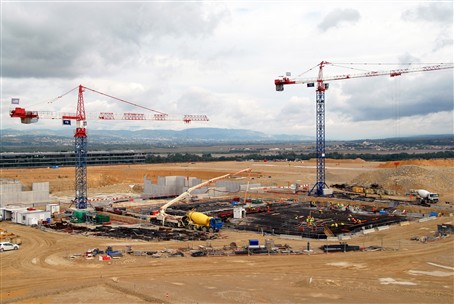 On the ITER platform, work is progressing well on the Assembly Hall of the Tokamak complex area.
This 57 metre high building, located next to the Tokamak pit, will host the two 750 tonnes cranes that will assemble the components of the ITER machine.
On 20 September 2012, the first structural concrete was poured in one of the three galleries by GTM (VINCI Group contractor). It was considered a big step forward linked to the foundations works.
It all started back in April 2012, where 500 boreholes (soil investigations to detect any void in the rock) preceded the impressive phase of excavation. Scrapers and shovels dug to 2.5 metres deep to extract close to 12,000 m3 of soil. During summer, the blinding concrete pouring activities kicked off in order to flat level the surface and make way for the reinforcement activities that will end up using 1,400 tonnes of steel! The foundations works are expected to end by March next year.
The basemat design, measuring 2.2 metres thick in the perimeter and 1.2 metres thick in the centre, integrates openings for electrical galleries, drainage, piping and tunnels that will be connected to the Tokamak complex building. According to Miguel Curtido, F4E’s Technical Project Officer, “it will be the first time that we will have to coordinate the work of two contractors working in parallel and very close proximity in order to be comply with our planning”. In fact, other tunnels and precipitation drainage activities will be performed in parallel with works on the Assembly Hall foundations. ‘’Good coordination will be one of the daily challenges for the next years due to the complexity of the project and our commitment to deliver on time‘’ he added.
Source: F4E
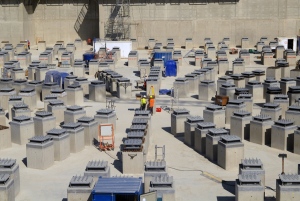 Contracting woes may cause further delays for €15 billion ITER effort.
The world's largest scientific project is threatened with further delays, as agencies struggle to complete the design and sign contracts worth hundred of millions of euros with industrial partners, Nature has learned.
ITER is a massive project designed to show the feasibility of nuclear fusion as a power source. The device consists of a doughnut-shaped reactor called a tokamak, wrapped in superconducting magnets that squeeze and heat a plasma of hydrogen isotopes to the point of fusion. The result should be something that no experiment to date has been able to achieve: the controlled release of ten times more energy than is consumed.
That's the dream. But so far, ITER has been consuming mostly money and time. Since seven international partners signed up to the project in 2006, the price has roughly tripled to around €15 billion (US$19.4 billion), and the original date of completion has slipped by four years to late 2020. Many of the delays and cost increases have come from an extensive design review, which was completed in 2009 (see 'Fusion dreams delayed').
Now, sources familiar with the project warn that the complex system for buying ITER's many pieces could put the project even further behind schedule. Rather than providing cash, ITER's partners have pledged 'in kind' contributions of pieces of the machine. Magnets, instruments and reactor sections will arrive from around the world to be cobbled together at the central site in St-Paul-lès-Durance in southern France. Because no one body holds the purse strings, designs for the machine's components face a tortuous back-and-forth between the central ITER Organization and national 'domestic agencies', which ensure that local companies secure contracts for ITER's components.
Nowhere is the problem more pronounced than the tokamak, the central structure that will eventually house ITER. The construction of the building is meant to be contracted out by Fusion for Energy (F4E), Europe's domestic agency. But the ITER Organization could not tell the agency what needed to be built, says Rem Haange, ITER's technical director, until it received data from the other domestic agencies on the numerous systems and subsystems that the building must house. That process was seriously behind schedule when Haange arrived in 2011, he says. "Not a single piece of data had been given by the domestic agencies."
Haange says, however, that the project remains firmly on schedule, and he is racing to make up for lost time. A task force of engineers is working through the tokamak building design floor-by-floor to finalize it. "We have a deadline for every floor level, and we are just about making it," he says. The final design will be finished in March next year, but to keep the project on schedule, F4E must tender the construction contract by the end of this year.
Contract compromises
F4E is also encountering trouble on another key contract, for the giant poloidal field coils that will wrap around the girth of the machine. The coils are among the largest in ITER, and the bottommost ones must be completed before the machine can be assembled. The ITER Organization authorized procurement of the coils in 2009, but F4E's tender received just a single, joint bid from the French firm Alstom and the German company Babcock Noell.
F4E rejected the bid because it came in far above the agency's cost expectations, according to multiple sources, who declined to be named because of the sensitivity of the bidding process. Isabelle Tourancheau, a spokeswoman for Alstom, said that the bid had failed after "long and difficult technical and commercial negotiations". Aris Apollonatos, a spokesperson for F4E, says that the contract will now be broken into seven parts to make it more attractive to competitors and put it back out to tender. A meeting earlier this month garnered interest from 27 companies, he says.
Despite the tight schedule, both Haange and Apollonatos say that they will not ask for more time at next month's ITER council meeting in Cadarache, France. "We remain committed to delivering on all fronts and in line with the ITER schedule," Apollonatos says. Haange says that Osamu Motojima, director-general of the ITER Organization, is already looking at "simplified assembly", a further stripping-down of the already bare-bones first version of the machine, to keep the project on track. "We will ask for more time only if it is absolutely necessary," Haange says.
But holding onto the date for start-up may delay the first power-producing experiments, now scheduled for late 2027 or early 2028. Those experiments require a radioactive isotope of hydrogen called tritium to be produced on site. The necessary tritium plant may have to be delayed to keep to the current budget and schedule, Haange says. That delay may be politically unacceptable, he says. "We will have to find ways of recovering potential time delays."
Source: nature.com


nsp_133.JPG)


nsp_133.JPG)


 |
 |
 |
 |
 |
 |
 |
 |
Media


Research projects carried out at the IPPLM are funded by the Polish Ministry of Education and Science, the National Science Centre and by the European Commission within the framework of EUROfusion Consortium under grant agreement No 101052200. Financial support comes also from the International Atomic Energy Agency, European Space Agency and LaserLab Consortium as well as from the Fusion for Energy Agency.