



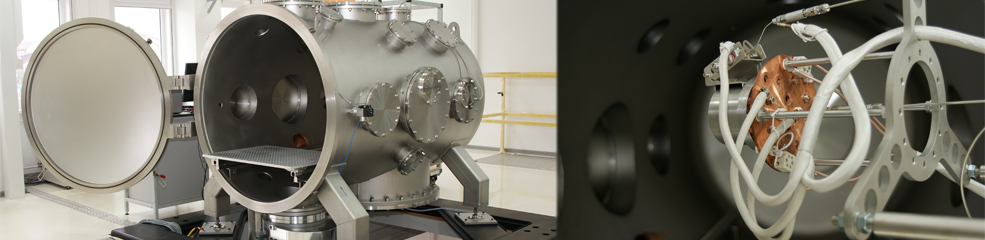


Zestaw obrazów 2019
zdjecie1.jpg
zdjecie2.jpg
zdjecie3.jpg
zdjecie4.jpg
zdjecie5.jpg
zdjecie6.jpg
2019_1.JPG
2019_2.JPG
2019_4.JPG

Gallery
 The European Fusion Development Agreement (EFDA) has published a roadmap which outlines how to supply fusion electricity to the grid by 2050. The roadmap to the realisation of fusion energy breaks the quest for fusion energy down into eight missions. For each mission, it reviews the current status of research, identifies open issues, proposes a research and development programme and estimates the required resources. It points out the needs to intensify industrial involvement and to seek all opportunities for collaboration outside Europe.
The goal of fusion research is to make the energy of the stars available on Earth by fusing hydrogen nuclei. Fusion energy is nearly unlimited as it draws on the abundant raw materials deuterium and lithium. It does not produce greenhouse gases or long-lived radioactive waste. It is intrinsically safe, as chain reactions are impossible.
So far, fusion scientists have succeeded in generating fusion power, but the required energy input was greater than the output. The international experiment ITER, which starts operating in 2020, will be the first device to produce a net surplus of fusion power, namely 500 megawatts from a 50 megawatt input.
Europe holds a leading position in fusion research and hosts ITER. The fact that the ITER project is funded and run by six other nations besides Europe reflects the growing expectations on fusion energy. China, for instance, is launching an aggressive programme aimed at fusion electricity well before 2050. “Europe can keep pace only if it focusses its effort and pursues a pragmatic approach to fusion energy” states Dr Francesco Romanelli, EFDA Leader.
Focussing on the research and engineering activities needed to achieve fusion electricity, the roadmap shows that these can be carried out within a reasonable budget. The amount of resources proposed are of the same level as those originally recommended for the seventh European Research Framework Programme – outside the European investment in the ITER construction.
The roadmap covers three periods: The upcoming European Research Framework Programme, Horizon 2020, the years 2021-2030 and the time between 2031 and 2050.
ITER is the key facility of the roadmap as it is expected to achieve most of the important milestones on the path to fusion power. Thus, the vast majority of resources proposed for Horizon 2020 are dedicated to ITER and its accompanying experiments. The second period is focussed on maximising ITER exploitation and on preparing the construction of a demonstration power plant DEMO, which will for the first time supply fusion electricity to the grid. Building and operating DEMO is the subject of the last roadmap phase.
In the course of the roadmap implementation, the fusion programme will move from being laboratory-based and science-driven towards an industry- and technology-driven venture. ITER construction already generates a turnover of about 6 billion euro. The design, construction and operation of DEMO requires full involvement of industry to ensure that, after a successful DEMO operation, industry can take responsibility for commercial fusion power.
Source: EFDA
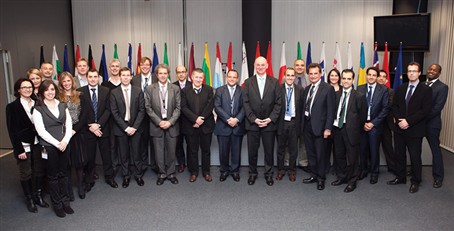 F4E celebrates a landmark achievement with the signature of one of its largest contracts in the area of the civil engineering works for the construction of the Tokamak complex, the building that will host the ITER Tokamak machine. Other buildings and amenities surrounding the Tokamak complex will also be delivered through this contract.
This is a key development for the ITER project and a milestone of significant importance for Europe, because it demonstrates F4E's commitment to this international collaboration in the field of energy and delivers on an instrumental chapter of its construction. The contract is expected to run for five and a half years and its budget is in the range of 300 million EUR. The VFR consortium, which consists of French companies VINCI Construction Grands Projets, Razel-Bec, Dodin Campenon Bernard, Campenon Bernard Sud-Est, GTM Sud and Chantiers Modernes Sud as well as Spanish company Ferrovial Agroman, boasts a proven track record in the field of construction and will deliver on a contract that is underpinned by impressive complexity, multiple interfaces and strict safety standards.
The ITER site in figures:
The size of the ITER platform is 42 hectares and Europe is the party responsible for the delivery of the 39 buildings that the ITER platform will host. Currently, the personnel directly involved in construction counts 200 people and by mid-2014 it is expected to reach 3,000 people. One of the key challenges will be to accommodate the needs of the rapidly growing workforce and to guarantee an optimal use of space to the different companies operating on the ground, in order to carry out the construction of all infrastructures in parallel and on time.
The scope and key figures of the Tokamak complex and surrounding buildings contract:
Through this contract the following infrastructure and amenities will be constructed: the Tokamak complex, consisting of the Tokamak, Diagnostics and Tritium buildings, the ITER Assembly hall, the radio frequency heating building, the areas for heating, ventilation and air conditioning, the cleaning facility and site services buildings, the cryoplant compressor and coldbox building, the control buildings, the fast discharge and switching network resistor building, and three bridges.
A total of 150, 000m³ of concrete will be used for all buildings out of which 110,000m³ will be used for the construction of the Tokamak complex. This is the equivalent of the concrete used for 3,000 houses of 120m². The building will be 80 metres high, 120 metres long and 80 metres wide. Its footprint will be bigger than that of a football stadium. The Tokamak building will rely on 493 plinths equipped with anti-seismic bearings, already in place, able to sustain the overall weight of the machine, which will be in the range of 23,000 tonnes almost three times the weight of the Eiffel Tower.
The Tokamak complex will host 100 heavy nuclear and confinement doors in total. The major doors will measure 4 metres high by 4 metres long and 35 cm thick. Their unit weight will be in the range of 40 tonnes and they will be remotely operated.
The works within the framework of the contract will require 7,500 tonnes of steel for the different structures and 16,000 tonnes of steel for reinforcement bars. The total number of embedded parts upon which the ITER equipment will be located, is expected to reach the impressive number of 60,000 units. Overall, it is estimated that 600 people will be involved in the works conducted in this contract.
Source: F4E
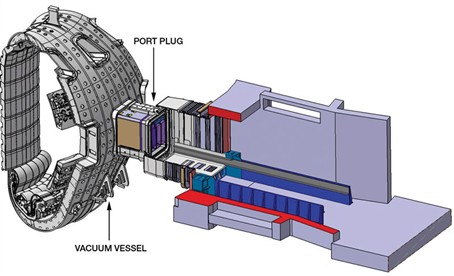
F4E’s Framework Partnership Agreement (FPA) for the design of Diagnostic components for the ITER Plasma Position Reflectometry is signed. Amounting to 3.5 million EUR for a period of up to four years, the FPA has been awarded to a consortium consisting of three EURATOM associations: Instituto Superior Técnico (IST), from Portugal; Centro de Investigaciones Energéticas, Medioambientales y Tecnológicas (CIEMAT), from Spain; and Consiglio Nazionale delle Ricerche, Istituto di Fisica del Plasma "Piero Caldirola" (IFP-CNR), from Italy. The FPA concerns the design of the Plasma Position Reflectometry components (antennas, waveguides, microwave electronics and real-time analysis software) for the Diagnostics systems. The antennas and waveguides launch and receive a radio frequency signal in the range 15-75 GHz which is assessed by microwave electronics and real-time analysis software to determine the density profile at the plasma edge and the distance between the plasma and tokamak wall. Co
ntrol of the plasma density profile is important in order to keep the plasma stable and prevent it from touching the wall, leading to a plasma disruption which would stop the fusion process.
So what exactly is a Framework Partnership Agreement (FPA)? It establishes a long-term collaboration (for up to 4 years) with a beneficiary or consortium (i.e. group of beneficiaries). The Agreement defines a set of rules (i.e. a framework) for conduct of the work; with the work itself performed under separate specific grants agreements. The FPA is well-fitted to projects requiring mostly R&D and design and where the design is at its first stages. It is ideal for Diagnostics, where designs are usually ‘first-of-a-kind’ and require a large, specialised design base; and need long continuity of the design team. A further advantage of the FPA is that it enables F4E to have stronger project management roll, to steer the work and to develop a better collaboration with the recipient of the Agreement.
The FPA for the design of Diagnostic components for the ITER Plasma Position Reflectometry covers R&D, engineering, quality support and managerial activities, and testing from functional specifications, up to the supply of an F4E-approved final design. It will bring together the work of some 30 physicists and engineers per year.
Source: F4E
 What we call ‘communication’ is more than just an additional reporting burden. Europe’s future economic growth and jobs will increasingly have to come from innovation in products, services and business models. With this in mind, communication about European research projects should aim to demonstrate the ways in which research is contributing to a European ‘Innovation Union’ and account for public spending by providing tangible proof.
This short guide will help you attain these outcomes. You will be given a clear overview of formal, contractual requirements on communication and their intended use. You will be inspired by some good practices emanating from fellow project coordinators. And you will find a helpful checklist for improving your own communication activities right from the start of your project. Finally, the European Commission is ready to spread the word about the good work of the projects it is supporting. Once you have some worthwhile material available, there are many ways in which we can help you pass on the message.
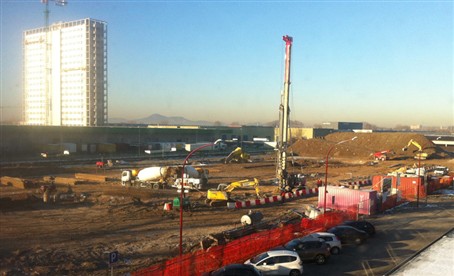 A great deal of progress has been made for the establishment of the Neutral Beam Test Facility (NBTF) hosted by Consorzio-RFX in Padova, Italy. During the autumn, F4E awarded several procurement contracts allowing for manufacturing of necessary components to move full-speed ahead.
The Neutral Beam Injection System is one of the main F4E contributions to ITER. It is composed of two Neutral Beam (NB) injectors, essential to reach the high temperature necessary for fusion reactions to occur in the plasma. The Neutral Beam Test Facility will host the prototypes of the ITER Neutral Beam Injector, which will be tested and developed there. The NBTF will host two independent test beds, namely SPIDER (Source for Production of Ion of Deuterium Extracted from Radio Frequency plasma) where the first full-scale ITER ion source will be tested and developed with an acceleration voltage up to 100 kV; and MITICA (Megavolt ITER Injector & Concept Advancement) which will be the first 1:1 full ITER injector aiming at operating up to the full acceleration voltage of 1 MV and a full power (16.5 MW).
In total, three contracts have been signed during the past few months and the signing of the contract for the SPIDER Beam Source and Vacuum Vessel, worth around seven and a half million EUR, marks an especially important step as it is these components that make up the heart of the SPIDER experiment. Involving highly demanding technologies which necessitate complex assembly and tight tolerances, i.e. very exact measurements with only a small margin of error, the SPIDER Beam Source will be the first ITER full-scale ion source built in the world. The contract has been awarded to a European consortium consisting of French company Thales, German company Galvano-T and Italian companies CECOM and Zanon.
A further milestone is the signature of contract for the NBTF Cooling Plant system for which manufacturing is starting on the components that will evacuate the 70 MW of heat from the SPIDER and MITICA test beds. The contract, worth eight million EUR, has been awarded to Italian company, Delta-ti Impianti S.p.A.
The contract concerning the PRIMA Vacuum and Gas Injection Plant, worth about two and a half million EUR, has been awarded to Italian company Angelantoni Test Technologies. The contract covers the design and construction of the gas injection and vacuum plant systems which are vital for operation: the gas injector will provide the deuterium and hydrogen gas needed for the operation of the plasma, while the vacuum system will pump and therefore deter the gas from spreading and hindering the functioning of other parts of the plant where very good vacuum conditions are required.
With the contract for the SPIDER High Voltage Deck and Transmission Line now in an advanced stage of its tendering and awarding procedure, the set of the main European industrial contracts for the construction of SPIDER is being completed. From 2013 onwards, the remaining European contracts for MITICA will be awarded.
In addition, the NBTF is also moving forward in a very concrete way, namely through construction: the NBTF building is currently being built. The works, which are funded by Italy in its capacity of Host State for the NBTF, include the construction of the halls which will host the MITICA and SPIDER experiments. The works are scheduled to be concluded by 2014, although the installation of some of the sub-systems will be possible starting from September 2013.
Source: Fusion for Energy


nsp_133.JPG)


nsp_133.JPG)


 |
 |
 |
 |
 |
 |
 |
 |
Media


Research projects carried out at the IPPLM are funded by the Polish Ministry of Education and Science, the National Science Centre and by the European Commission within the framework of EUROfusion Consortium under grant agreement No 101052200. Financial support comes also from the International Atomic Energy Agency, European Space Agency and LaserLab Consortium as well as from the Fusion for Energy Agency.