




Zestaw obrazów 2019
zdjecie1.jpg
zdjecie2.jpg
zdjecie3.jpg
zdjecie4.jpg
zdjecie5.jpg
zdjecie6.jpg
2019_1.JPG
2019_2.JPG
2019_4.JPG

Gallery
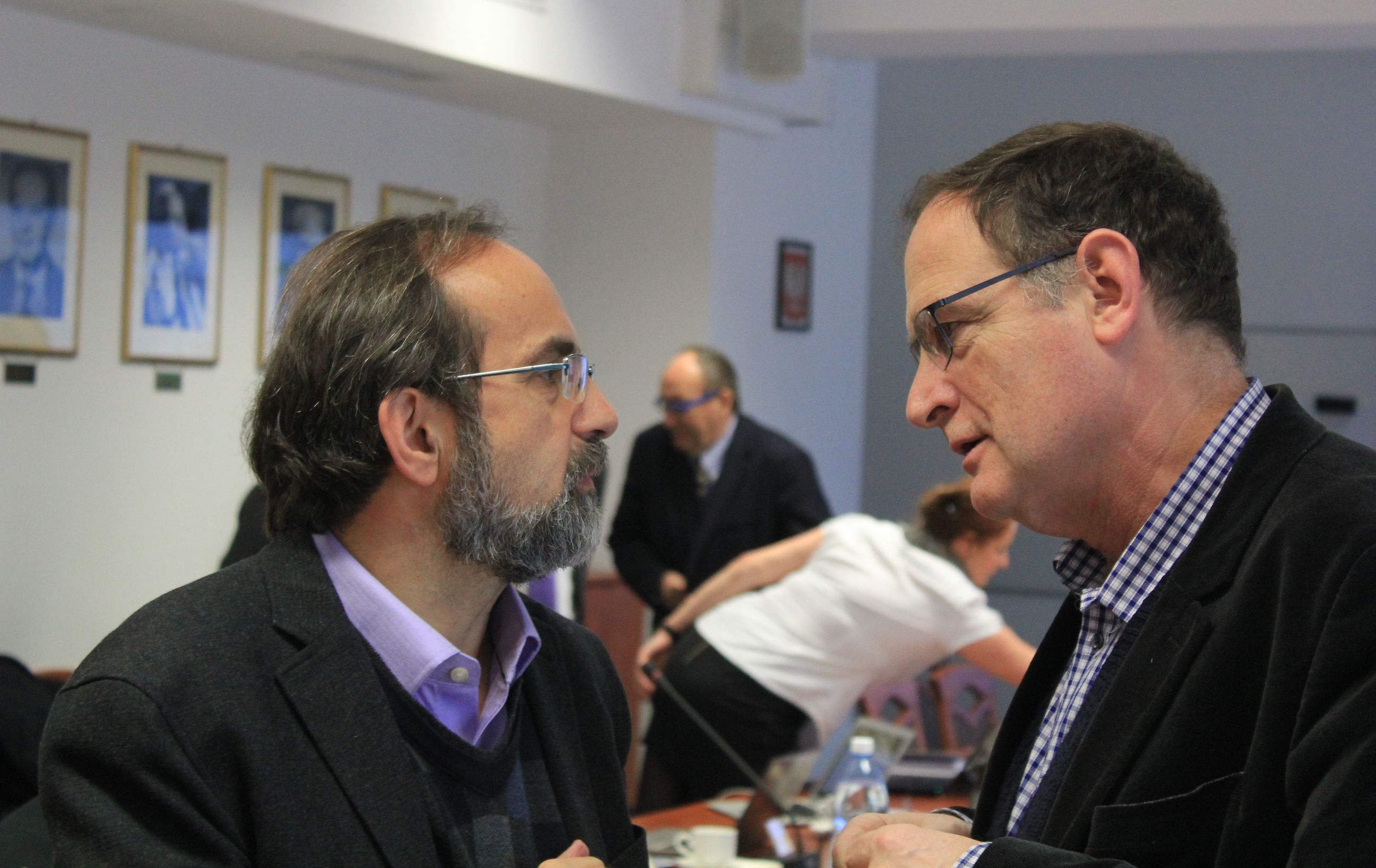 During 11-13 January 2017 Dr. Angel Ibarra, the manager of the research work package Early Neutron Source (WPENS), paid a visit to the Polish Institutes that are involved scientifically in these works. The Early Neutron Source work package deals with the preparation of project theories of the IFMIF-DONES Facility, a strong source of fast neutrons, in which the research and qualification of the resources used in fusion reactors will be conducted.
On 11 January 2017 dr. Ibarra was a guest of the Institute of Nuclear Physics of the Polish Academy of Science (IFJ PAN) in Cracow. During the meeting the progress of the works realized in IFJ PAN was discussed, especially the state of project works of the STUMM detector. On 12 January the meeting was continued in the National Center for Nuclear Research (NCBJ) in Świerk where was a discussion on the contribution of NCBJ into the Works concerning the Plant Systems, Test Systems and Accelerator Systems units into future DONES facility. On the next day the manager of the WPENS package talked to professor Roman Zagórski from the Institute of Plasma Physics and Laser Microfusion so as to summarize the results of the meetings in Poland and to discuss the scope of works for the project that will be fulfilled by Polish institutes in 2017.
 The 6th CeNTE Governing Board Meeting can be undoubtedly called a historic one. Despite regular points for discussion, there was one more that appeared in the agenda, it was concerning joining a new member to the Centre the Szczecin University. On that day the Szczecin University was represented by the dean of the Mathematics and Physics faculty Prof. Zbigniew Kondrad Czerski. After a brief but concise presentation of the Szczecin University’s achievements in the field of physics, the CeNTE Governing Board unanimously supported the efforts of the Szczecin University to join into the structure of the Centre. There was only a matter of signing appropriate contract left. After completing those formalities there will be 13 institutions from entire Poland in the Centre that will be working and fulfilling the projects in terms of nuclear fusion.
CeNTE (in polish: Centum naukowo-przemysłowe Nowe Technologie Energetyczne) is a polish consortium that conducts scientific works in the field of thermonuclear energy.
The 6th CeNTE Governing Board Meeting took place on 10 January 2017 in the headquarters of the main coordinator – the Sylwester Kaliski Institute of Plasma Physics and Laser Microfusion.
 Tony Donné – the managing director of the EUROfusion Consortium with his deputy Xavier Litaudon visited a few Polish institutions that take part in European research on thermonuclear energy. The aim of two-days long visit was to present Polish scientific achievements and contribution into the development of nuclear fusion.
On the first day the guests visited the Sylwester Kaliski Institute of Plasma Physics and Laser Microfusion and had a chance to participate in the meeting with the members of the national association of the scientific-and industrial centre New Energy Technologies (CeNTE). The meeting was opened by the IPPLM Director Andrzej Gałkowski who introduced the representatives of various units with an aim to present his scientific profile. The EUROfusion manager got familiar with the works of the following units: the Warsaw University of Technology, the National Center for Nuclear Research, the West Pomeranian University of Technology, the PAN Institute of Nuclear Physics, the Poznan Supercomputing and Networking Center, the Wrocław Technology Park along with the representatives of the industrial company ELEKTROBUDOWA S.A. The all-day meeting ended with visiting the laboratories of the Institute of Plasma Physics and Laser Microfusion.
During the second day of the visit Tony Donné and Xavier Litaudon visited the laboratories of the National Center for Nuclear Research (NCBJ) in Świerk and Warsaw University of Technology. The manager of NCBJ Krzysztof Kurek invited the visitors to see nuclear power reactor Maria constructed in 1974, plasma-focus device PF360, Cherenkov detectors and IBIS II device. In turn, scientists of the Warsaw University of Technology showed him around the labs of Department of Materials Science and Engineering and Department of Electronics and Information Technology.
The visit of the EUROfusion manager Tony Donné took place on 1st and 2nd December 2016.
EUROfusion consortium is the European Association for the Development of Nuclear Energy, gathering research institutions from 27 European countries, including also the associated Switzerland. Additionally, in 2016 some negotiations started to support joining the Ukrainian countries to that group.
 It is not always easy to thoroughly analyze the past and think strategically about the future. However, the scientists from the leading plasma centers of Europe took this challenge with purpose of further continuous development of science in the field of nuclear energy. It was conducted in terms of conference organized by IPPLM ‘European Fusion Programme Workshop 2016 (EFPW2016)’ held in Zakopane in November 2016.
‘We gathered here in order to talk about what we still don’t know about nuclear fusion and what we still should learn’– this is how the managing director of the EUROfusion Consortium Tony Donné started the speech. The leading subject was ‘Towards improved plasma performance in ITER and DEMO consistent with few and tolerable disruptions’, which was discussed in five thematic session: Improved pedestal; Paths to improved core fuelling while controlling impurities and He ash; Paths to reduced core heat transport; Disruption avoidance; Scenario integration.
More than 70 scientists took part in the meeting, those were the representatives of European fusion centers from 16 countries such as: Austria, Belgium, Croatia, Czech Republic, Denmark, Finland, Germany, Italy, Hungary, France, Great Britain, Poland, Portugal, Sweden, Switzerland and Spain.
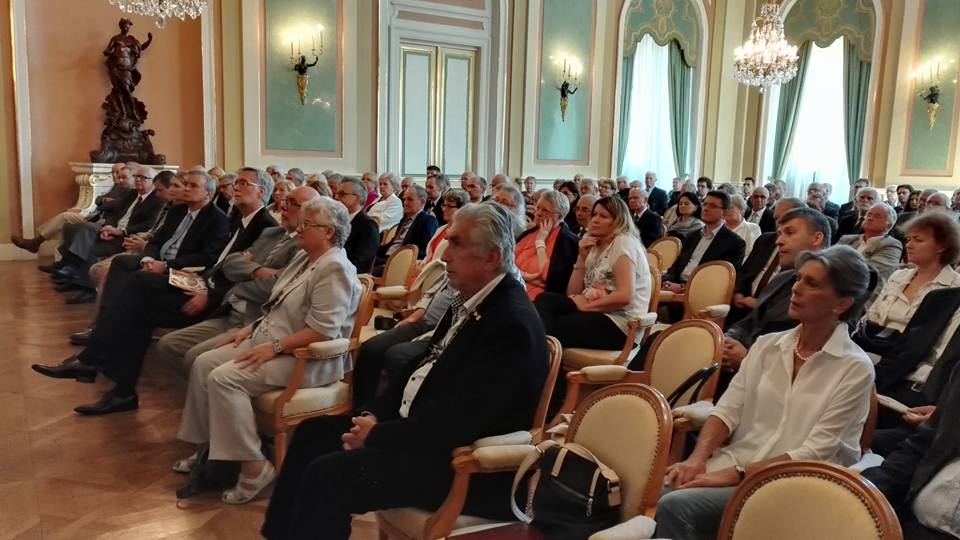
The Jubilee year of the Sylwester Kaliski Institute of Plasma Physics and Laser Microfusion achieved its peak point with an official celebration on the Royal Castle in Warsaw, which took place on 16th September 2016. On that day on the concert hall gathered not only multiannual Staff of the Institute but also honorable guests who congratulated from the stage on the Institute’s contribution into the development of Polish science in plasma physics. The IPPLM Director Andrzej Gałkowski had an honour to welcome the Manager of the Marshall’s Office Mrs Magdalena Flis-Lichota, the representative of Energy Ministry Mr Zbigniew Kubicki, the rector of the Warsaw University of Technology Prof. Jan Schmidt, the president of Polish Physical Association Prof. Katarzyna Chałasińska-Macukow, the Chairman of the General Council of Research Institutes Prof. Leszek Rafalski, the senator of 4th and 5th term, the president of the NOT ward in Częstochowa Grzegorz Lipowski and also the Chairman of Scientific Council of IPPLM Prof. Ryszard Romaniuk.
The official celebration was led by the journalist Krzysztof Michalski, and for the final part the guests had a chance to listen to the music of Fryderyk Chopin performed by a pianist Justyna Lechman.
The received awards, both individual and collected for the community of the Institute of Plasma Physics and Laser Microfusion added to the elevated atmosphere of the whole event. The Gold Cross of Merit entitled by the President of Poland Andrzej Duda was awarded to: dr Andrzej Gałkowski, Józef Makowski, dr Marian Paduch. The Silver Cross of Merit entitled by the President of Poland Andrzej Duda was awarded to: Jerzy Król, Prof. Tadeusz Pisarczyk. The Bronze Cross of Merit entitled by the President of Poland Andrzej Duda was awarded to: dr Sławomir Jabłoński, dr Monika Kubkowska, Leszek Ryć, Ewa Sieczkowska, dr Roman Zagórski.
Moreover, the Marshal of Mazovian Province awarded the Sylwester Kaliski Institute of Plasma Physics and Laser Microfusion a Pro Mazovia commemorative medal for the outstanding merits and overall activity for the Mazovian Province.
The Institute was also honored by the NOT Chief Technical Organization with a commemorative plate with the best wishes of success and development of the Institute as well as achievements in implementation of advanced technologies.
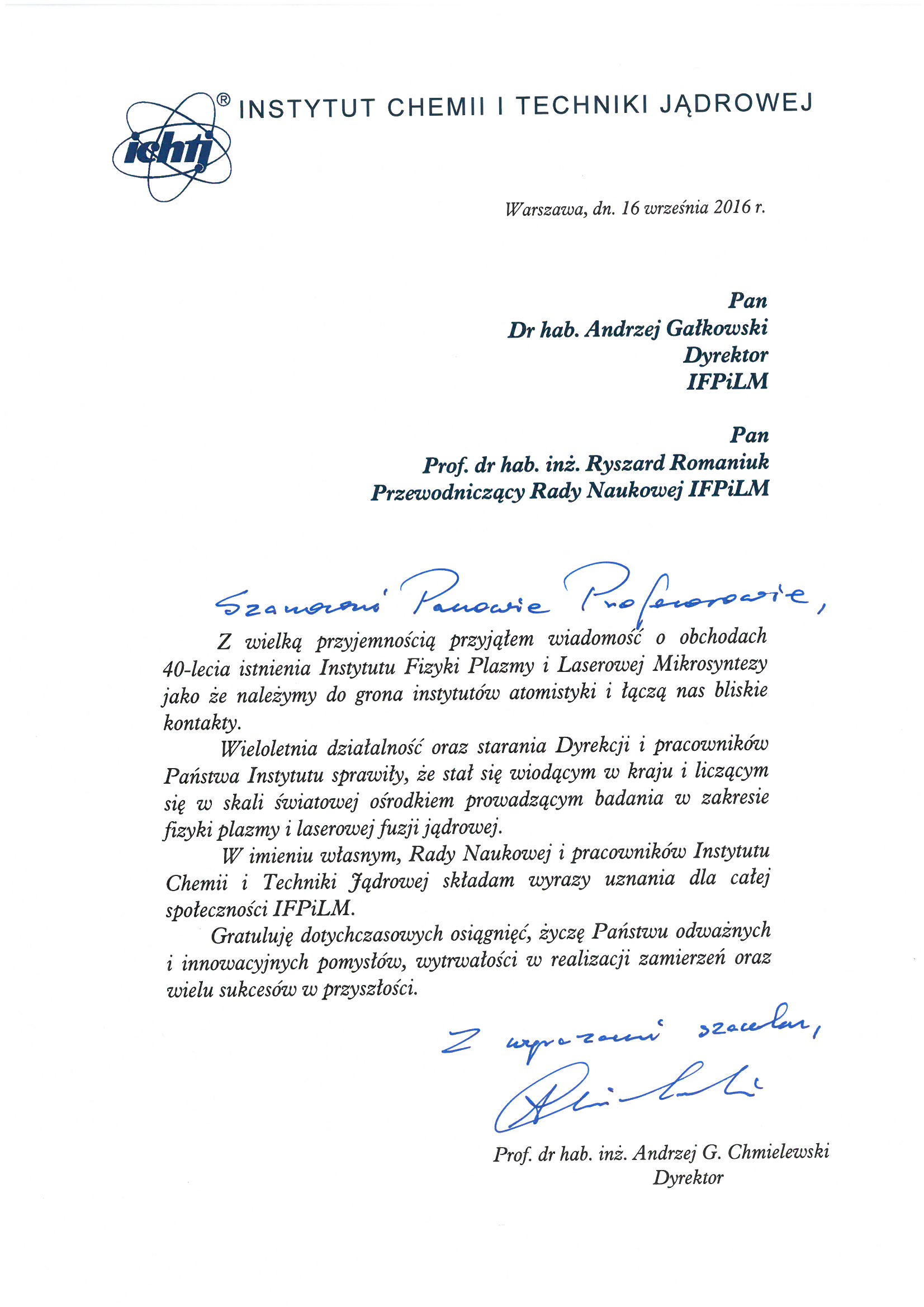
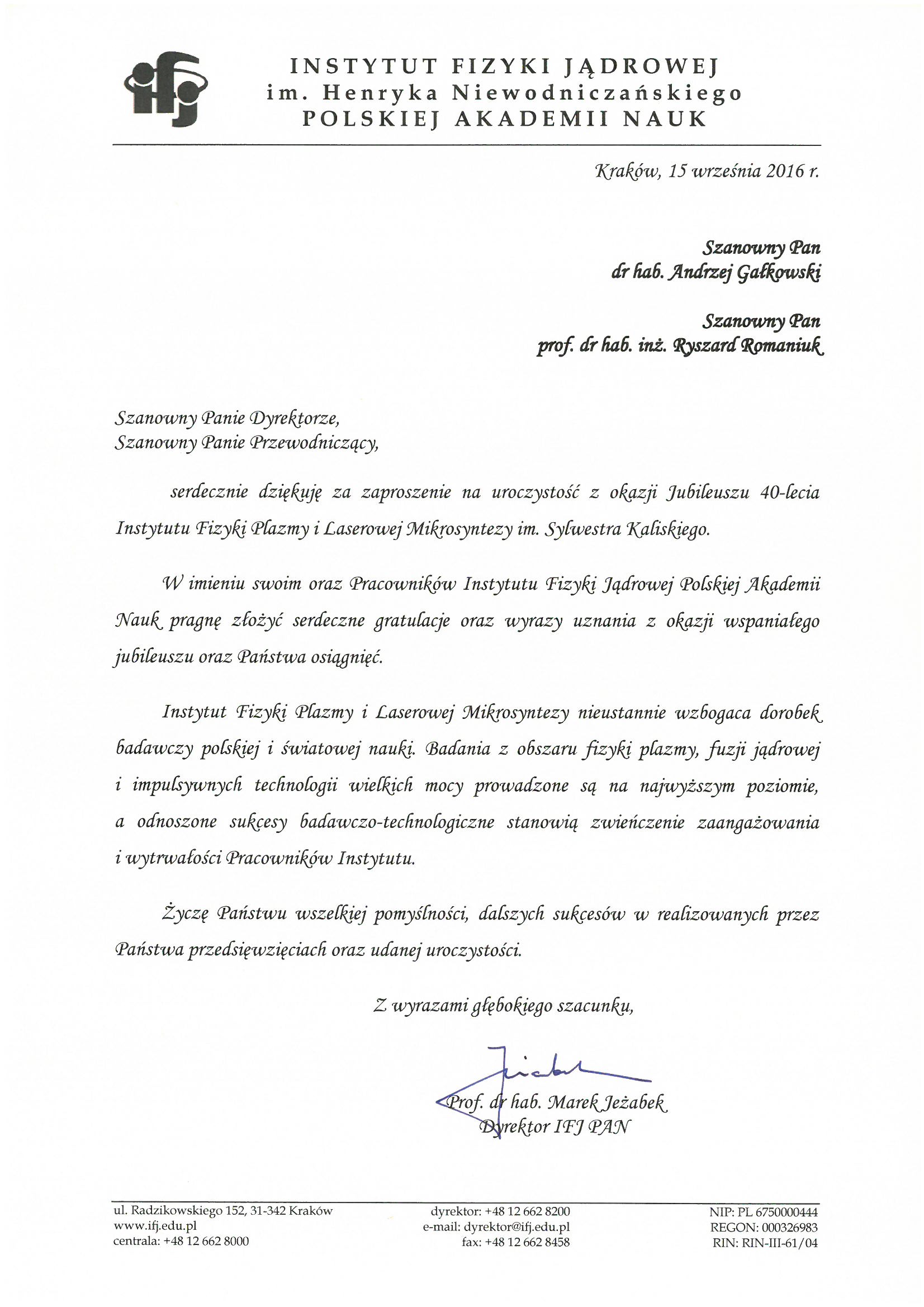
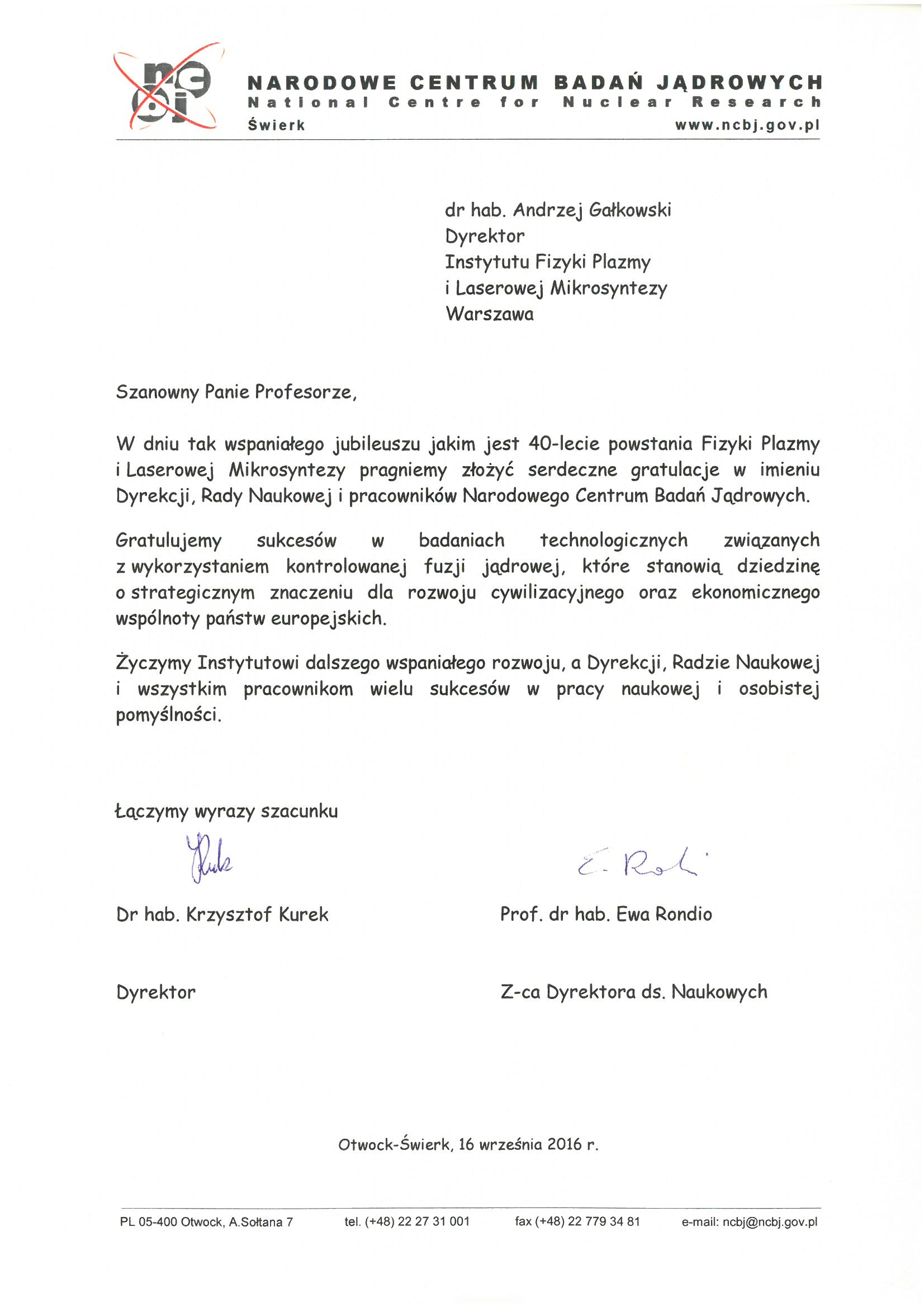
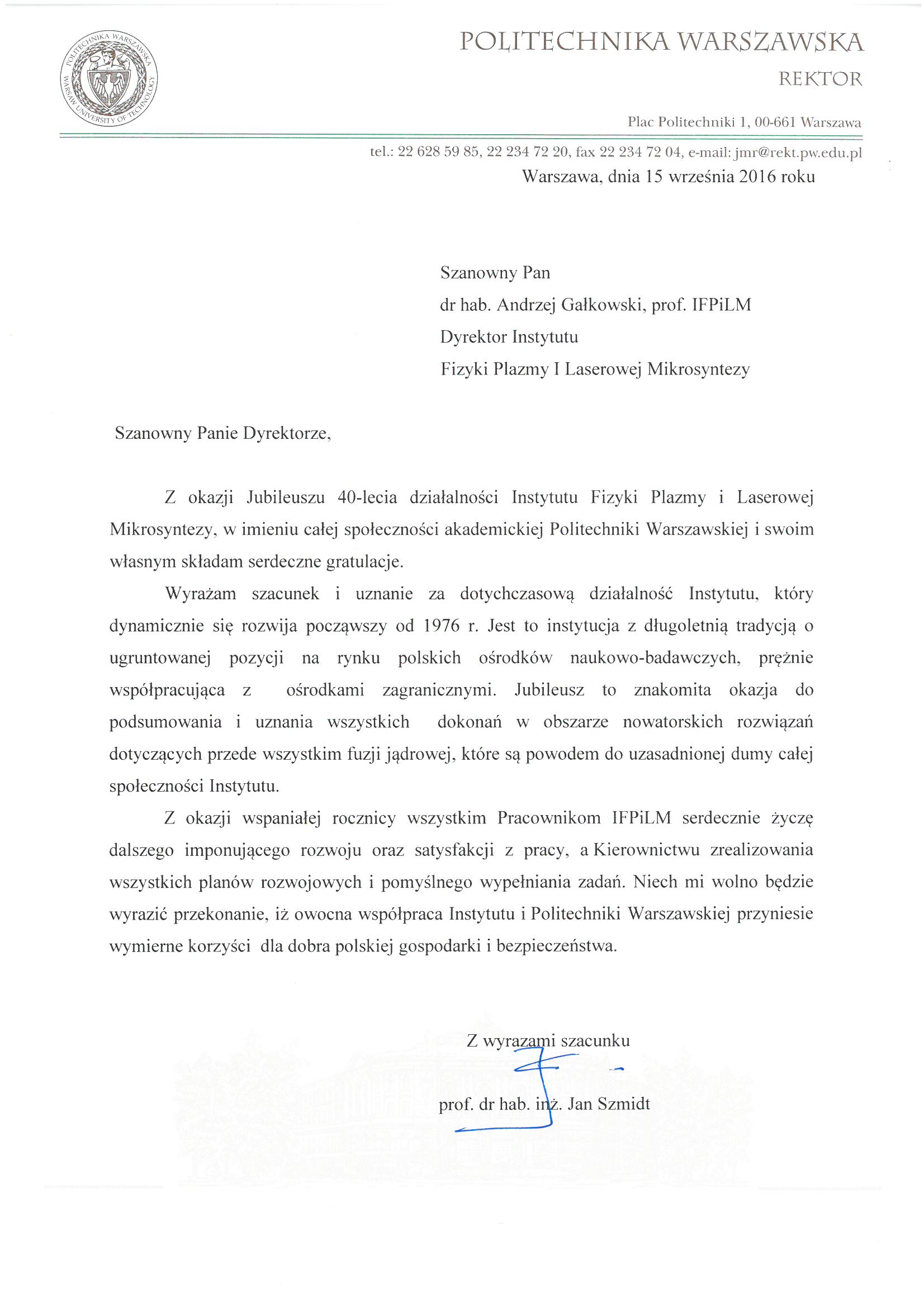
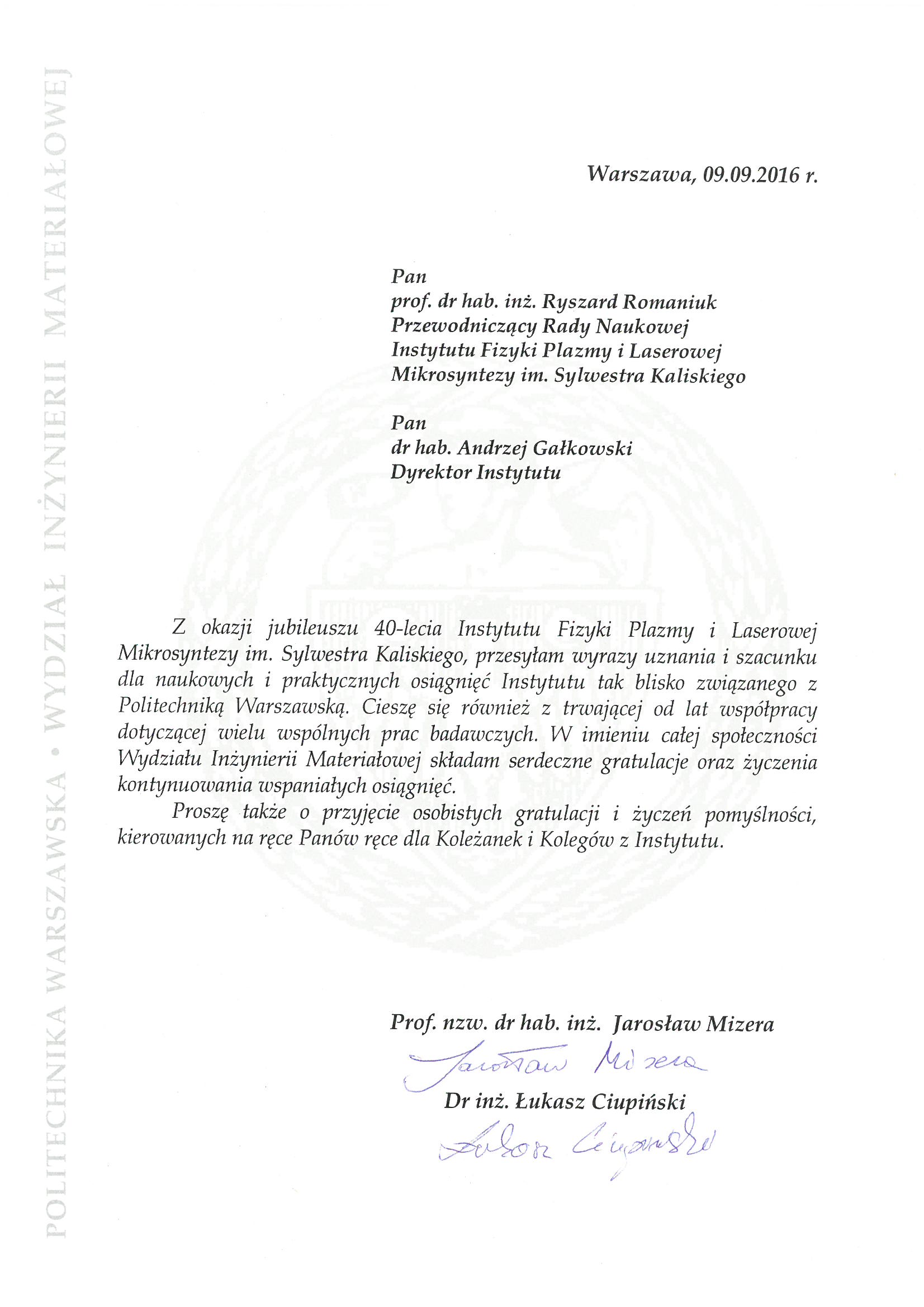
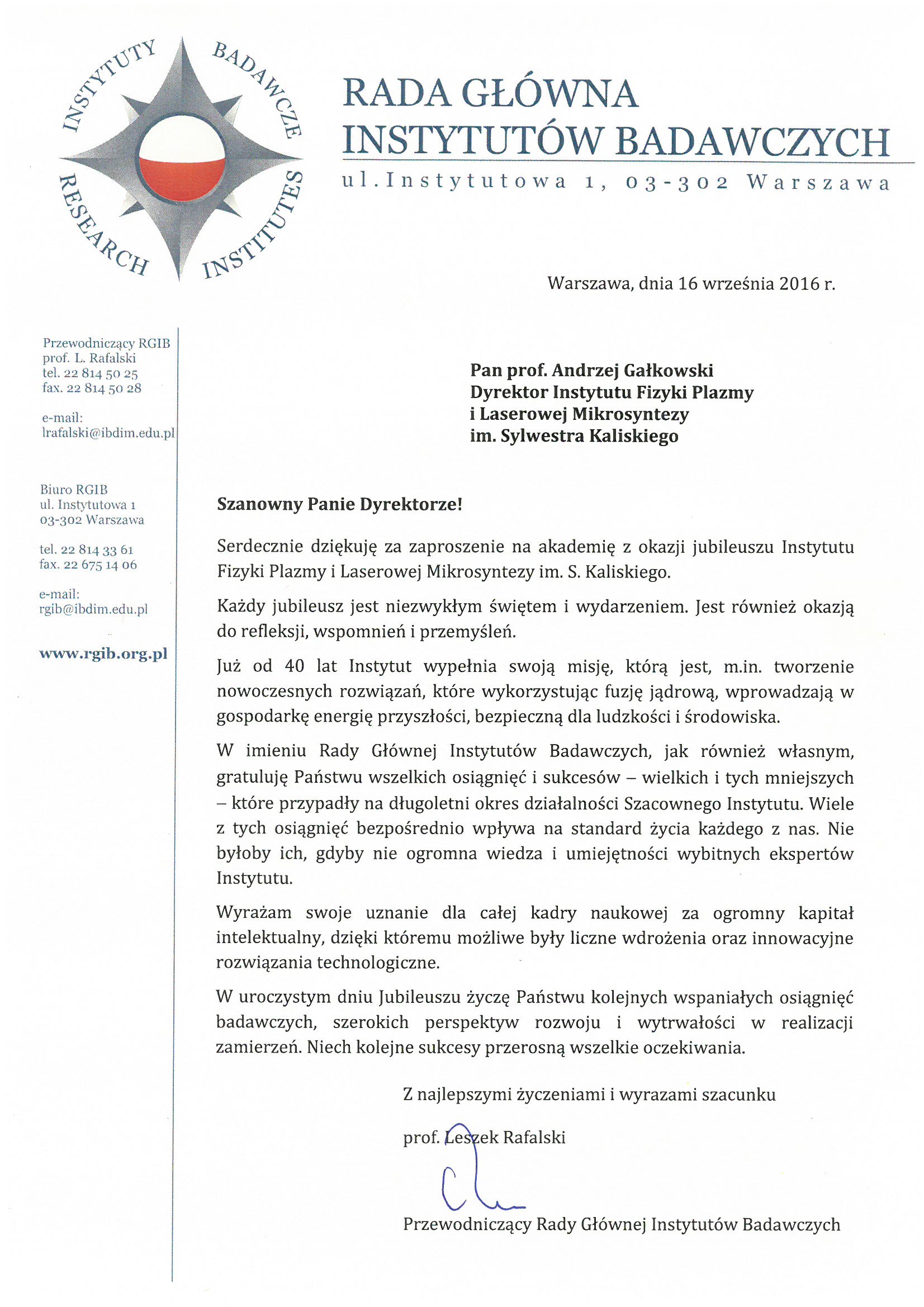
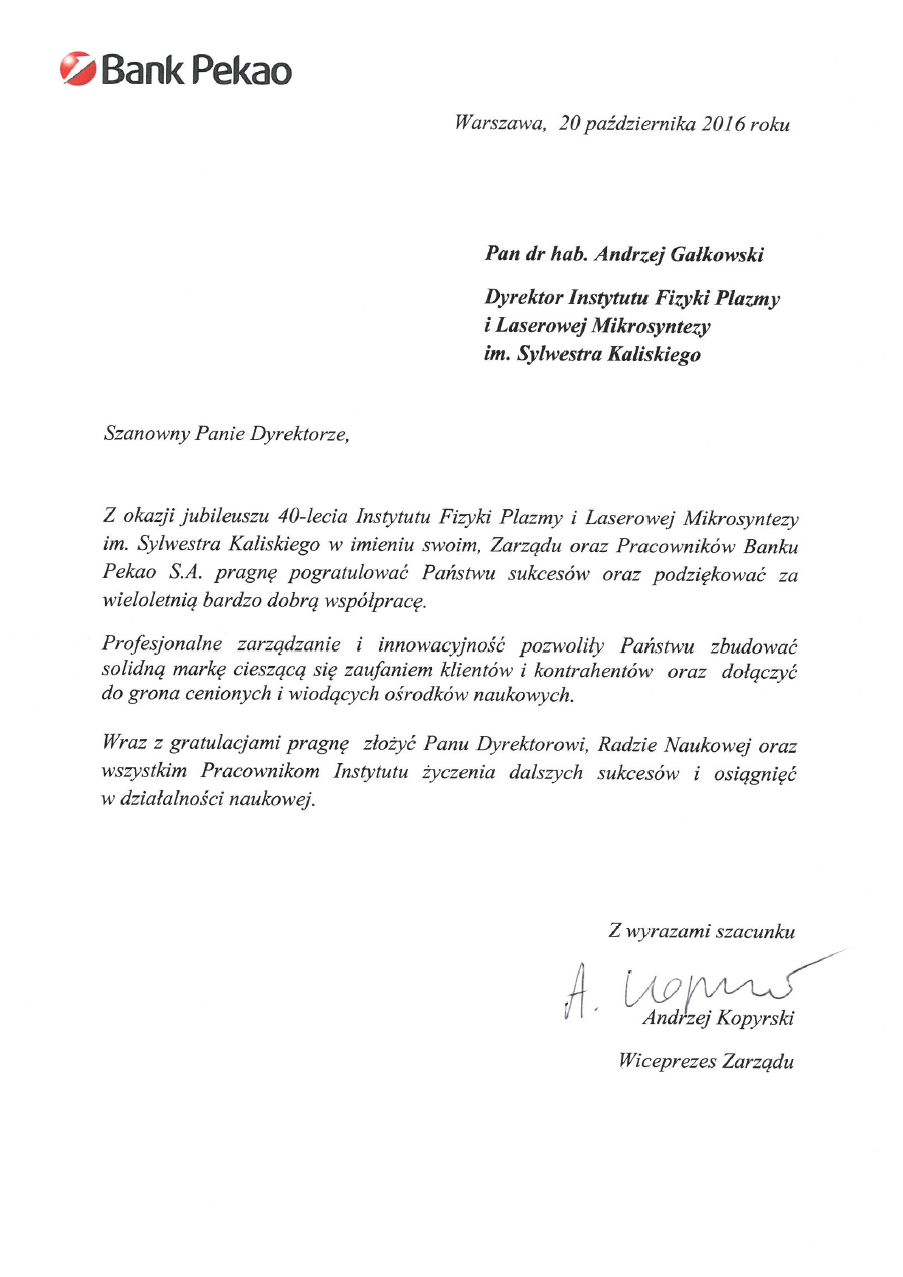
In turn, the high schools, research institutes and other organizations close to the Institute expressed words of appreciation in their acknowledgement letters.
Acknowledgement Letters

Jubileusze (Anniversaries) - 40-lecie IFPiLM (40th IPPLM Anniversary) - Listy gratulacyjne (Congratulations)
List_gratulacyjny_IChiTJ.jpg
List_gratulacyjny_IFJ.jpg
List_gratulacyjny_NCBJ.jpg
List_gratulacyjny_PW.jpg
List_gratulacyjny_PW_WIM.jpg
List_gratulacyjny_RGiB.jpg
List_gratulacyjny_Szkola_w_Gorze.jpg
list_gratulacyjny_pekao.png


nsp_133.JPG)


nsp_133.JPG)


 |
 |
 |
 |
 |
 |
 |
 |
Media


Research projects carried out at the IPPLM are funded by the Polish Ministry of Education and Science, the National Science Centre and by the European Commission within the framework of EUROfusion Consortium under grant agreement No 101052200. Financial support comes also from the International Atomic Energy Agency, European Space Agency and LaserLab Consortium as well as from the Fusion for Energy Agency.