



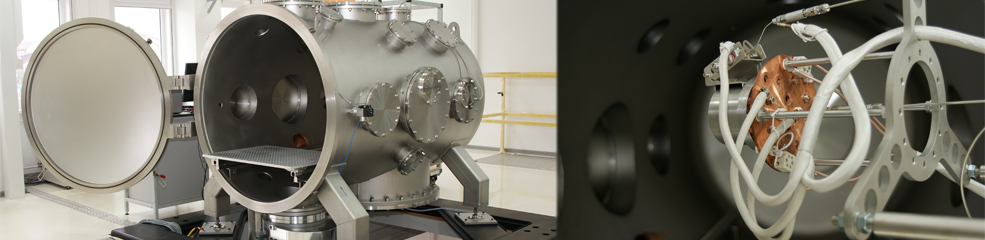


Zestaw obrazów 2019
zdjecie1.jpg
zdjecie2.jpg
zdjecie3.jpg
zdjecie4.jpg
zdjecie5.jpg
zdjecie6.jpg
2019_1.JPG
2019_2.JPG
2019_4.JPG

Gallery
 During one busy weekend in January, while plasma operations had paused, another upgrade was installed on JET. The item in question is called a 'collimator'. It weighs about 2 tonnes and it is made of layers of lead and polythene, contained in a stainless steel envelope.
To understand what a collimator is, consider when you were a child and your mother gave you a cardboard tube to play with. You probably put it to your eye and looked through it, pretending that it was a telescope. Of course it does not magnify the image that you see, but it simply limits your field of view, blocking out the surrounding bigger picture. This toy telescope is really a collimator. The main difference between this and JET's new collimator is that light is stopped by a thin layer of card, but the energetic neutrons from the JET plasma need layers of high density lead and of low density, hydrogen rich, polythene to slow them down.
The installation process was almost like an exercise in choreography. Different teams of people were required to complete the work at precisely scheduled times. The shielding doors had to be opened and the shielding beams lifted. 4,000 tonnes of concrete has to be moved to achieve this! The main crane was then able to carry the collimator and its stand into the torus hall. The crane operations team, the 'riggers' had to be ready. A team of scaffolders built a tower a few metres high, for the team of fitters to work from. First the stand was lifted into place and bolted to an existing component. The positions of the feet were then marked on the concrete floor and the stand was lifted away so that the floor could be drilled. Then the stand was re-installed, bolted into position, and the collimator lifted into position, aligned and secured.
Source: efda.org
 Researchers working at the SLAC National Accelerator Laboratory have used the world's most powerful X-ray laser to create and probe a two-million-degree piece of matter in a controlled way for the first time. This feat, reported today in Nature, takes scientists a significant step forward in understanding the most extreme matter found in the hearts of stars and giant planets, and could help experiments aimed at recreating the nuclear fusion process that powers the sun.

This time we have decided to combine the sets of pictures from November and December and release them in one go in order to announce two significant developments: the lower basemat of the Tokamak complex is completed and that the PF Coils building is going through the final acceptance procedure.
 Brussels – Following the 13 December 2011 agreement between the two branches of the budgetary authority (Council and Parliament), the Commission has adopted a draft amending budget to meet part of this year's financial needs for the ITER project (€ 650 million) without asking Member States for additional contributions.
 F4E has signed a contract to receive engineering support over the next four years in the field of remote handling with OTL, Assystem UK and CCFE for a budget in the range of 3,5 million EUR.
Mechanical, electrical, electronic and control systems engineering linked to remote handling systems and components will also be covered by the contract.
The work will be structured along the four packages for which Europe is responsible in this area: the divertor remote handling system, the cask and plug remote handling system, the in vessel viewing system and the neutral beam remote handling system.
Furthermore, the framework contract could be used to verify the remote handling compatibility of other ITER systems like plugs and in vessel components.
The scope of the contract is to support design and fabrication studies of remote handling equipment and their respective systems; industrial evaluation of remote handling concepts and solutions in the areas of remote maintenance and decontamination; radiation tolerance assessments of components and materials; review CAD models, technical specifications and safety evaluations.
The knowledge stemming from that contract is expected to be complemented by existing and future grants in the area of remote handling when needed.
When ITER starts operating, inspections or repair of any of the Tokamak components in the activated areas will be conducted by remote handling. Cutting edge technology underpinned by precision and reliability will be necessary to manipulate and replace components weighing up to 50 tonnes.
Source: F4E


nsp_133.JPG)


nsp_133.JPG)


 |
 |
 |
 |
 |
 |
 |
 |
Media


Research projects carried out at the IPPLM are funded by the Polish Ministry of Education and Science, the National Science Centre and by the European Commission within the framework of EUROfusion Consortium under grant agreement No 101052200. Financial support comes also from the International Atomic Energy Agency, European Space Agency and LaserLab Consortium as well as from the Fusion for Energy Agency.