



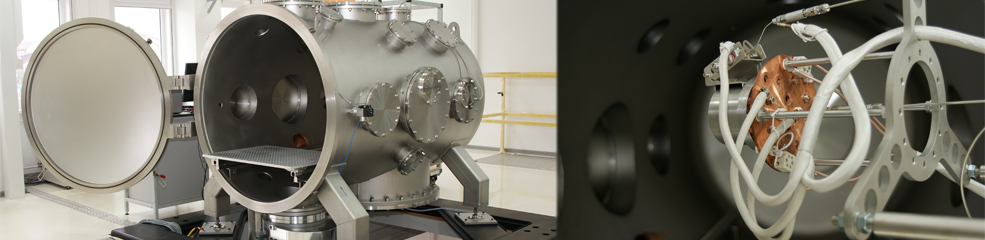


 A Framework Partnership Agreement (FPA) for the design of the ITER Core Plasma Charge Exchange Recombination Spectroscopy diagnostic system (CP CXRS) has been signed by F4E and a consortium consisting of Forschung Zentrum Jülich (FZJ), Karlsruhe Institute of Technology (KIT); universities of technology in Budapest (BME) and Eindhoven (TU/e); the Dutch Institute for Fundamental Energy Research (DIFFER); and Culham Centre for Fusion Energy (CCFE) in the UK. Contributing third parties include the Spanish CIEMAT centre and the Hungarian Wigner-RCP institute. The FPA will run for four years with an F4E contribution of 4.9 million EUR.
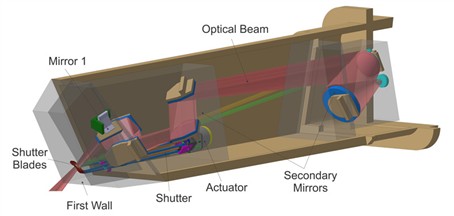
The CP CXRS diagnostic will view a region of the ITER plasma illuminated by a high-energy beam of neutral hydrogen particles injected by a companion device (the Diagnostic Neutral Beam) being constructed by ITER’s Indian partners. Collisions of particles in this beam with particles in the fusion plasma will produce visible light. Measurement by the CP CXRS of the wavelength and spatial distribution of this light will allow conclusions to be drawn on various properties of the plasma. This includes the density of helium, which is formed during the fusion reaction and must be removed from the combustion chamber in order for the fusion reaction to be sustained. Other important parameters such as the concentration, temperature and velocity of different plasma species can also be determined using the diagnostic.
Once the CP CXRS diagnostic is designed, it will be procured by F4E and assembled into an ITER port plug to be installed in an inset at the upper edge of the vacuum vessel.
Source: F4E


nsp_133.JPG)


nsp_133.JPG)


