





 A key issue for the development of fusion energy to generate electricity is the ability to confine the superhot, charged plasma gas that fuels fusion reactions in magnetic devices called tokamaks. This gas is subject to instabilities that cause it to leak from the magnetic fields and halt fusion reactions.
Now a recently developed imaging technique can help researchers improve their control of instabilities. The new technique, developed by physicists at the U.S. Department of Energy's Princeton Plasma Physics Laboratory (PPPL), the University of California-Davis and General Atomics in San Diego, provides new insight into how the instabilities respond to externally applied magnetic fields.
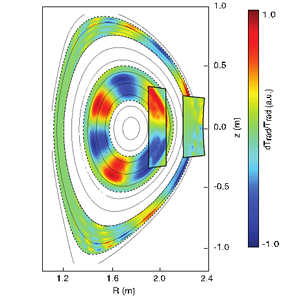
This technique, called Electron Cyclotron Emission Imaging (ECEI) and successfully tested on the DIII-D tokamak at General Atomics, uses an array of detectors to produce a 2D profile of fluctuating electron temperatures within the plasma. Standard methods for diagnosing plasma temperature have long relied on a single line of sight, providing only a 1D profile. Results of the ECEI technique, recently reported in the journal Plasma Physics and Controlled Fusion, could enable researchers to better model the response of confined plasma to external magnetic perturbations that are applied to improve plasma stability and fusion performance.
Source: phys.org


nsp_133.JPG)


nsp_133.JPG)


