





 After three days and 29 presentations, a comprehensive design review with probably the largest participation in the history of the ITER project was completed last week. More than 80 experts from the ITER Organization, Domestic Agencies and industry attended the Final Design Review of the ITER blanket system.
 "The development and validation of the final design of the blanket system is a major achievement on our way to deuterium-tritium operation—the main goal of the ITER project," Blanket Integrated Product Team Leader (BIPT) and Section Leader Rene Raffray concluded at the end of the meeting, obviously relieved at the success of this tremendous endeavour. "We are looking at a first-of-a-kind fusion blanket which will operate in a first-of-a-kind fusion experimental reactor."
The ITER blanket system provides the physical boundary for the plasma and contributes to the thermal and nuclear shielding of the vacuum vessel and the external machine components such as the superconducting magnets operating in the range of 4 Kelvin (-269°C). Directly facing the ultra-hot plasma and having to cope with large electromagnetic forces, while interacting with major systems and other components, the blanket is arguably the most critical and technically challenging component in ITER.
The blanket consists of 440 individual modules covering a surface of 600 m2, with more than 180 design variants depending on the segments' position inside the vacuum vessel and their functionality. Each module consists of a shield block and first wall, together measuring 1 x 1.5 metres and weighing up to 4.5 tons—dimensions that not only demand sophisticated remote handling in view of maintenance requirements during deuterium-tritium operation, but also an approach to attaching the modules which is far from trivial when considering the enormous electromagnetic forces.
The first wall is made out of shaped "fingers." These fingers are individually attached to a poloidal beam, the structural backbone of each first wall panel through which the cooling water will be distributed. Depending on their position inside the vacuum vessel, these panels are subject to different heat fluxes. Two different kinds of panels have been developed: a normal heat flux panel designed for heat fluxes of up to 2 MW/m2 and an enhanced heat flux panel designed for heat fluxes of up to 4.7 MW/m2.
The enhanced heat flux panels are located in areas of the vacuum vessel with greater plasma-wall interaction and they make use of the hyper-vapotron technology which is similar to that used for the divertor dome elements. All panels are designed for up to 15,000 full power cycles and are planned to be replaced at least once during ITER's lifetime. A sophisticated R&D program is currently under way in Japan for the development of remote handling tools to dismantle and precisely re-position the panels.
Due to the high heat deposition expected during plasma operation—the blanket is designed to take a maximum thermal load of 736 MW—ITER will be the first fusion device with an actively cooled blanket. The cooling water is fed to and from the shield blocks through manifolds and branch pipes. Furthermore, the modules have to provide passage for the multiple plasma diagnostic technologies, for the viewing systems, and for the plasma heating systems.
Because of its low plasma-contamination properties, beryllium has been chosen as the element to cover the first wall. Other materials used for the blanket system are CuCrZr for the heat sink, ITER-grade steel 316L(N)-IG for the steel structure, Inconel 718 for the bolts and cartridges, an aluminium-bronze alloy for the pads that will buffer the electromechanical loads acting on the segments, and alumina for the insulating layer.
The procurement of the 440 shield blocks is equally shared between China and Korea. The first wall panels will be manufactured by Europe (50%), Russia (40%) and China (10%). Russia will, in addition, provide the flexible supports, the key pads and the electrical straps. The assembly of the blanket is scheduled for the second assembly phase of the ITER machine starting in May 2021 and lasting until August 2022. The work will be performed with the help of two in-vessel transporters working in parallel.
In assessing the work presented at the Final Design Review, Andre Grosman, deputy head of Magnetic Fusion Research Institute at CEA and chair of the review panel, enthusiastically commended the BIPT for its achievements since the Preliminary Design Review in December 2011 which were "beyond the expectation of the panel." He added: "We have singled out the continuity and benefit of the work done by the ITER Organization and the Domestic Agencies within the BIPT framework with a sharing of risk and information among all stakeholders."
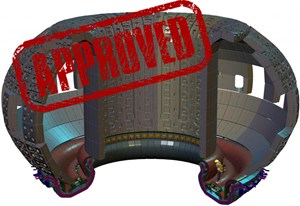
The panel nevertheless pointed out some remaining issues, including a few challenging issues that need to be addressed at the project level. But thanks to the excellent quality of work performed by the BIPT, the ITER blanket design can today be called "approved." The BIPT can now turn its focus to addressing the feedback received at the Final Design Review, applying the final touches to the design, and preparing for the Procurement Arrangements, where fabrication is handed over to the Domestic Agencies, starting at the end of 2013.
Source: ITER.org


nsp_133.JPG)


nsp_133.JPG)


