



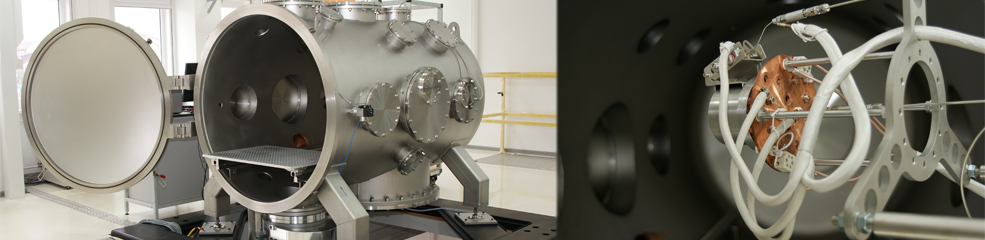


Magnum-PSI is the first facility in the world to simultaneously produce all the relevant plasma conditions expected in the ITER divertor. Its cascaded arc plasma source produces a hot, dense plasma which is then guided to the target by a magnetic field. Magnum-PSI already delivers a power of more than 20 megawatts per square meter on the target, comparable to the expected load in ITER. The current conventional magnet system will be replaced by a superconducting magnet later in 2012, allowing for exposure times of several hours. The team has also developed a pulsed plasma source that can, for the first time, reach power densities at which edge-localised modes or ELMs appear. ELMs are turbulent occurrences which are a major source of energy loss in fusion experiments.
With the new facility, DIFFER will help develop strategies to increase the lifetime of the ITER wall. Research topics are damage mechanisms of wall materials, plasma response to impurities, and investigations of material migration and tritium retention. The scientific exploitation of Magnum-PSI started in February 2012.
Association EURATOM-FOM: from Rijnhuizen to DIFFER
In 2010, the Dutch physics organisation FOM decided to broaden the mission of its plasma physics institute FOM Rijnhuizen. The new Dutch Institute for Fundamental Energy Research or DIFFER will continue the Rijnhuizen tradition of fusion-related research and will also start up a new research division in Solar Fuels, storing renewable energy in chemical fuels for easy transport and energy buffering. DIFFER is currently located at the exisiting Rijnhuizen facility in Nieuwegein. To strengthen its ties to the academic environment, DIFFER is moving to a new laboratory building at the campus of the Dutch Eindhoven University of Technology in 2015.
DIFFER is the Dutch signatory to EFDA.
Source: EFDA


nsp_133.JPG)


nsp_133.JPG)


