



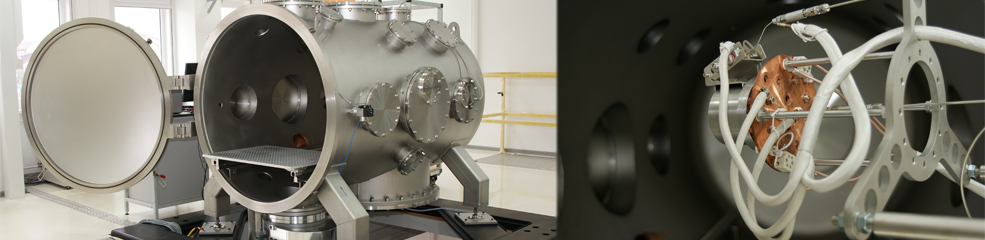


Thermonuclear fusion promises to be a possible solution to the current energy crisis. It is produced when two atomic nuclei of light elements combine to produce heavier elements, which give off a huge quantity of energy. So that this reaction can occur, it is necessary to supply an enormous amount of energy, so that temperatures of many millions of degrees can be reached, allowing the nuclei to come close enough to overcome their natural repulsion and become condensed in a plasma state.
"This plasma, which reaches temperatures near that of the stars, around 100 million degrees, does not touch the walls of the reactors because they would melt," explained one of the project researchers, Vanessa de Castro, from the UC3M Physics Department. In order to confine the plasma, it is confined within the reactor by the magnetic fields. "Even so the walls must resist some very high temperatures as well as the effects of the irradiation from the neutrons from the reaction, for which we have to produce new materials that can withstand these extreme conditions," the Professor remarked.
A Universidad Carlos III de Madrid release reports that the ITER project (under construction) and its successor, DEMO (scheduled for 2035) propose development of fusion reactors that are economically viable. This work depends on, among other things, the development of these new structural materials capable of withstanding damage by irradiation and elevated temperatures resulting from the fusion reaction.
Source: Homeland Security News


nsp_133.JPG)


nsp_133.JPG)


