





Dr Agnieszka Jardin from the Department of Thermonuclear Plasma Research and Space Technologies has been awarded a grant from the National Science Centre, Poland, under the SONATA 21 call for a basic research project.
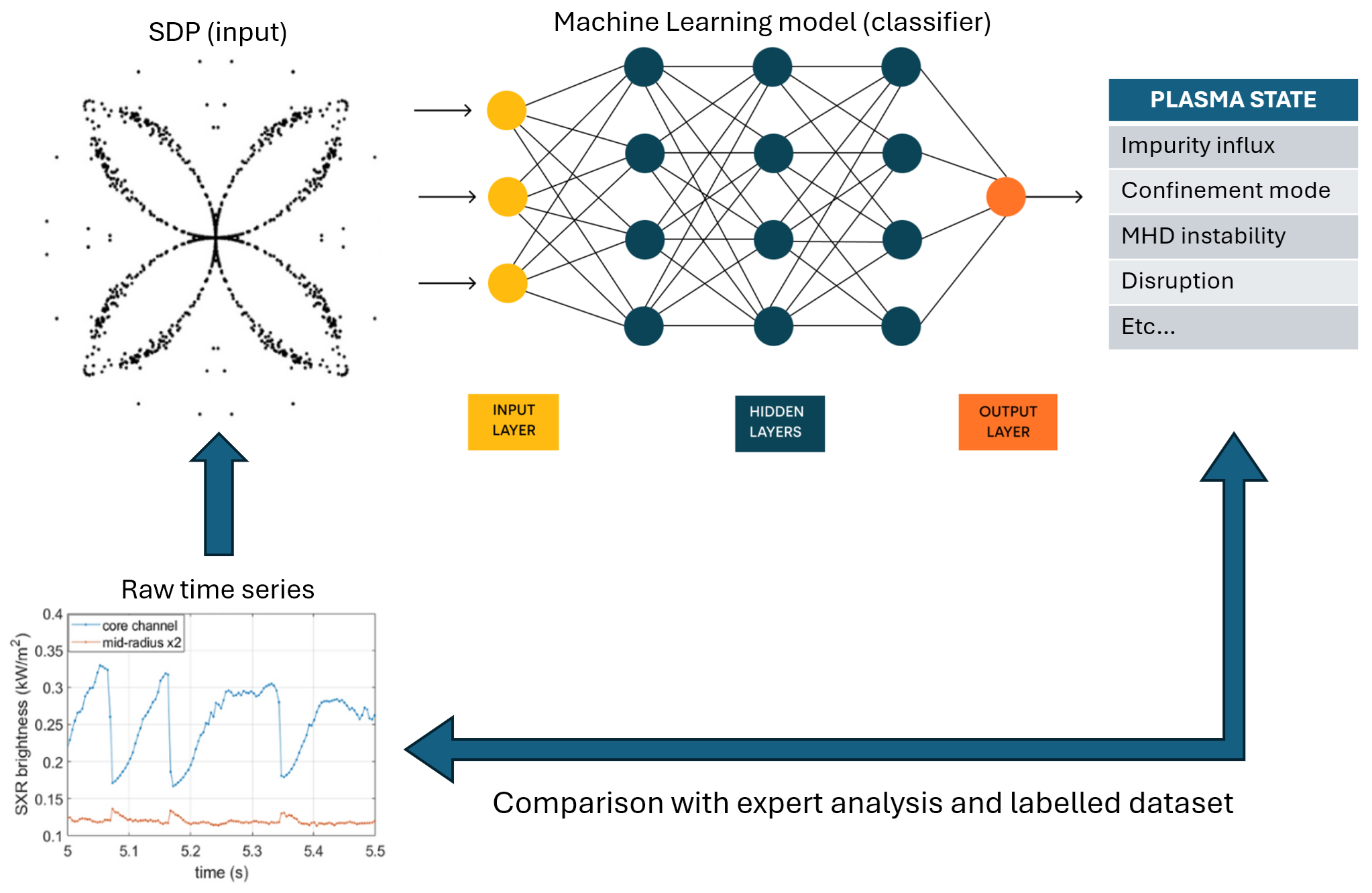
Dr Agnieszka Jardin’s project, entitled "Plasma state classification and abnormal event detection in nuclear fusion devices with Symmetrized Dot Pattern and Machine Learning applied to time series of tokamak plasma radiation measurements", focuses on the development of advanced plasma diagnostics methods based on modern data analysis techniques and artificial intelligence.
The aim of the project is to develop methods for the automatic classification of plasma states and the detection of anomalies in the operation of fusion devices, using diagnostic data from plasma radiation measurements. The research will apply an innovative approach based on the Symmetrized Dot Pattern (SDP), which enables time signals to be transformed into image representations and then analysed using machine learning methods.
 |
The project will contribute to a better understanding of plasma behaviour in tokamaks and to the development of tools supporting the monitoring and safe operation of future fusion reactors. The results may be applicable in next-generation diagnostic systems for fusion devices, supporting the further development of fusion energy.
The project will run for three years, with funding amounting to PLN 1,678,864.
We warmly congratulate Dr Agnieszka Jardin and wish her continued success in her research work and in the implementation of the project.


nsp_133.JPG)


nsp_133.JPG)


