



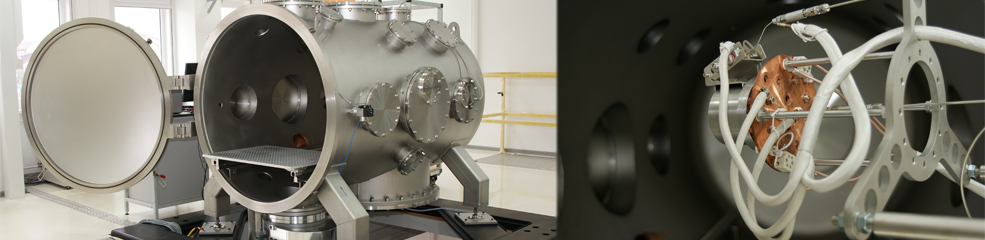


The team of the researchers from the Institute of Plasma Physics and Laser Microfusion (IPPLM) has carried out a significant modernization of the PHA (pulse-height analyser) diagnostics, which is currently actively used on the Wendelstein 7-X stellarator as part of the OP.2.2 campaign, launched on 10 September 2024.
The PHA system, designed, manufactured and programmed by the researchers from the IPPLM, enables the analysis of the spectra of X-ray radiation emitted from the plasma, which allows determining the ionic composition of the plasma, the average effective charge of the plasma, etc. During the modernization, the old detectors were replaced with new ones with better characteristics, which significantly improved the quality of measurements. The faulty filter change system was also dismantled and replaced with permanent filters, and the software and operating parameters of the entire system were optimized and adapted to the new conditions. The modernization works were carried out by: Marta Gruca, Jacek Kaczmarczyk, Leszek Ryć, Maciej Szymański, Adam Arkuszewski and Sławomir Jabłoński, head of the Stellarator Plasma Research Laboratory. Diagnostics operators delegated from the IPPLM are Tomasz Fornal and Łukasz Syrocki.
The Wendelstein 7-X facility, located at the Max Planck Institute for Plasma Physics (IPP) in Greifswald, Germany, is the world's largest experimental stellarator fusion reactor. The purpose of the research system launched in 2015 is to analyse an alternative concept of magnetic confinement of plasma to the tokamak. Research on the device is carried out by an international team of researchers from many institutes around the world, including the IPPLM.
In February 2023, at the end of the OP2.1 campaign, plasma with record parameters was obtained on the stellarator - the discharge lasted 8 minutes and the output power obtained was 1.3 GJ. Between April 2023 and September 2024, conservation and modernization works were carried out on W7-X, including a review of nearly 50 diagnostic systems.
The researchers from the IPPLM have been involved in the work on the stellarator from the very beginning. In addition to PHA diagnostics, a system for monitoring light plasma contaminants, such as oxygen or carbon, will also be launched on W7-X from 2024, which is a joint achievement of the IPPLM and the University of Opole.
 |
 |
 |
 |
 |
 |
Photos: IPPLM researchers with the PHA diagnostics. © IPPLM


nsp_133.JPG)


nsp_133.JPG)


