



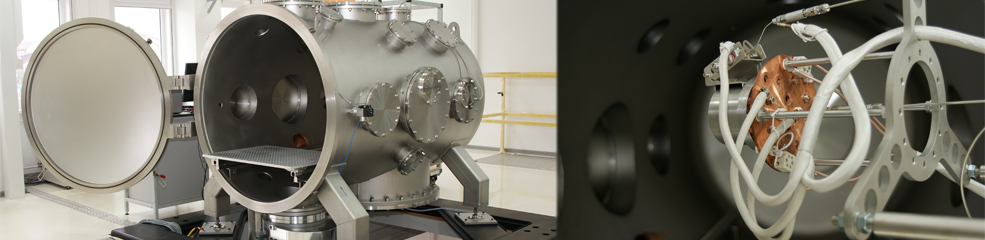


During a week-long visit to the Max Planck Institute for Plasma Physics in Greifswald, researchers from the IPPLM performed intensive work related to the preparation of PHA diagnostics developed in the Institute for the next experimental campaign on the Wendelstein 7-X stellarator (www.ipp.mpg.de/w7x).
One of the PHA detectors was equipped with an additional collimator in order to reduce the photon flux reaching its surface. Moreover, work was carried out to eliminate false peaks in the PHA spectrum, which were related to part of the diagnostics electronics. The improved system will then be used to measure X-ray spectra from the W7-X plasma in a cooled carbon divertor configuration. The next experimental campaign is scheduled for the second half of 2022.
The Wendelstein 7-X Stellarator is located at the Max Planck Institute for Plasma Physics (IPP) in Greifswald, Germany. The experimental fusion reactor was first put into operation in 2015. It is currently the largest device of this type worldwide. This project aims to investigate the concept of magnetic plasma retention as an alternative to the tokamak. The international team of researchers from many research institutes all over the world, including the IPPLM, is involved.
 |
 |
Photo: © IFPiLM


nsp_133.JPG)


nsp_133.JPG)


