




Basic information about impurities is obtained by studying the line emission of trace elements. Solving most problems related to impurities depends largely on understanding how their emission evolves over time and how it is distributed in space across the plasma cross-section. This makes it possible to understand how impurities affect plasma confinement and discharge scenarios. Such knowledge should enable better assessment of plasma conditions and optimization of discharge parameters in future fusion reactors.
X-ray spectroscopy used for this purpose is a well-established, effective, and powerful tool in plasma diagnostics. Measuring radiation in the 0.1 - 20 keV range is a standard method for obtaining valuable information about particle transport, magnetic configuration, and MHD (magnetohydrodynamic) phenomena. Research conducted in the Laboratory focuses on further development of plasma imaging technology in the soft X-ray (SXR) range, intended for monitoring impurity radiation in future fusion devices.
Research activities carried out in the Laboratory also include the development of diagnostic systems dedicated to plasma impurity studies for the Wendelstein 7-X stellarator (Greifswald, Germany). One of the systems developed for Wendelstein 7-X to investigate plasma impurities in the soft X-ray and ultraviolet (soft X-ray/XUV) range is a setup based on pulse height analysis (Pulse Height Analyser - PHA) using cooled semiconductor detectors operating in the photon-counting regime. The purpose of this diagnostic is to measure plasma impurities in the soft X-ray energy range of 0.1-20 keV. The system started operation on the W7-X stellarator in 2016 during the first experimental campaign, OP1.1.

PHA diagnostic system at the W7-X
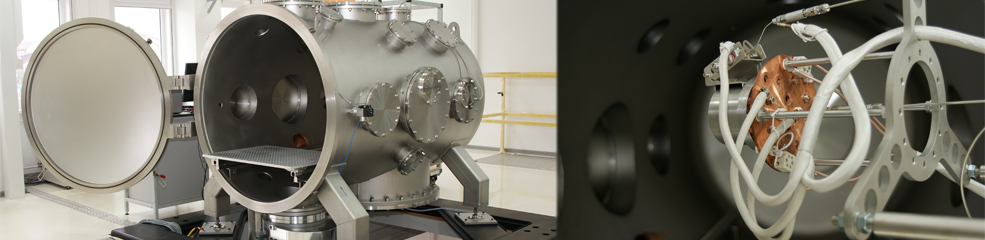
Another diagnostic system developed at IFPiLM is the C/O Monitor spectrometer, designed for measurements of light plasma impurities - boron, carbon, nitrogen, and oxygen. The diagnostic provides information on the temporal evolution of selected spectral lines, with measurements performed in the XUV radiation range. The system was commissioned during the OP 2.1 experimental campaign of the Wendelstein 7-X stellarator in 2023. Currently, the first of the two vacuum chambers is operational and used for measurements of hydrogen-like carbon and oxygen ion emission. Further extension of the system with additional measurement channels for light impurities is planned in the next stages of the diagnostic development.

Laboratory work on the diagnostic device “C/O Monitor” for W7-X
Research on plasma impurities is also carried out at the National Institute for Fusion Science on the Large Helical Device (Toki, Japan) (www.nifs.ac.jp/en). As part of this work, scientists from IFPiLM actively participate in experimental campaigns aimed at deepening the understanding of impurity transport in both hydrogen and deuterium plasmas. These experiments focus on studying both intrinsic impurities and those injected externally using TESPEL (Tracer Encapsulated Solid Pellet) capsules. The goal is to inject a controlled and known amount of selected impurities into the plasma and then carefully compare their behavior under different plasma conditions, such as density, temperature, heating method (ECRH, NBI), and the radial position of deposition relative to the plasma axis.
This work is carried out within the framework of the EUROfusion project.


